Technology & AI

Fedor Zhilkin
·
Updated on

A manager assigns a task: "Find information about five potential clients, check their websites, create a brief dossier on each, and email it to me." A typical AI assistant would respond: "Here's what I know about these companies" — and produce text based on its data. An AI agent goes to the internet, opens websites, gathers current information, structures it according to the required template, and sends an email. Without human involvement.
This is the key difference. The mymeet.ai team works with agentic systems every day — and in this article, we explain how AI agents work, how they differ from familiar AI assistants, and where they actually help business.
What Is an AI Agent and How Does It Differ from an AI Assistant
An AI agent is a program based on artificial intelligence that doesn't just answer questions but independently performs multi-step tasks. It perceives its environment, plans a sequence of actions, uses external tools, and completes tasks without constant human involvement.
The keyword is autonomy. An AI assistant waits for the next user request after each response. An AI agent decides what to do next on its own until it achieves the goal.
How an AI Agent Makes Decisions and Executes Tasks
Most AI agents are built on large language models that serve as the system's "brain." After receiving a goal, the agent breaks it into subtasks, determines the sequence of steps, and begins executing them.
At each step, the agent evaluates the result and adjusts the plan if necessary. If a search with one query didn't yield the needed result — it tries another. If a tool returns an error — it finds a workaround. This cycle repeats until the goal is achieved or until the agent understands the task is complete.
This approach is called real-time reasoning. The agent doesn't simply apply a pre-written script but thinks as it executes the task.
The Difference Between an AI Agent, AI Assistant, and Chatbot
These three concepts are often confused, though there's a fundamental difference in their level of autonomy.
A chatbot works according to pre-written scripts. It cannot go beyond its script and doesn't make independent decisions. It handles standard tasks excellently: answering common questions, helping with order processing.
An AI assistant understands natural language and conducts dialogue. It answers questions, writes texts, analyzes data — but waits for the next command from the user after each response. ChatGPT, Claude, Gemini — these are all assistants.
An AI agent acts autonomously. After receiving a task, it plans steps on its own, uses tools, checks results, and moves toward the goal without constant prompting. The difference isn't in how smart the model is, but in the architecture: the agent is embedded in an action — result — next action loop.
How an AI Agent Works: Architecture and Principles
Understanding AI agent architecture helps soberly assess their capabilities and limitations. An agent isn't magic — it's a concrete system with understandable components.
The Perception — Planning — Action Cycle
Every AI agent operates on one basic cycle. First, it perceives incoming information: task text, results from previous steps, data from tools. Then it plans the next action based on the current state and goal. Then it executes the action and perceives the result again.
This cycle repeats as many times as needed to complete the task. In simple cases — two or three steps. In complex ones — dozens of iterations with intermediate checks and plan adjustments.
What Tools AI Agents Use
An agent's capabilities are determined by the set of tools it has access to. Without tools, an agent is no different from a regular assistant.
A typical toolset includes web search, file operations, code execution, sending emails and messages, interacting with third-party service APIs, and browser operation. The broader the toolset, the more complex tasks the agent can handle.
It's precisely the presence of tools that distinguishes an agent from an assistant in practice. An assistant says "I can't send an email." An agent accesses email and sends it.
Single Agents and Multi-Agent Systems
A single agent handles linear tasks well: find, analyze, record, send. But for complex processes where different parts of the task require different specializations, multi-agent systems are used.
In a multi-agent system, several agents work in parallel or sequentially. One searches for information, the second analyzes, the third formats the result, the fourth sends the final document. An orchestrator coordinates the entire system's work.
This approach allows solving tasks that would be too complex or time-consuming for a single agent.
Types of AI Agents and Their Applications
AI agents are used in various business areas, and specialized solutions for specific tasks have emerged in each niche.
AI Agents for Business Process Automation
The broadest class of agents are those that automate repetitive operations. Processing incoming requests, routing documents, filling out forms, synchronizing data between systems — an agent can do all of this without human involvement 24/7.
A law firm launches an agent for initial analysis of incoming contracts: it checks structure, finds non-standard clauses, prepares a brief summary, and routes it to the appropriate lawyer. Work that used to take 40 minutes gets done in 3 minutes.
AI Agents for Sales and Customer Work
In sales, agents help with tasks requiring information gathering and processing. An agent researches a potential client before a call: studies the website, finds company news, analyzes LinkedIn profiles of key people, and prepares a dossier for the manager in minutes.
Another scenario: an agent monitors incoming inquiries, qualifies leads according to set criteria, and automatically schedules meetings in the manager's calendar. The human joins at the live conversation stage.
AI Agents for Data Analysis and Research
Research agents can work with large volumes of unstructured information. Give an agent 100 documents and ask it to find all mentions of a specific event with dates and sources — a task that would take days manually.
Product teams use agents for analyzing user interviews: the agent processes recordings, identifies recurring problems, groups them by topic, and prepares a structured report.
AI Agents for Meetings and Corporate Communications
A separate and rapidly growing class consists of agents specializing in business communications. They connect to video calls, capture content, extract decisions and tasks, update CRM, and send summaries to participants.
This isn't just recording and transcription — it's a full agentic cycle: perceived meeting content, analyzed it, extracted structured data, performed actions (created tasks, updated records, sent emails).
mymeet.ai as an AI Agent for Business Meetings
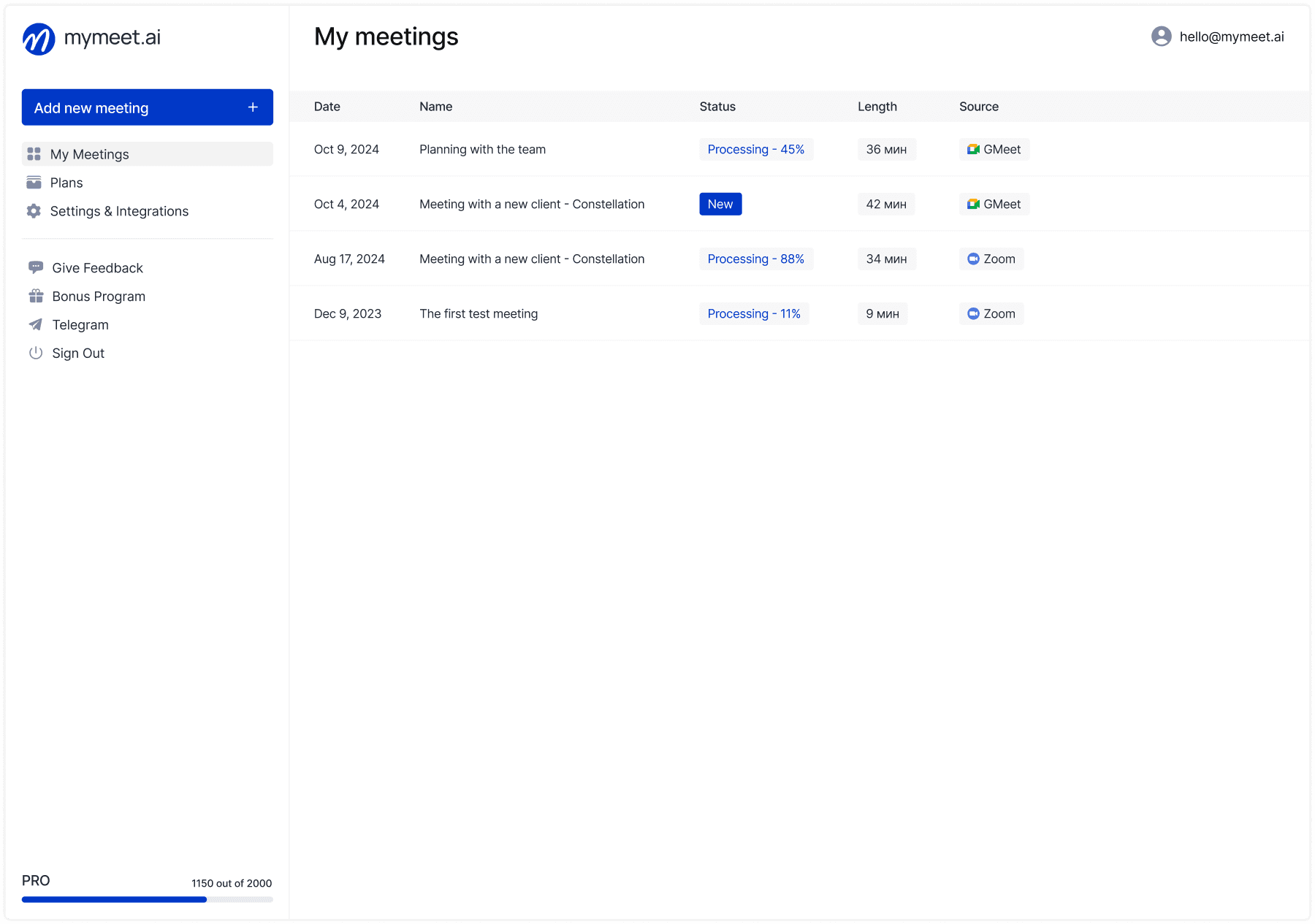
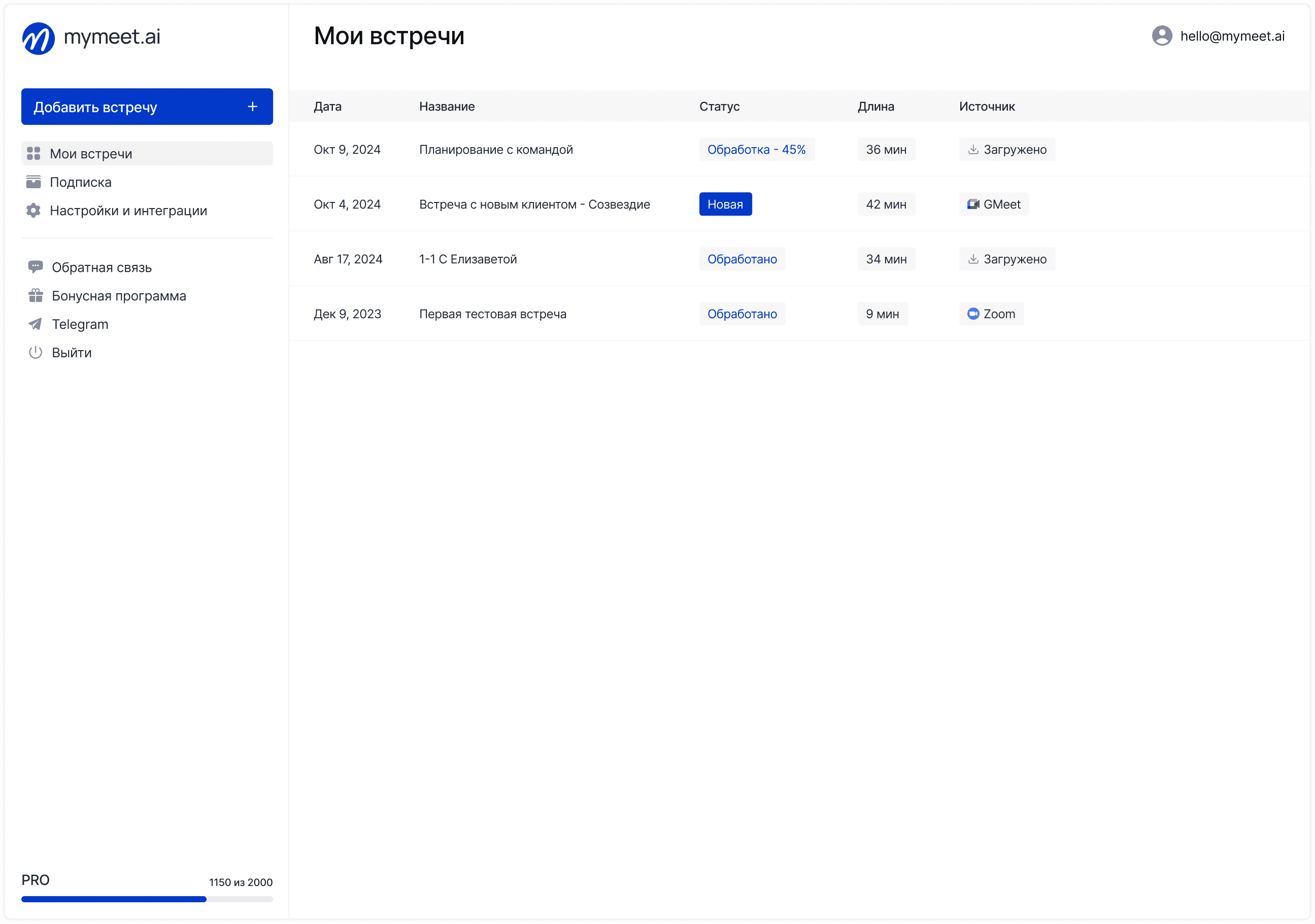
mymeet.ai operates on the agentic principle: receives a task (record and analyze the meeting), independently executes a chain of actions, and delivers the final result without human involvement.
The bot connects to meetings in Zoom, Google Meet, Microsoft Teams, Yandex.Telemost (Russian video conferencing service), or other platforms through calendar integration. While the team discusses, the agent records the audio stream, transcribes speech with 96-98% accuracy, separates utterances by speaker, identifies semantic blocks, and forms a structured document.
After the meeting ends, the agent continues working: generates a report using the selected template from 11 formats, extracts all tasks with assignees and deadlines, updates CRM cards, and sends summaries to participants via email. The person receives the finished result without performing a single action manually.
Key features:
Auto-connection through Google Calendar, Outlook, Yandex Calendar, Microsoft Exchange
96-98% transcription accuracy with speaker separation and timestamps
11 AI report types for different meeting formats
Automatic task extraction with assignees and deadlines
AI chat for searching information across all meeting archives
Integration with amoCRM and Bitrix24 (popular Russian CRM systems)
Full compliance with Russian data protection law (152-FZ), data stored on servers in Russia
180 minutes free, no credit card required
The agentic approach of mymeet.ai solves the main problem of business communications: information stops getting lost. Every meeting automatically becomes a structured document, tasks go to the right systems, and the team works with results rather than spending time creating them.
Case Study: How electro.cars Saved 15 Hours per Week with an AI Agent
The electro.cars sales department was conducting over 15 client meetings per week. After each call, managers manually filled out the CRM, wrote summaries, and sent them to participants — this took up to 15 hours per week for the entire department.
After connecting mymeet.ai, the process became fully agentic: the bot recorded meetings itself, generated a report using the "Client Meeting" template, updated deal cards in the CRM, and sent summaries to clients. Managers spent 3-5 minutes reviewing the finished document instead of 30 minutes of manual work. 15 hours per week returned to client work.
How to Implement an AI Agent in Business: Where to Start
Implementing AI agents can seem daunting in scale, but in practice, the best results come from small, targeted projects with measurable impact. Trying to automate everything at once is a sure way to get chaos instead of value.
Start with one process that takes a lot of time, is highly repeatable, and has a clear end result. Meeting documentation, incoming request processing, weekly reporting — all are good candidates for a first agentic project.
Scenario | Agent Type | Expected Impact | Implementation Complexity |
Meeting recording and analysis | mymeet.ai | 5-15 hours per week | Low |
Incoming lead qualification | Sales agent | Reduced SDR time | Medium |
User interview analysis | Research agent | Faster data processing | Medium |
Brand mention monitoring | Monitoring agent | Automatic digest | Low |
Incoming document processing | Document workflow agent | Reduced manual work | High |
After the first successful implementation, scaling the experience to other processes becomes much easier. The team understands how agents work, knows their limitations, and can formulate tasks to get good results.
AI Agent Limitations: What's Important to Understand
AI agents are a powerful tool, but not a universal solution to all problems. Understanding their limitations helps use the technology where it provides real value.
Agents make mistakes. The language models underlying agents can hallucinate — confidently produce incorrect information. For high-stakes tasks, an agent's results always need human verification. Trusting an agent to send an important email without final review is still risky.
Complex tasks require good goal definition. The vaguer the task, the more likely the agent will go off course. "Improve our sales" is a bad task for an agent. "Find 10 companies in niche X with revenue over $10M and prepare a dossier on each" is a good one.
Data security is relevant for any agent working with corporate information. Before implementation, understand: what data is being passed to the agent, where it's processed, and who has access. For companies handling personal data, compliance with relevant data protection regulations is critical.
Conclusion
An AI agent is the next step after an AI assistant. If an assistant answers questions, an agent executes tasks. The difference is in autonomy: the agent plans steps on its own, uses tools, and completes the work.
For business, this means the ability to automate not individual responses but entire processes. Meeting documentation, request processing, research analysis — tasks that used to require several hours of manual work, an agent completes in minutes.
The best way to start is to choose one specific process and launch a specialized agent. For most teams, the most obvious candidate is business meetings. mymeet.ai covers this task completely and offers 180 minutes free without requiring a credit card.
Frequently Asked Questions About AI Agents
What is an AI agent in simple terms?
An AI agent is a program that independently performs multi-step tasks without constant human involvement. Unlike an AI assistant that answers questions and waits for the next command, an agent plans actions on its own, uses tools, and completes tasks to the final result.
How does an AI agent differ from an AI assistant?
An AI assistant responds to each user request and waits for the next command. An AI agent receives a goal and independently executes a chain of actions to achieve it. The key difference is autonomy: an agent acts, not just responds.
What tasks can an AI agent perform?
Gathering and analyzing information from the internet, filling out CRM after meetings, sending emails and notifications, processing documents, qualifying leads, monitoring mentions, analyzing user interviews. The list is limited only by the set of tools the agent has access to.
Is it safe to use AI agents in business?
With proper implementation — yes. It's important to control what data is passed to the agent, set up final human review for important actions, and choose solutions that meet security requirements. For companies handling personal data, compliance with relevant data protection laws is critical.
How is an AI agent used in sales?
An agent researches potential clients before calls, qualifies incoming inquiries, records and analyzes client meetings, automatically updates CRM, and generates post-negotiation reports. mymeet.ai implements the agentic approach specifically for client meetings.
What is a multi-agent system?
It's multiple AI agents working together to solve a complex task. One searches for information, the second analyzes, the third formats the result, the fourth performs final actions. An orchestrator coordinates the entire system's work.
Can you create an AI agent without programming?
Yes. Platforms like mymeet.ai, Zapier, Make, and others allow configuring agentic scenarios through a visual interface without writing code. More complex agents with custom logic will require technical setup.
How much does AI agent implementation cost?
It depends on task complexity. Specialized agents like mymeet.ai start with a free tier. Custom agent development for specific business processes costs significantly more. For most companies, starting with a ready specialized solution is optimal.
How does an AI agent help with business meetings?
The agent joins the meeting as a participant, records and transcribes speech, separates utterances by speaker, generates minutes, extracts tasks with assignees, and updates necessary systems. mymeet.ai implements exactly this scenario for Zoom, Google Meet, Teams, and other platforms.
Where should you start with AI agent implementation in a company?
Choose one process with a clear result and measurable completion time. Good candidates: meeting documentation, incoming request processing, weekly reporting. Launch a pilot in one department, measure the impact, and only then scale.
Fedor Zhilkin