Technology & AI

Radzivon Alkhovik
·
Updated on
A sales manager finishes a call with a client, hangs up, and sits down to fill out the CRM. Conversation details, objections, next steps, budget — all of this needs to be manually entered into the system. It takes 25 minutes. Then the next call, and another 25 minutes. Five such calls per day. That's over two hours of pure time spent just on documentation.
An AI assistant does this automatically — records the conversation, structures the data, and fills in the required fields without human involvement. But that's just one scenario. Let's break down what an AI assistant is, how it works, and where it actually helps business.
Hello! The mymeet.ai team works with AI assistants for business meetings every day and knows this topic from the inside.
What Is an AI Assistant and How Does It Differ from a Chatbot
An AI assistant is a program based on artificial intelligence that understands natural language requests, performs tasks, and adapts to conversation context. Unlike a calculator or search engine, an AI assistant doesn't just produce results on demand — it conducts a dialogue, clarifies details, and considers previous messages.
The key difference from simple programs is that an AI assistant works with unstructured data. You can write "prepare a brief summary of this call and highlight the tasks" — and it will understand the task without programming language instructions.
How an AI Assistant Processes Requests and Makes Decisions
Most modern AI assistants are built on large language models (LLMs). They're trained on massive amounts of text and have learned to predict the most appropriate response based on the request context.
When a user writes or says something, the assistant analyzes the meaning of the request, considers the dialogue history, accesses available tools or databases, and formulates a response. This entire process takes seconds.
Advanced assistants can not only respond but also act: send emails, create tasks, search the internet, run code. This is called agentic mode — when AI doesn't just consult but performs actions.
The Difference Between an AI Assistant, Chatbot, and Voice Assistant
These three concepts are often confused, though there's a fundamental difference between them.
A chatbot works according to pre-written scripts. It answers specific questions from its database and doesn't understand requests beyond its script. It's a useful but limited tool for standard tasks: website FAQ, order processing, appointment booking.
A voice assistant is an AI assistant with a voice interface. Siri, Alexa, Google Assistant can understand speech and execute commands, but most often work with simple requests: set a timer, call a contact, check the weather.
An AI assistant is a broader concept. It can be text-based or voice-based, work with documents, analyze data, and perform complex multi-step tasks. ChatGPT, Claude, Gemini, mymeet.ai — these are all AI assistants with different focuses.
Types of AI Assistants: Classification and Examples
AI assistants are categorized by interaction interface, specialization, and use cases. Understanding this classification helps choose a tool for a specific task rather than paying for features you'll never use.
Voice AI Assistants: Siri, Alexa, Google Assistant
Voice assistants are built into smartphones, smart speakers, and cars. Their main advantage is hands-free, screen-free interaction. A driver can ask for directions, a doctor can dictate notes after an appointment, a chef can set a timer.
Siri from Apple, Google Assistant, Alexa from Amazon — these are the most common examples. They handle everyday tasks well but fall short of specialized tools in complex work scenarios.
Text AI Assistants: ChatGPT, Claude, Gemini
Text assistants work in dialogue format through a chat interface. ChatGPT from OpenAI, Claude from Anthropic, Gemini from Google — these are universal tools that help write texts, answer questions, analyze documents, and write code.
Their main strength is flexibility: a journalist uses the same tool for interview transcription, a developer for debugging code, and a marketer for generating campaign ideas.
AI Assistants for Business Tasks and Automation
Specialized business assistants are tailored for specific workflows. They integrate with CRM, ERP, email, calendars, and perform tasks within the corporate ecosystem.
Such an assistant can automatically create tasks based on call outcomes, analyze incoming emails and prioritize them, prepare weekly reports from data across multiple systems. The key difference from universal tools is deep integration into company workflows.
AI Assistants for Meeting Recording and Business Communications
A separate class of assistants specializes in business meetings. They connect to video calls, record and transcribe speech, extract decisions and tasks, and generate minutes.
This is especially relevant for teams that have many meetings: sales departments, HR, project managers, researchers. Instead of someone taking notes and spending an hour on minutes, an AI assistant does this automatically within minutes after the call ends.
AI Assistant Applications in Work and Business
The gap between companies that use AI assistants and those that don't becomes more noticeable every year. This isn't about replacing people — it's about routine tasks no longer consuming specialists' work time.
Automating Routine Tasks with an AI Assistant
Routine consumes a significant part of the workday in any company. Compiling reports, formatting documents, responding to standard emails, filling out forms — an AI assistant can do all of this faster and without fatigue-related errors.
A law firm uses an AI assistant for initial contract analysis: it highlights key clauses, finds potentially problematic wording, and prepares a brief summary for the lawyer. Work that used to take an hour now takes 10 minutes.
Data Analysis and Document Preparation
AI assistants can work with large volumes of text information: analyzing customer feedback, summarizing research results, preparing analytical briefs from multiple sources.
A product team uploads 50 user interviews to the assistant and asks it to identify recurring problems and requests. Instead of several days of analysis — a structured report in 15 minutes. This doesn't replace the researcher but dramatically accelerates their work.
Meeting Management and Corporate Communications
Meetings generate enormous amounts of information that often gets lost. Who said what, what decision was made, who's responsible for what — without documentation, all of this evaporates from participants' memory within a few days.
An AI assistant for meetings connects to the call, captures every word, separates utterances by participant, and after completion generates a structured protocol with tasks and deadlines. A manager who used to spend 40 minutes on minutes after each standup now spends 3 minutes reviewing the automatically created document.
Mymeet.ai — AI Assistant for Automatic Business Meeting Recording
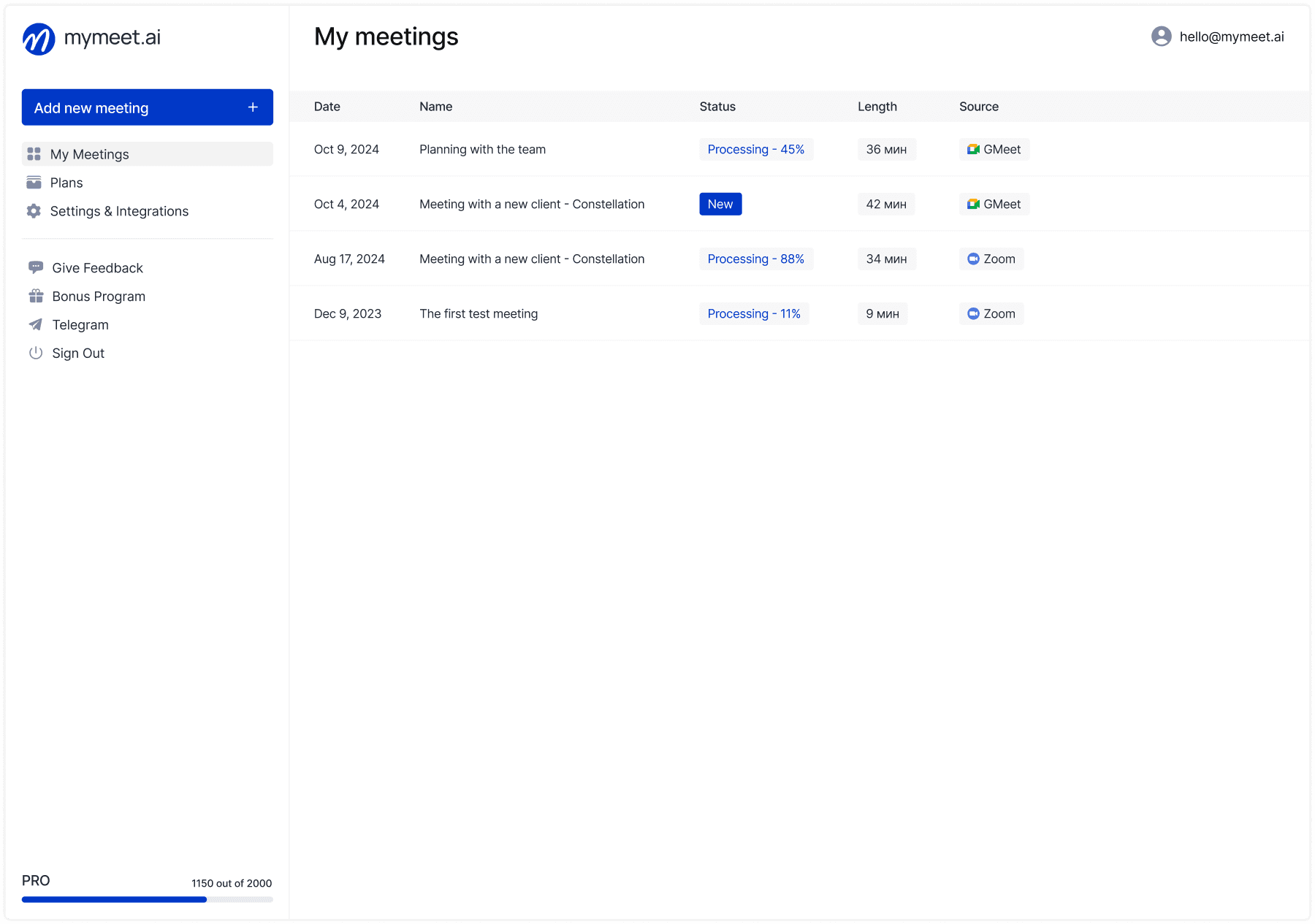
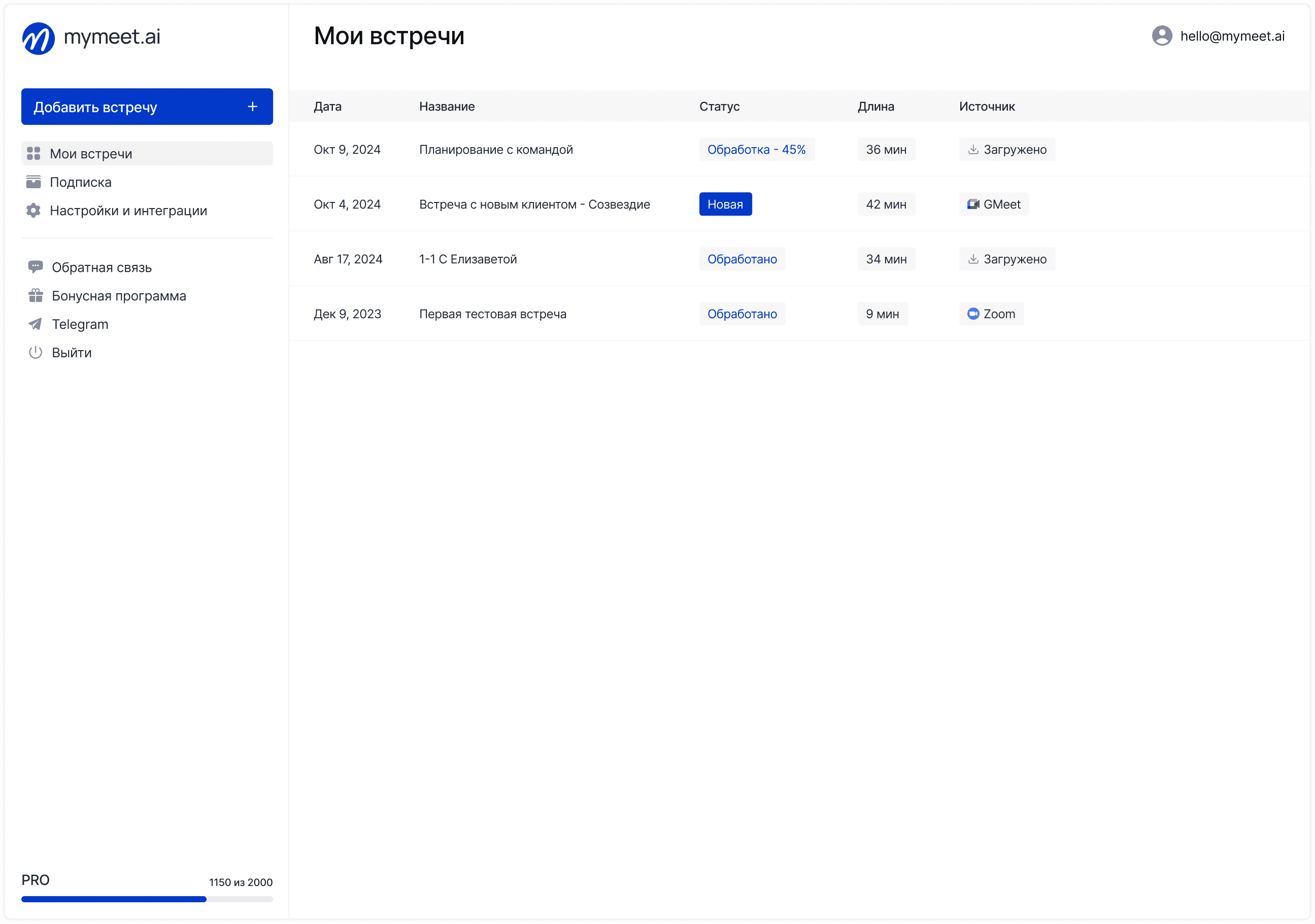
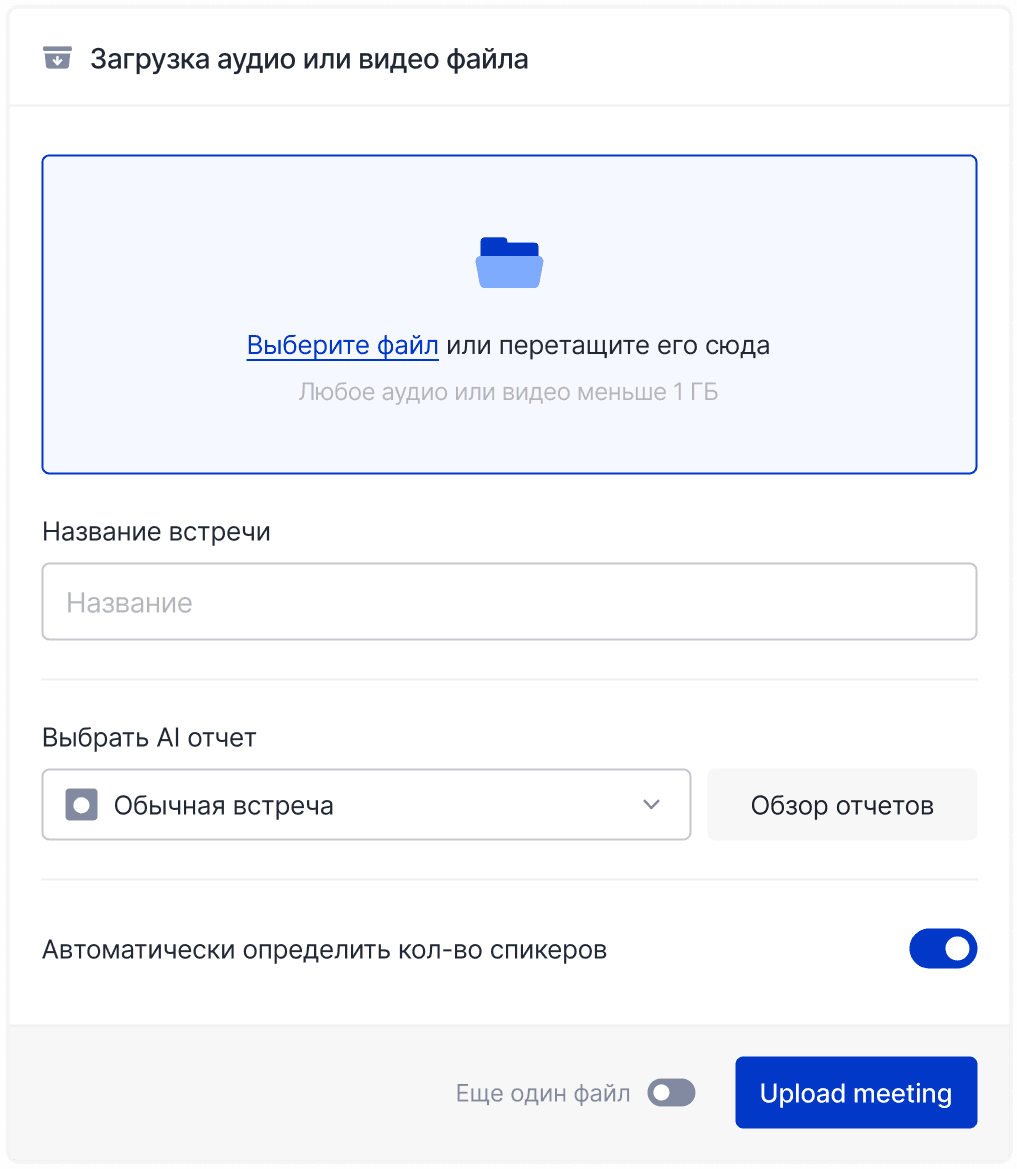
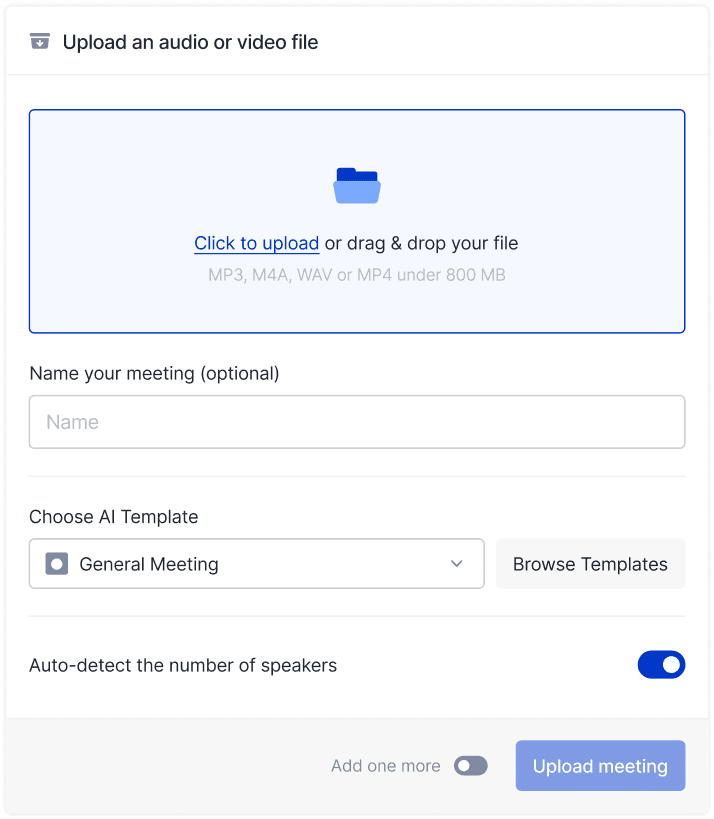
mymeet.ai specializes in one task and does it well: automatically records business meetings and transforms them into structured documents. The bot connects to Zoom, Google Meet, Microsoft Teams, Yandex.Telemost (Russian video conferencing service), and other platforms through calendar integration. While the team discusses, the assistant works in the background.
After the meeting ends, a transcript with 96-98% accuracy appears in the dashboard, divided by speakers and timestamps. Based on this, AI generates a report in one of 11 formats: Meeting Minutes, Client Meeting, HR Interview, Team Sync, and others. All tasks with assignees and deadlines are extracted automatically.
Through AI chat, you can ask questions about any past meeting from the archive: "What was decided about the budget last week?", "What objections did the client raise on Friday?" — and get precise answers with quotes.
Case Study: How electro.cars Saved 15 Hours per Week with an AI Assistant
The electro.cars sales department was conducting over 15 client meetings per week. After each call, managers manually filled out the CRM and wrote brief summaries — this took up to 15 hours per week for the entire department.
After connecting mymeet.ai, the process changed: the assistant recorded meetings itself, generated a report using the "Client Meeting" template, and attached it to the deal in CRM. Managers only needed to review the finished document and adjust details if necessary. 15 hours per week returned to client work.
✅ 96-98% transcription accuracy with speaker separation
✅ 11 AI report formats for different meeting types
✅ Automatic task extraction with assignees and deadlines
✅ Auto-connection through Google Calendar, Outlook, Yandex Calendar
✅ AI chat for searching decisions across meeting archives
✅ Integration with amoCRM and Bitrix24 (popular Russian CRM systems)
✅ 180 minutes free per month, no credit card required
How to Choose an AI Assistant for Business Needs
The AI assistant market has grown so much that choosing has become a non-trivial task. Universal tools like ChatGPT work for a wide range of tasks, but specialized solutions deliver better results in specific scenarios.
Before choosing, answer several questions: what specific task should the assistant solve, what systems should it integrate with, how important is data security and compliance with local regulations.
Task | Suitable Assistant Type | Examples |
Writing texts, analyzing documents | Universal text | ChatGPT, Claude, Gemini |
Voice commands, everyday tasks | Voice | Alexa, Siri, Google Assistant |
Recording and analyzing business meetings | Specialized for meetings | mymeet.ai |
Business process automation | Business assistant with integrations | Depends on company stack |
Customer support | Chatbot or AI assistant for support | Depends on request complexity |
For companies handling personal data, an additional selection factor is compliance with data protection regulations and data storage location. If the assistant works with customer or employee personal data, this question needs clarification before implementation, not after.
AI Assistant Limitations: What to Consider
AI assistants work well, but not perfectly. Understanding their limitations helps use tools where they provide real value and not expect the impossible.
Language models sometimes make factual errors — this is called hallucination. An assistant may confidently state an incorrect date, percentage, or name. For tasks where accuracy is critical, results always need verification.
AI assistants perform poorly with highly specialized terminology without additional tuning. Medical terms, legal constructs, industry jargon — all of this requires either a specially trained model or manual result verification.
Data confidentiality is relevant for any company transmitting information to a cloud service. You need to understand where data is stored, how it's processed, and who has access. For sensitive corporate information, this is a fundamental consideration.
Conclusion
An AI assistant isn't a replacement for specialists — it's a tool that takes on tasks not requiring human judgment: routine documentation, formatting, initial analysis, composing standard texts.
Companies that have figured out how to integrate AI assistants into workflows save time on routine and redirect it where a live person is needed — to negotiations, strategy, and client relationships.
A good way to start is with a narrow, specific task. Not "implement AI," but "automate meeting minutes" or "speed up weekly report preparation." A specific task yields a specific result that's easy to measure.
Frequently Asked Questions About AI Assistants
What is an AI assistant in simple terms?
An AI assistant is a program based on artificial intelligence that understands requests in ordinary language and performs tasks: answers questions, writes texts, analyzes data, manages other tools. Unlike a search engine, it conducts dialogue and considers conversation context.
How does an AI assistant differ from a chatbot?
A chatbot works according to pre-written scripts and doesn't understand requests beyond its script. An AI assistant understands natural language, adapts to context, and can perform complex multi-step tasks without rigid limitations.
Which AI assistants are most popular?
For text tasks, ChatGPT, Claude, and Gemini are most commonly used. For voice control — Alexa, Siri, and Google Assistant. For automatic business meeting recording — mymeet.ai, which offers 96-98% transcription accuracy in Russian.
Is it safe to share corporate data with an AI assistant?
It depends on the specific service. You need to check where data is stored, how it's processed, and whether the service complies with relevant data protection regulations. Always review the privacy policy and data handling practices before implementation.
Can an AI assistant completely replace a secretary or assistant?
Partially — yes. AI handles meeting documentation, composing emails, planning, and reminders well. But tasks requiring empathy, non-standard solutions, and live communication still remain with people.
How much does an AI assistant for business cost?
The range is very wide. Universal tools like ChatGPT Plus cost around $20 per month per user. Specialized business solutions depend on usage volume. mymeet.ai offers 180 minutes free without requiring a credit card.
How does an AI assistant help in sales?
It records client calls, automatically fills out CRM, highlights objections and client needs, and generates a meeting summary report. Managers spend less time on documentation and more on working with clients.
Do you need technical knowledge to use an AI assistant?
For most user-facing tools — no. Modern AI assistants work through a standard chat interface or mobile app. For deep integration with corporate systems, API configuration may be required.
Which AI assistant is best for team collaboration?
It depends on the task. For collaborative document work, tools based on ChatGPT or Claude with sharing capabilities work well. For team meetings — mymeet.ai with workspaces where all recordings are accessible to the entire team.
How do you start using an AI assistant in a company?
Start with one specific task, not a global rollout. Choose a process that takes a lot of time and lends itself well to automation: meeting minutes, standard emails, weekly reports. Test with a small team, evaluate results, and scale.
Radzivon Alkhovik