Meeting Tips

Radzivon Alkhovik
·
Updated on
A manager gathers the team for a "quick" standup. An hour later, everyone leaves tired — discussed a lot, decided little. The next day it turns out three people didn't need to be there at all, and the key decision still wasn't made. The problem isn't the people or the topic — the problem is that the meeting format didn't match its purpose.
Hello! The mymeet.ai team works with thousands of business meetings every day and knows: choosing the right format is half the success of any meeting.
Why Know Meeting Types and How It Affects Results
Most teams use one universal format for everything: gather, talk, disperse. This works for simple tasks but doesn't scale well. The more complex the organization and the more meetings — the more expensive the wrong format becomes.
Understanding meeting types helps choose the right participants, set realistic timing, and formulate the expected outcome before the call starts. This isn't theory — it directly impacts how much time the team spends in meetings and what comes out of them.
How Meeting Format Differs from Meeting Purpose
Meeting purpose is what we want to achieve: make a decision, synchronize the team, gather ideas. Format is how we conduct the meeting: offline or online, synchronous or asynchronous, one-on-one or whole team.
The same purpose can be achieved through different formats. Team synchronization can be done as a live standup, a video call, or an asynchronous voice message with chat responses. The choice depends on urgency, team geography, and topic complexity.
Why Wrong Meeting Format Kills Productivity
When format doesn't match purpose — the meeting loses effectiveness regardless of participant preparation. A brainstorm with 15 people rarely produces good ideas — too many voices, too little space for each person. A strategic decision made hastily in five minutes between other meetings is a bad decision even if everyone agreed.
The three most common mismatches we see: informational meetings that could be replaced by email, decisions attempted in large groups instead of small circles, and syncs that turn into undirected discussions.
Meeting Classification by Purpose
The most useful way to classify meetings is by what we want to achieve. When the purpose is clearly formulated, everything else — composition, timing, format — becomes obvious.
Informational Meetings: Standups and Briefings
Informational meetings are needed to convey information from one person or group to others. Classic examples: morning standup, project launch briefing, company all-hands.
The main problem with this meeting type — they're often held where an email or recorded video would suffice. If information is one-way and doesn't require discussion — a meeting is redundant. An informational meeting is justified by the ability to ask questions and get answers in real time.
Optimal timing: 15-30 minutes. Composition: everyone who needs this information. Outcome: shared understanding of the situation among all participants.
Decision-Making Meetings
Meetings of this type gather exactly the people whose voice affects the outcome. Extra participants are especially costly here: the more people, the harder it is to reach a decision.
A good decision-making meeting starts with a clearly formulated question — not "let's discuss strategy" but "we're choosing between option A and option B, here are the criteria." Materials for review are sent in advance; the meeting itself is for discussion, not data presentation.
Optimal timing: 45-60 minutes. Composition: 3-7 people with real authority. Outcome: documented decision with rationale.
Idea Generation Meetings: Brainstorming and Creative Sessions
Brainstorming and creative sessions work by special rules. Criticizing ideas during generation kills the process — first collect all options, then evaluate. This requires special moderation and psychological safety in the group.
The optimal group size for brainstorming is 5-8 people. Fewer — not enough diversity of ideas; more — some participants stay silent. For online format, anonymous idea boards work well: people suggest more boldly when there's no direct public evaluation.
Optimal timing: 60-90 minutes with a break. Composition: people with different experiences and perspectives. Outcome: list of ideas sorted by priority.
Team Synchronization Meetings: Status Updates and Syncs
Syncs are the most common meeting type in distributed teams. Their purpose: ensure everyone is moving in the same direction, identify blockers, and coordinate next steps.
The key problem with syncs — they easily turn into work reports instead of live problem discussions. A good sync focuses on three questions: what we did, what we're planning, what's blocking us. Everything else is off-topic.
Optimal timing: 15-30 minutes, at least once a week. Composition: entire project working group. Outcome: shared understanding of status and list of blockers to address.
Development Meetings: One-on-Ones and Retrospectives
One-on-ones between manager and employee are one of the most underrated formats. This isn't a work report or task assignment. It's space for honest conversation about development, challenges, and expectations — in both directions.
A retrospective is a team meeting to analyze the past period. What worked well, what needs to change, what agreements we're making for the next sprint. Without retrospectives, teams repeat the same mistakes.
Optimal timing for one-on-one: 30-60 minutes every two weeks. For retrospective: 60-90 minutes at the end of each sprint or period.
Meeting Classification by Conduct Format
Beyond purpose, meetings differ by how they're conducted. This choice affects communication quality, participant engagement, and convenience of documenting results.
Offline Meetings: When Live Communication Matters More
Offline provides maximum nonverbal communication — people see reactions, feel group energy, build trust more easily. For some tasks this is fundamental: strategic sessions, complex negotiations, team events.
The downside of offline is logistics. Gathering a distributed team in one place is expensive and time-consuming. So offline should be reserved for tasks where it truly matters, not used out of inertia.
Online Meetings and Video Conferences
Online format has become the norm for most teams. Zoom, Google Meet, Microsoft Teams, Yandex.Telemost (Russian video conferencing service) — there are enough tools for any task. Main advantages: no logistics, easy to connect people from different cities, easier to record the meeting.
Online requires clearer structure than offline: without an agenda and moderator, a video call falls apart faster than a live meeting. But recording and transcript of an online meeting provide a complete archive for those who weren't present.
Hybrid Meetings: Part Online, Part Offline
Hybrid format is the most complex to organize. Some participants are in a conference room, others join online. Without proper tech and moderation — online participants drop out of the discussion.
For hybrid meetings, good acoustics in the conference room are important, a camera that shows all attendees, and a moderator who specifically monitors online participant engagement.
Asynchronous Meetings: When Recording Is More Effective Than Live Calls
Asynchronous format isn't a meeting in the traditional sense, but solves the same tasks. One participant records a video or voice message with a project update, others watch at convenient times and respond with their own recordings or text.
Async works well for informational updates, status reports, and discussions where instant reaction isn't needed. It saves hours of team synchronous time and allows people in different time zones to work without late-night calls.
Mymeet.ai — AI Assistant for Automatic Documentation of Any Meeting Type
Regardless of what meeting type you choose — informational standup, brainstorm, or one-on-one — outcomes need to be documented. Without this, agreements get lost, tasks don't get done, and the same questions get discussed again.
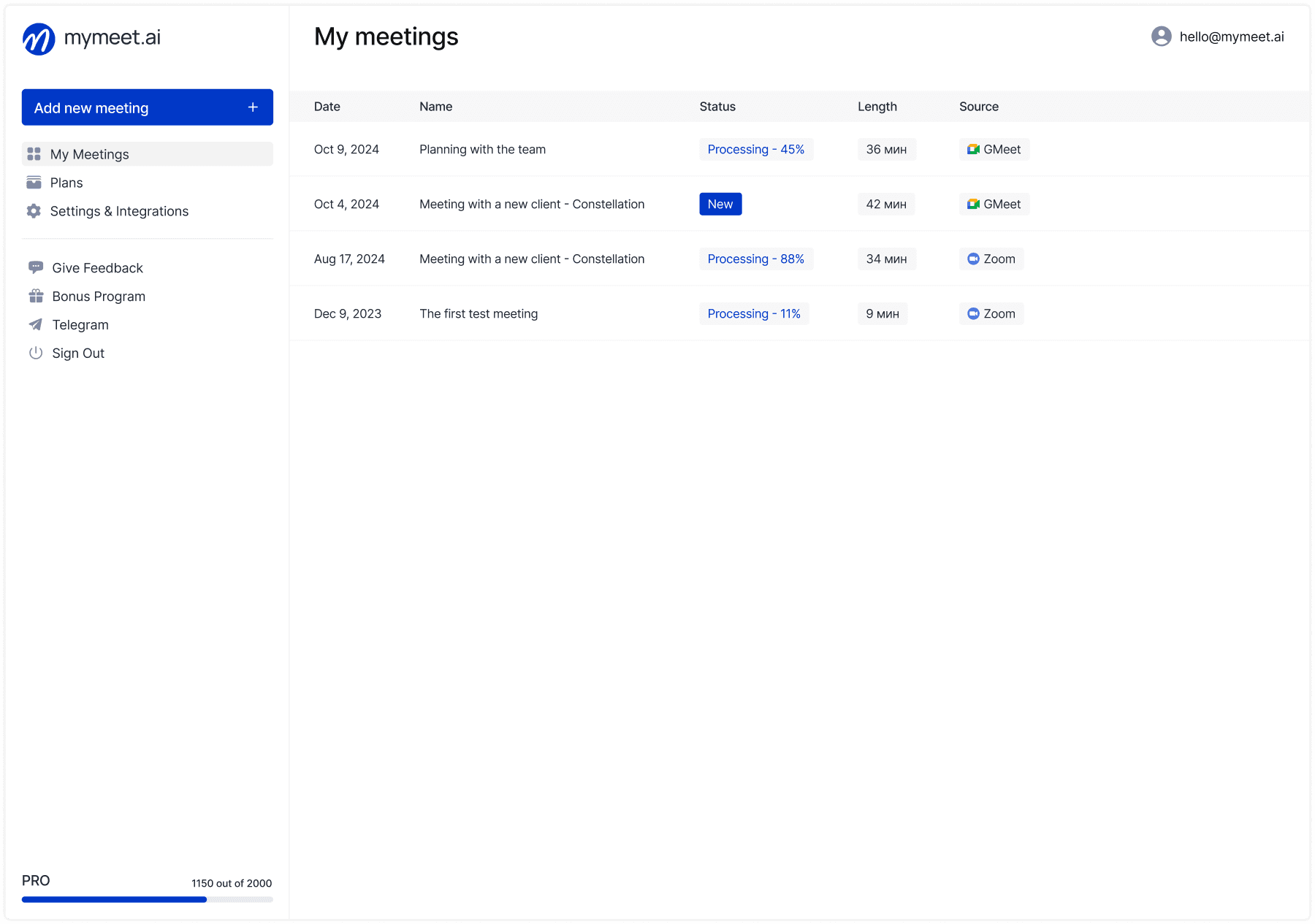
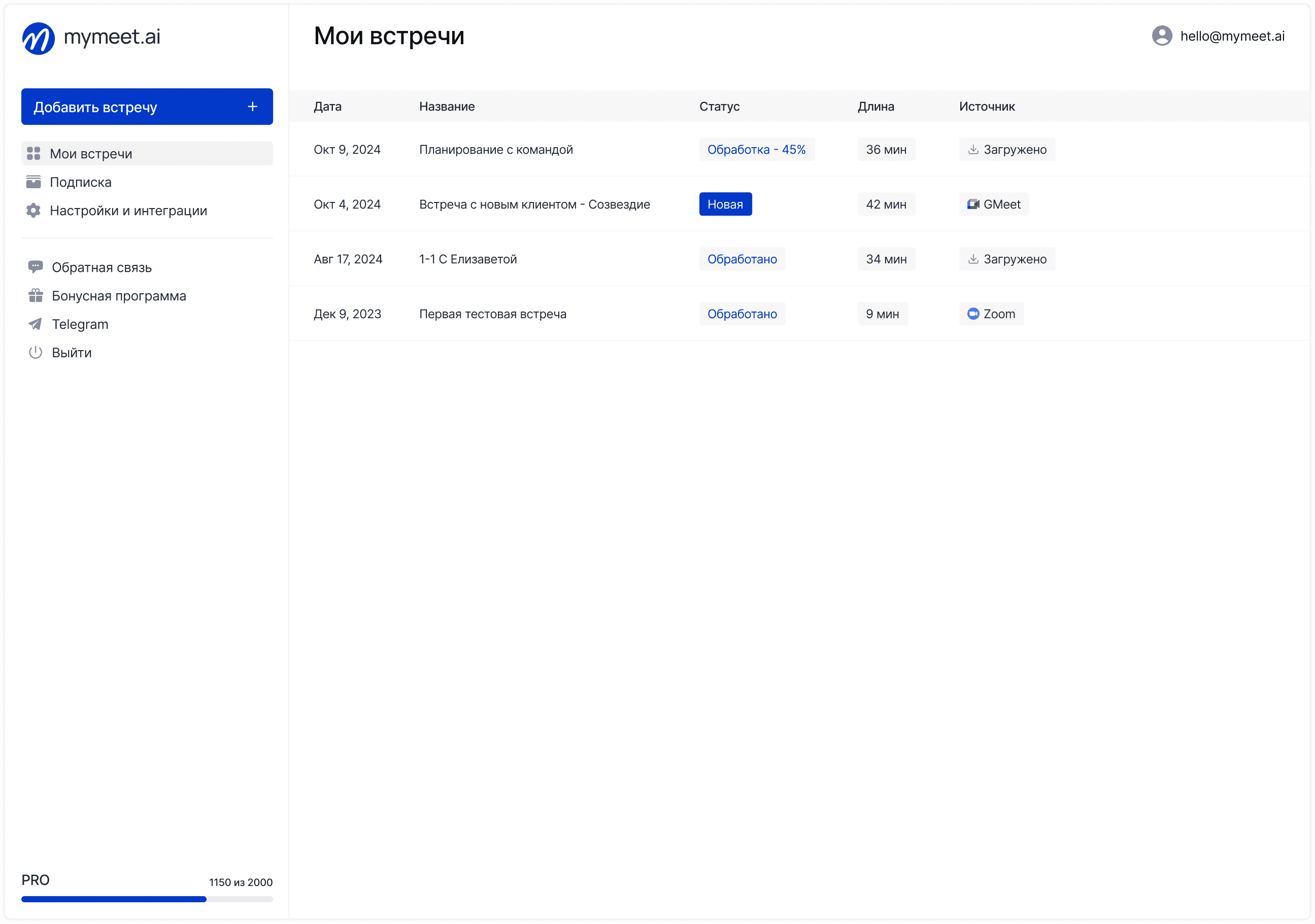
mymeet.ai connects to meetings in Zoom, Google Meet, Microsoft Teams, or Yandex.Telemost through calendar integration and automatically records, transcribes, and analyzes the conversation. After the meeting, the dashboard shows a transcript with speaker separation and a structured report in the needed format.
Case Study: How electro.cars Saved 15 Hours Weekly on Meetings
The electro.cars sales department was conducting over 15 client meetings weekly. After each call, managers manually filled out CRM and wrote summaries — this took up to 15 hours weekly for the entire department.
After connecting mymeet.ai, summaries for every meeting started appearing automatically within minutes after the call. The "Client Meeting" template report automatically extracted needs, objections, and next steps — and attached to the deal in CRM. 15 hours weekly returned to client work.
✅ Automatic meeting recording in Zoom, Google Meet, Teams, Yandex.Telemost
✅ 96-98% transcription accuracy with speaker separation
✅ 11 AI report formats for different meeting types
✅ Automatic task extraction with assignees and deadlines
✅ AI chat for searching decisions across all meeting archives
✅ Integration with amoCRM and Bitrix24 (popular CRM systems)
✅ 180 minutes free, no credit card required
When outcome documentation happens automatically for every meeting type, the team stops spending time on documentation and focuses on executing agreements.
Types of Business Meetings with Clients and Partners
Meetings with external participants — clients, partners, investors — have their own specifics. Stakes are higher, preparation is more important, and requirements for documenting agreements are stricter.
Presentation Meetings and Product Demos
A presentation meeting and demo isn't a seller's monologue. The best demos are built around the client's specific pain: first understand the task, then show exactly how we solve it. The client should see themselves in the demo, not abstract product features.
The key outcome of such a meeting is a clear next step: date of next call, list of questions to clarify, specific terms to agree on.
Negotiations and Terms Alignment
Negotiations require maximum precision in documenting agreements. A discrepancy in understanding deal terms discovered a week after the meeting is one of the most common reasons for losing a client at the final stage.
Every agreement in negotiations must be documented with exact wording and confirmed by both parties. A verbal agreement without written confirmation isn't an agreement.
Relationship Support and Development Meetings
Not all client meetings are for selling or solving problems. Regular relationship maintenance meetings — quarterly business reviews, informal coffee calls — build long-term partnerships.
The purpose of such meetings: understand how the client is doing, share useful information, identify new needs before they become problems. This is an investment in the relationship, not a transaction.
Comparison Table of Meeting Types by Purpose and Format
Different meeting types require different approaches to preparation, participant composition, and timing. Below is a summary table for quick navigation across formats.
Meeting Type | Purpose | Composition | Timing | Outcome |
Standup | Convey information | All interested parties | 15-30 min | Shared understanding |
Decision | Make a decision | 3-7 people with authority | 45-60 min | Documented decision |
Brainstorm | Generate ideas | 5-8 people | 60-90 min | Prioritized idea list |
Sync | Synchronization | Working group | 15-30 min | Status and blocker list |
One-on-one | Development | 2 people | 30-60 min | Development agreements |
Retrospective | Period analysis | Entire team | 60-90 min | Changes list for next period |
Demo | Show product | Seller and client | 30-60 min | Next step in deal |
Negotiation | Align terms | Key stakeholders | 60-90 min | Documented agreements |
How to Choose the Right Meeting Type for a Task
Before putting a meeting on the calendar, it's useful to answer three questions: what outcome is needed, who is actually needed to achieve it, and can this outcome be obtained without a synchronous meeting.
If the outcome is conveying information and no questions are expected, an email or recorded video is probably sufficient. If a decision is needed — invite only those who influence the decision, not the whole department. If team synchronization is needed — a 20-minute sync is better than an hour-long standup.
The main criterion for choosing format: how high is the cost of a wrong decision and how important is the speed of feedback. The higher the stakes and the more important live reaction — the more reason for a synchronous meeting with the right people.
Conclusion
Meeting types aren't a formal classification but a practical tool. When the team understands why they're gathering and chooses a format for the specific task — meetings become shorter, more productive, and less likely to cause fatigue.
Start simple: before every meeting, formulate one sentence — "the purpose of this meeting is to decide on X" or "the purpose is to synchronize the team on Y status." If you can't formulate the purpose — the meeting probably isn't needed.
And document outcomes of every meeting regardless of its type. mymeet.ai does this automatically — first 180 minutes free without requiring a credit card.
Frequently Asked Questions About Meeting Types
What types of business meetings are there?
Business meetings are divided by purpose: informational, decision-making, idea generation, team synchronization, and development. By format: offline, online, hybrid, and asynchronous. Each type requires its own approach to participant composition, timing, and outcome documentation.
How does a standup differ from a meeting?
A standup is a short informational meeting for status sharing and synchronization, usually 15-30 minutes. A meeting is a broader concept that includes discussion, decision-making, and can last significantly longer. A standup is one type of meeting.
What is a sync in business?
A sync (from synchronization) is a short regular team meeting for project status alignment. Usually 15-30 minutes, focused on three questions: what we did, what we're planning, what's blocking us. Popular in IT and product teams.
How often should different meeting types be held?
Syncs — once a week or more often for active projects. One-on-ones — every two weeks. Retrospectives — at the end of each sprint or work period. Strategic meetings — once a quarter. Informational meetings should be minimized — most can be replaced by email.
What is an asynchronous meeting?
An asynchronous meeting is a format where participants don't gather simultaneously. One records a video or voice message with an update, others watch and respond at convenient times. Works well for informational updates and teams in different time zones.
How does an online meeting differ from offline?
Offline provides more nonverbal communication and is better suited for complex negotiations and strategic sessions. Online is convenient for regular meetings of distributed teams, easier to record, and easier to add participants from different cities. Hybrid format combines both approaches but requires special attention to tech and moderation.
How many participants are optimal for different meeting types?
For decision-making — 3-7 people. For brainstorming — 5-8 people. For syncs — the entire working group. One-on-one — always two. For informational meetings, participant count isn't limited, but the more there are, the more important structure and moderation become.
How do you properly end any meeting type?
Document decisions made with clear wording, assign tasks with owners and deadlines, note open questions and the date of the next meeting. Summaries should be sent to participants the same day while information is fresh.
How do you automatically document outcomes of different meeting types?
mymeet.ai connects to meetings in Zoom, Google Meet, Teams, or Yandex.Telemost and automatically creates a structured report after each call. Different templates are available for different meeting types: Meeting Minutes, Client Meeting, HR Interview, Team Sync, and others.
Can a meeting be replaced by an email or message?
Yes, if the purpose is conveying information without discussion. An email or voice message handles this better than a meeting: the recipient reads at a convenient time, information is documented, no need to coordinate schedules. A meeting is justified when live reaction, discussion, or decision-making is needed.
Radzivon Alkhovik