Meeting Tips

Radzivon Alkhovik
·
Updated on

A designer downloads music for a presentation — the file is 400 megabytes. A developer receives a meeting recording for transcription — the file won't open in the needed program. A podcaster records an interview in the wrong format and loses quality during editing. All these problems are solved in a minute if you understand how audio formats differ from each other.
Hello! The mymeet.ai team works with audio files in different formats every day and knows which format is best suited for which tasks.
What Is an Audio Format and Why Does It Matter
An audio format is a method of storing sound data in a file. It determines exactly how the sound wave is encoded, how accurately it's reproduced during playback, and how much space the file takes on disk. Two files with the same recording in different formats can differ in size by 10 times and sound different.
Format choice affects three things: sound quality, file size, and compatibility with devices and programs. Understanding these three parameters allows you to choose a format consciously for a specific task.
Lossy vs Lossless Compression: What's the Difference
All audio formats fall into three categories by data storage type.
Uncompressed formats store the full sound wave without any changes. Quality is maximum, file size is huge. Examples: WAV, AIFF.
Lossless compression reduces file size using mathematical methods without losing information. When decoded, the file is restored to original quality. Examples: FLAC, ALAC.
Lossy compression removes parts of the sound signal that the human ear practically doesn't perceive. The file becomes significantly smaller, but some data is lost forever. Examples: MP3, AAC, OGG.
For most everyday tasks, lossy compression is absolutely sufficient — the quality difference between good MP3 and WAV is indistinguishable on regular speakers. The difference becomes noticeable in professional recording and mixing.
How Format Affects Sound Quality and File Size
Audio quality is measured by bitrate — the amount of data bits per second. The higher the bitrate, the more information about the sound is stored in the file and the better the quality.
For MP3: 128 kbps is acceptable quality for speech, 192 kbps is good quality for music, 320 kbps is maximum MP3 quality. WAV doesn't have bitrate in the usual sense — it stores uncompressed data at 44,100 Hz sample rate and 16 or 24-bit depth.
Practical example: one hour of audio in WAV weighs about 600 MB, the same hour in MP3 320 kbps is about 140 MB, in MP3 128 kbps is about 55 MB.
Main Audio File Formats: Detailed Breakdown
There are more than a dozen audio formats, but for practical work you only need to know seven main ones. Each has its niche and tasks it's best suited for.
MP3 — The Most Popular Audio Format
MP3 (MPEG Audio Layer III) is the most common audio format in the world. It appeared in the 1990s and remains the standard for storing and transmitting music and speech.
MP3's main advantage is universal compatibility. Absolutely any device and any program opens it: phone, car stereo, smart speaker, any media player. This makes MP3 the default format when compatibility matters.
MP3's limitation is lossy compression. At low bitrates, compression artifacts are audible: metallic timbre, blurred high frequencies. At 192-320 kbps these artifacts are practically inaudible to most people.
When to use: for everyday music listening, publishing audio online, sending voice recordings, storing large music collections.
WAV — Uncompressed Format for Maximum Quality
WAV (Waveform Audio File Format) is the standard uncompressed format developed by Microsoft and IBM. It stores the full sound wave without any compression.
WAV is the working format for professional audio recording. All studio recordings are made in WAV or AIFF, editing and mixing happen with uncompressed audio. This guarantees that quality doesn't degrade with multiple processing passes.
WAV's downside is huge file size. An hour of recording takes 600-1,200 MB depending on settings. This is inconvenient for file exchange and storing large archives.
When to use: for studio recording and mixing, mastering, working with audio in video editing, creating podcasts and webinars before final publication.
FLAC — Lossless Compression for Audiophiles
FLAC (Free Lossless Audio Codec) is an open lossless compression format. It reduces file size by 50-60% compared to WAV while fully preserving quality. During playback, the file is decoded to its original uncompressed state.
FLAC has become the standard for audiophiles and music collectors who want to store recordings in maximum quality without WAV's huge size. Supported by most modern players and devices, though compatibility is still lower than MP3.
When to use: for archiving music collections in maximum quality, for listening on hi-fi equipment, for storing master recordings.
AAC — Format for Streaming and Apple Devices
AAC (Advanced Audio Coding) is the format that replaced MP3 as a more efficient compression algorithm. At the same bitrate, AAC sounds better than MP3 — fewer artifacts and cleaner high frequencies.
AAC is used by all major streaming services: Apple Music, YouTube, Spotify. It's the native format for Apple devices — iPhone, iPad, Mac. AAC files usually have .m4a or .aac extensions.
AAC's limitation is slightly worse compatibility compared to MP3. Older devices and some programs don't support it.
When to use: for publishing podcasts on Apple Podcasts, for exporting audio from Apple devices, for streaming.
OGG — Open Format for Streaming and Games
OGG Vorbis is an open free lossy compression format. Quality-wise it's comparable to AAC and surpasses MP3 at the same bitrate. Popular in the gaming industry and on platforms that use open standards.
Spotify uses OGG for music streaming. Many games store sound effects and music in OGG. Compatibility is lower than MP3 and AAC — some devices and programs don't support this format.
When to use: for gaming projects, for publishing on Spotify, for web applications where using open formats matters.
M4A — Audio from the Apple Ecosystem
M4A is a container that usually contains audio in AAC or ALAC (Apple Lossless) codec. This is the standard format for music purchased on iTunes, voice message recordings on iPhone, and audio exported from GarageBand and Logic Pro.
Essentially M4A and AAC are the same thing technically, the difference is only in the container. M4A is well supported in the Apple ecosystem and most modern programs.
When to use: when working with audio from Apple devices, for podcasts targeting iOS audiences.
WMA — Windows Media Format
WMA (Windows Media Audio) is a format developed by Microsoft as an alternative to MP3. It was popular in the early 2000s when MP3 was protected by patents. Now it's practically displaced by MP3 and AAC.
WMA is still found in archival recordings and on some corporate platforms. Compatibility is limited — well supported on Windows, worse on other platforms.
When to use: practically nowhere in new projects. If you receive a WMA file — convert it to MP3 or WAV for further work.
Audio Format Comparison Table
Format choice is always a tradeoff between quality, file size, and compatibility. The table helps quickly compare main parameters and choose the appropriate format for a specific task.
Format | Compression Type | Quality | Size (1 hour) | Compatibility |
WAV | Uncompressed | Maximum | 600-1200 MB | Excellent |
FLAC | Lossless | Maximum | 250-500 MB | Good |
MP3 320 | Lossy | Very Good | 140 MB | Excellent |
MP3 128 | Lossy | Good | 55 MB | Excellent |
AAC | Lossy | Very Good | 100-130 MB | Good |
OGG | Lossy | Very Good | 100-130 MB | Medium |
M4A | Lossy | Very Good | 100-130 MB | Good |
WMA | Lossy | Good | 80-120 MB | Weak |
For most practical tasks, MP3 192-320 kbps or AAC provides the optimal balance of quality and size. WAV and FLAC are only needed when quality is critical — studio work, archiving, professional audio processing.
Which Audio Format to Choose for a Specific Task
There's no universal best format — there's one appropriate for a specific task. Several practical recommendations.
For Voice Recording and Online Business Meetings
For recording meetings, interviews, and client calls, MP3 with 128-192 kbps bitrate is optimal. Speech occupies significantly less frequency range than music, so even 128 kbps gives excellent quality for voice with compact file size.
If you plan to transcribe the recording — use MP3 128-192 kbps or AAC. Speech recognition algorithms work well with these formats and don't require uncompressed WAV for high accuracy.
For Podcasts and Audio Content
Record in WAV, published in MP3 or AAC. This is the standard podcaster workflow: source in maximum quality, final file in compact format for distribution.
For Apple Podcasts publication, MP3 or AAC with 128-192 kbps bit rate is recommended for mono and 192-256 kbps for stereo. Spotify accepts MP3 and AAC, automatically converts to OGG for streaming.
For Music and Studio Recording
Record and process in WAV 24-bit 48 kHz or 96 kHz — this is the professional studio recording standard. For storing finished material, use FLAC. For distribution — MP3 320 kbps or AAC 256 kbps.
Never edit an already-compressed MP3 or re-encode it to another lossy format — each re-encoding adds artifacts and degrades quality.
For Transcription and Speech Recognition
For automatic transcription, most formats work — MP3, WAV, M4A, OGG. Transcription quality depends mainly on recording quality (noise level, speech clarity, number of speakers), not on format choice.
MP3 128 kbps and above gives results no worse than WAV for speech recognition. If you use mymeet.ai — the service accepts MP3, WAV, M4A, OGG, FLAC, and other popular formats and automatically optimizes audio before processing.
For Streaming and Online Publishing
AAC or MP3 with 128-192 kbps bitrate is the optimal choice for online publishing. YouTube automatically converts uploaded audio to AAC. Streaming services use their own formats, so they accept MP3 or WAV for upload and do the conversion themselves.
Mymeet.ai — Transcribing Audio of Any Format to Text
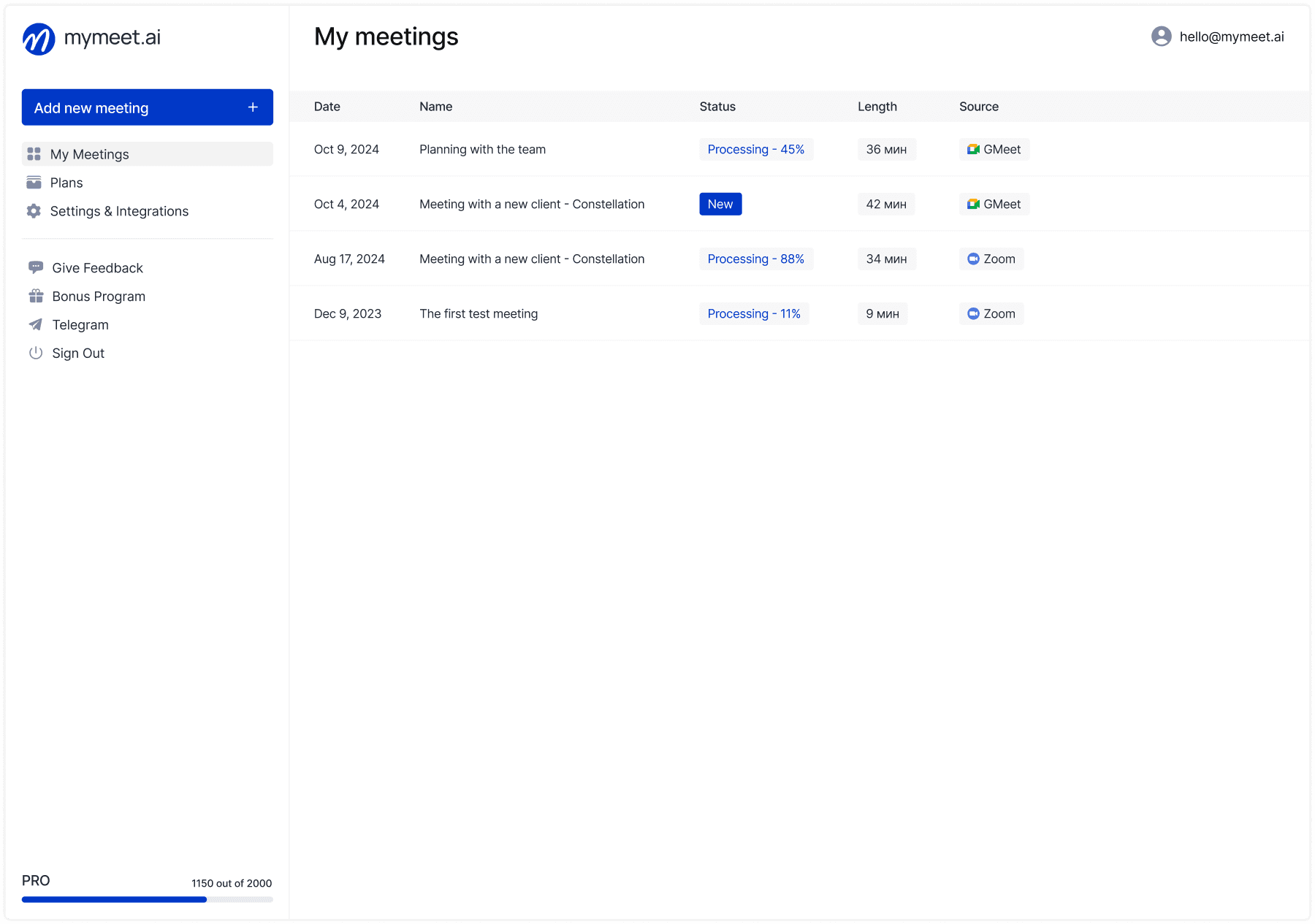
One frequent question when working with transcription: what format should audio be uploaded in to get the best result? mymeet.ai accepts all popular formats and automatically optimizes audio before processing — no need to specifically choose a format.
What Audio and Video Formats Does mymeet.ai Support
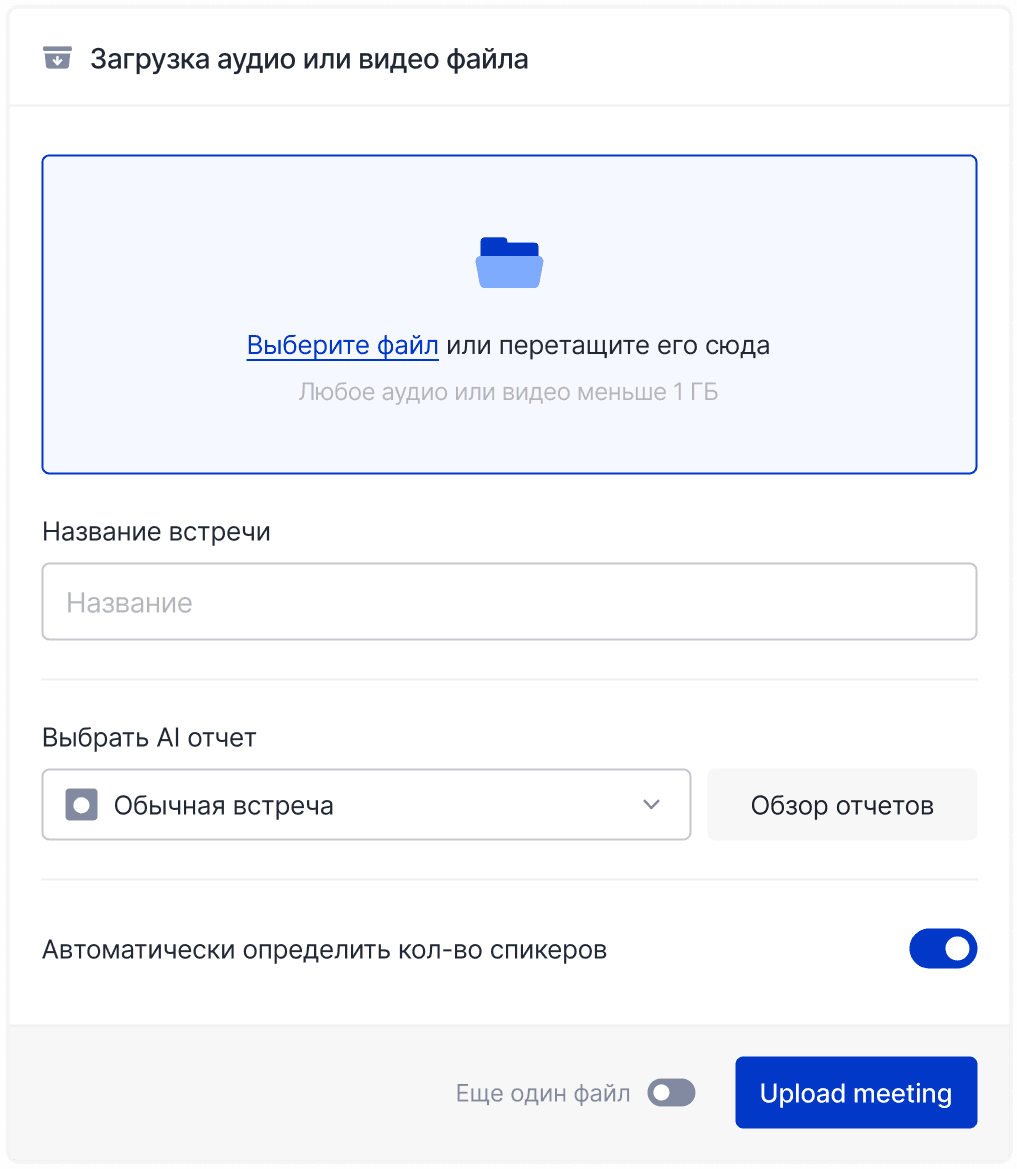
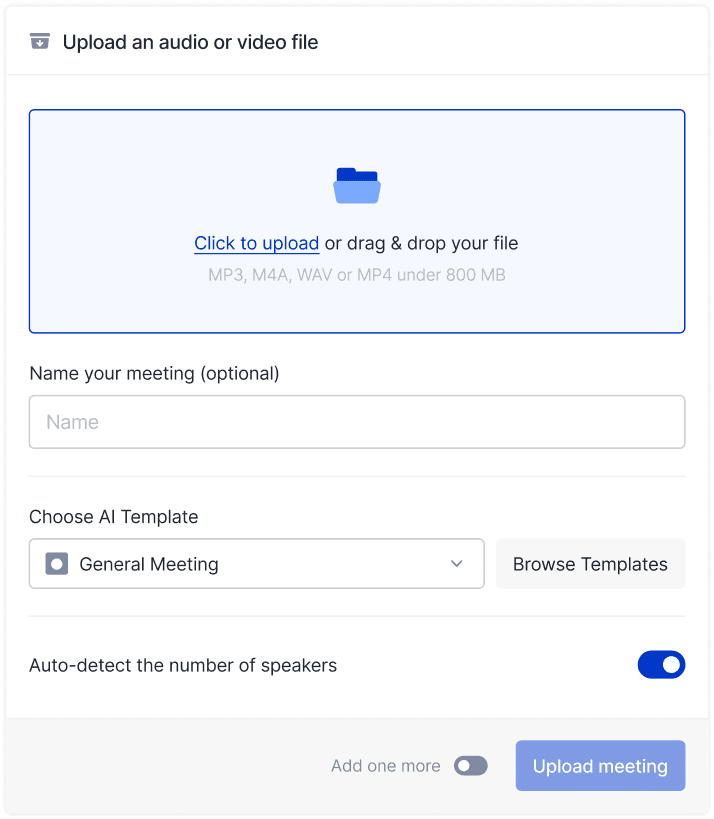
For manual file uploads, mymeet.ai supports: MP3, WAV, M4A, OGG, FLAC, MP4, MOV, AVI, MKV, and other popular audio and video formats. For recording meetings via bot, you don't need to choose formats — the service automatically connects to Zoom, Google Meet, Microsoft Teams, or Yandex.Telemost (Russian video conferencing service) and records in optimal format.
After upload, the file goes through an AI audio cleaning model that removes background noise before transcription. This improves recognition accuracy even if the original recording was made in less than ideal conditions.
✅ Support for MP3, WAV, M4A, OGG, FLAC, MP4, MOV, and other formats
✅ AI audio noise cleaning before transcription
✅ 96-98% transcription accuracy with speaker separation
✅ 11 AI report formats for different meeting types
✅ Result export to DOCX, PDF, MD, JSON
✅ 180 minutes free, no credit card required
For business meetings and calls, we recommend recording in MP3 128-192 kbps — optimal balance of quality and file size for voice recording and subsequent transcription.
How to Convert Audio from One Format to Another
Sometimes you need to convert audio: received WAV, need MP3, or vice versa. Here are free tools that will handle the task:
VLC Media Player — free player with conversion function. Works on Windows, Mac, and Linux. Supports almost all formats
Audacity — free audio editor with export to MP3, WAV, FLAC, OGG, and other formats
FFmpeg — command-line tool for developers, supports all existing formats
Online Audio Converter (online-audio-converter.com) — online converter without installing programs, works right in the browser
CloudConvert — online service supporting over 200 file formats including all audio formats
Important rule when converting: converting from a lossy format to a lossless format doesn't restore lost data. MP3 converted to WAV will weigh like WAV but sound like MP3 — losses already happened and can't be recovered.
Conclusion
Audio formats aren't a complex topic if you understand the basic principle: uncompressed formats (WAV) for professional audio work, lossless formats (FLAC) for archiving, lossy formats (MP3, AAC) for everyday use and publishing.
For voice recording and business meetings, MP3 128-192 kbps covers all tasks. For music and studio work — WAV at recording stage and FLAC for storage. For publishing everywhere — MP3 or AAC.
Frequently Asked Questions About Audio Formats
Which audio format is better: MP3 or WAV?
Depends on the task. WAV is better for studio recording and professional audio work — maximum quality without losses. MP3 is better for everyday use, music storage, and publishing — 5-10 times smaller size with practically indistinguishable quality on regular speakers.
How does FLAC differ from MP3?
FLAC uses lossless compression — when decoded, the file is restored to original quality. MP3 uses lossy compression — some audio data is permanently removed. FLAC weighs more than MP3 but less than WAV and preserves full quality.
Can you convert MP3 to WAV without quality loss?
No. Converting from a lossy format to a lossless format doesn't restore deleted data. MP3 converted to WAV will sound like MP3 — the file just got bigger without quality improvement.
Which audio format is best for transcription?
MP3 128 kbps and above gives results no worse than WAV for automatic speech transcription. Recognition quality depends mainly on recording quality — noise level and speech clarity, not on format choice.
How does AAC differ from MP3?
AAC is a more modern and efficient compression algorithm. At the same bitrate, AAC sounds better than MP3 — fewer artifacts and cleaner high frequencies. AAC is used by Apple Music, YouTube, and most streaming services.
Which audio format to choose for a podcast?
Recorded in WAV, published in MP3 192 kbps or AAC 128-192 kbps. This is the standard workflow: source in maximum quality, final file in compact format for distribution.
Why are WAV files so large?
WAV stores the full uncompressed sound wave — every audio sample is saved without mathematical processing. An hour of stereo recording in WAV 44.1 kHz 16-bit takes about 600 MB. This is necessary for professional audio work but excessive for everyday use.
What is audio bitrate?
Bitrate is the amount of data bits per second. The higher the bitrate, the more information about the sound is stored in the file and the better the quality. For MP3: 128 kbps is good for speech, 192 kbps is good for music, 320 kbps is maximum MP3 quality.
Which audio format is supported by all devices?
MP3 is supported by absolutely all devices and programs — it's the most compatible format. If you need to send an audio file and don't know what the recipient has — use MP3.
What format is best for storing a music collection?
FLAC is the optimal choice for storing a music collection in maximum quality. Files are half the size of WAV with identical quality. If disk space isn't limited and maximum compatibility matters — WAV.
Radzivon Alkhovik