Meeting Tips

Ilya Berdysh
·
Updated on
A product team spent three months developing a new feature. They launched — users didn't understand how to use it. If they'd run a focus group before launch, the problem would have been discovered in two hours of discussion with six participants. A focus group is one of the fastest ways to get quality feedback before a decision is made.
Hello! The mymeet.ai team works with researchers who conduct online focus groups every day — and knows what makes this method effective, and what turns it into a waste of time.
What Is a Focus Group and When Is It Used
A focus group is a structured group discussion with 6-10 participants led by a moderator. Participants discuss a product, concept, advertising material, or user experience, while the researcher observes reactions, collects opinions, and identifies hidden patterns that are difficult to discover through other methods.
An online focus group works on the same principles as offline, but is conducted via a video conferencing platform. Participants connect from anywhere, the moderator leads the discussion following a guide, and everything is recorded for subsequent analysis.
How a Focus Group Differs from an In-Depth Interview
An in-depth interview is a one-on-one conversation where the researcher deeply explores a specific person's experience. A focus group involves group dynamics where participants react to each other, supplement and challenge opinions, and generate ideas that wouldn't emerge in an individual conversation.
The key difference: in a focus group, group dynamics are the value. When one participant says "I never trust those buttons," others either agree and develop the thought, or object — and this gives the researcher a much richer picture than one person's answer.
In-depth interviews are better when the topic is sensitive and people won't speak honestly in a group, or when detailed individual experience is needed. Focus groups are better when audience reaction to a specific stimulus matters: advertising, interface, product concept.
When Focus Groups Deliver Results and When They Don't
Focus groups work well for the following tasks:
Testing advertising materials, packaging, names, and concepts
Studying target audience perception of a brand or product
Generating ideas for a new product or feature
Validating hypotheses before quantitative research
Understanding the language and formulations the audience uses
Focus groups don't deliver results when statistically significant data is needed — that requires a survey with a large sample. The method also doesn't work well for very sensitive topics where people won't speak honestly in a group, and for highly specialized products where it's difficult to recruit homogeneous participants.
How to Organize an Online Focus Group: Step-by-Step Plan
The quality of focus group results is 70% determined by preparation. Poorly selected participants, a weak guide, and technical problems at the start of a session destroy research regardless of how experienced the moderator is.
Participant Selection and Focus Group Recruiting
The optimal size for an online focus group is 6-8 people. Offline you can work with 10, but online more than 8 participants creates chaos: it's difficult to manage speaking order, some participants go silent.
Participants must match the target research profile — this is called screening. If you're researching an app for small business, all participants should be small business owners or managers, not just "people who sometimes use apps."
An important principle: participants should be similar enough to discuss the same experience, and different enough to create productive discussion. Don't mix executives and rank-and-file employees in one group — status differences kill honesty.
Preparing a Guide for the Focus Group Moderator
A guide isn't a script to read word for word. It's a discussion structure that helps the moderator stay on track and cover all necessary topics. A good guide contains:
Opening section: introductions, discussion rules, warm-up question
Main topics with key questions for each (3-5 topics for a 90-minute session)
Stimulus materials: prototypes, advertising concepts, images participants will discuss
Projective techniques: incomplete sentences, associations, ranking
Closing section: final question, thank you
Every question in the guide should be open-ended — starting with "how," "what," "why," "tell me about." Closed yes/no questions kill discussion.
Technical Requirements and Pre-Session Check
Technical problems at the start of a focus group throw participants off and eat up time. Check everything in advance using this list:
Send participants connection instructions a day before the session
Conduct a test call with each participant the day before
Verify everyone's camera and microphone work
Make sure recording is enabled and working from session start
Prepare a backup communication channel for technical issues
Ensure observers have access to the broadcast without speaking ability
Assign a technical assistant to help participants connect
Additionally, ask participants to connect from a computer rather than phone, wear headphones, and find a quiet place. Background noise and poor audio are the main enemies of online focus groups.
How to Conduct an Online Focus Group: Tips for Moderators
The online format creates specific challenges that don't exist offline. The moderator can't see all participants simultaneously, it's harder to read nonverbal signals, and participants are more easily distracted.
How to Maintain Online Focus Group Participant Attention
Attention online doesn't hold as well as offline — this is a fact to work with, not fight against. Several techniques that actually help:
Break the session into 20-25 minute blocks with small transitions between them. Use interactive tools: voting boards, collaborative whiteboards, polls during the session. Address questions to specific participants by name — this prevents them from going into background mode. Show stimulus materials via screen sharing — visual anchors hold attention. Limit online focus groups to 90 minutes maximum — beyond that, everyone's concentration drops.
Common Mistakes When Conducting Online Focus Groups
Even experienced moderators step on the same rakes in online format. Here are five mistakes to avoid:
Ignoring quiet participants. Online, active participants capture airtime faster than offline. The moderator must specifically give the floor to those who are silent: "Anna, you haven't spoken on this question yet — what do you think?"
Not pausing. Online, participants are afraid to interrupt and stay silent after questions longer than offline. Hold a pause of 5-7 seconds before moving on.
Overloading the guide. 90 minutes online is a maximum of 4-5 topics. Trying to cover 8-10 topics turns discussion into a superficial gallop.
Not recording the session. A moderator can't simultaneously lead a discussion and take detailed notes. Recording is mandatory.
Neglecting warm-up. The first 10 minutes are the most important. Participants need to feel comfortable before they'll speak honestly.
mymeet.ai — A Tool for Documenting Focus Groups
Recording a focus group is just the first step. Then you need to transcribe an hour to hour-and-a-half session, label utterances by participants, extract key quotes and patterns. Manually this takes 4-6 hours per session. With three to four groups in one project — that's an entire work week just on transcription.
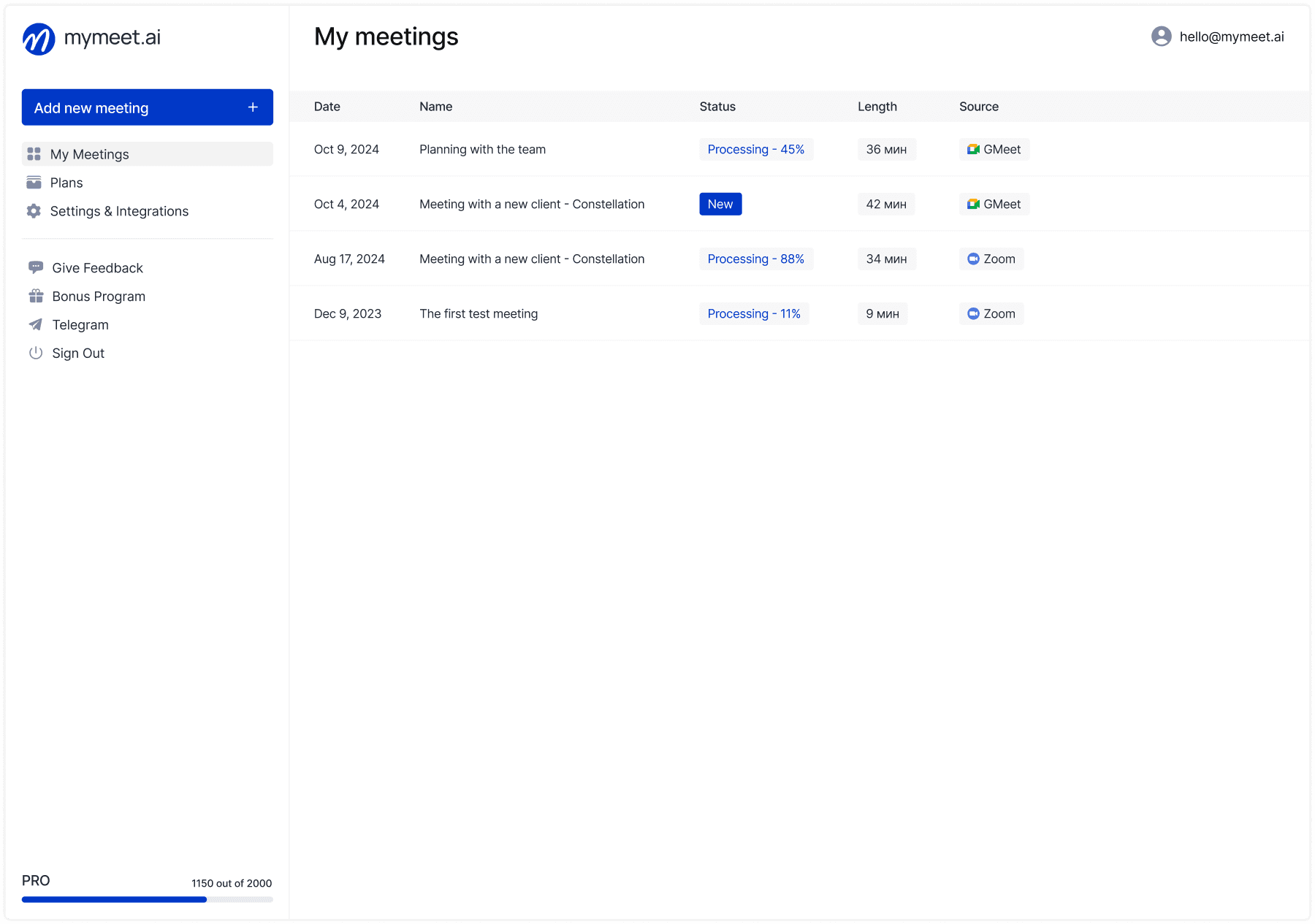
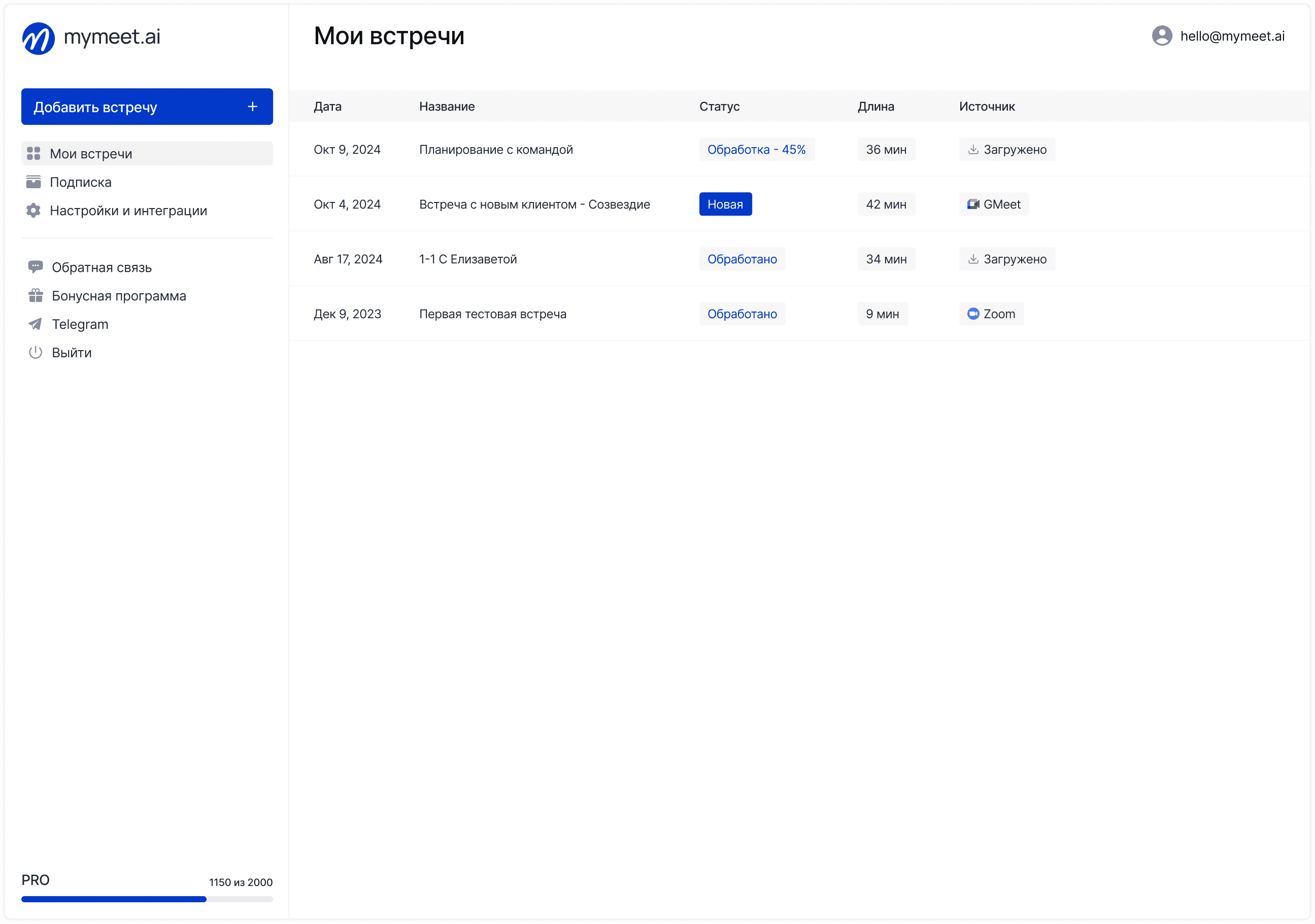
mymeet.ai automatically connects to focus groups in Zoom, Google Meet, Microsoft Teams, or Yandex.Telemost (Russian video conferencing service) through calendar integration and captures everything that happens. After the session ends, the dashboard shows a full transcript with participant separation and timestamps.
What mymeet.ai does automatically for focus groups:
✅ Session recording without manual activation through calendar integration
✅ 96-98% transcription accuracy with speaker separation
✅ Filler word cleanup and smart chapter division by topic
✅ "Research" report with key insights and quotes
✅ AI chat for finding specific moments across all session archives
✅ Export to DOCX, PDF, MD, JSON for further analysis
✅ Full compliance with Russian data protection law (152-FZ), data on servers in Russia
✅ 180 minutes free, no credit card required
Through AI chat you can ask questions about any recorded session's content: "What did participants say about pricing?", "Who expressed negative reactions to the second concept?", "What words did participants use to describe the problem?" This cuts quote-finding time from hours to minutes.
Case Study: How Researchers Save Time on Focus Group Transcription
A research team conducting a series of four focus groups for a product company spent an average of 5 hours transcribing each session. After connecting mymeet.ai, transcripts with participant separation appeared automatically within minutes after completion. The team spent 30 minutes on review and moved straight to analysis. Total project savings — over 18 hours.
How to Analyze Results and Create a Focus Group Report
Focus group analysis is the most labor-intensive research stage. Qualitative data isn't analyzed automatically: you need to read transcripts, identify patterns, group quotes, and formulate conclusions.
Transcription and Focus Group Data Coding
Coding is the process of assigning semantic labels to text fragments. Each utterance or part of an utterance is assigned a code describing what it's about. Codes are grouped into themes, themes become conclusions.
Focus group data analysis stages:
Get transcripts of all sessions with participant separation
Read all transcripts completely without making notes — to get an overall impression
Highlight significant fragments and assign codes
Group codes into themes and subthemes
Compare patterns between different groups if there were several
Formulate key findings with supporting quotes
Tables or specialized qualitative analysis tools work well for coding. The main rule: a quote without context proves nothing — always indicate who said it, at what point in the discussion, and how other participants reacted.
What Should Be in a Focus Group Report
A good focus group report isn't a transcript or a collection of quotes. It's a structured document that helps the client make specific decisions. The report should contain:
Executive summary on one page with main findings and recommendations
Methodology description: how many groups, participant profile, dates conducted
Main themes with key insights and supporting quotes
Comparison of reactions between different participant groups if applicable
Specific recommendations tied to the business objective
Appendix with full transcripts for detailed study
Comparison Table: Online vs Offline Focus Group
The choice between online and offline format depends on the task, budget, and target audience. Both formats provide quality data — the difference is in conduct conditions and group dynamics specifics.
Parameter | Online Focus Group | Offline Focus Group |
Cost | Lower — no venue, logistics | Higher — venue, catering, transport |
Geography | Participants from any city | Limited to one city |
Nonverbal cues | Limited — face only | Full — gestures, posture, expressions |
Group dynamics | Weaker due to screen | Stronger with live contact |
Recording & transcription | Easier to automate | Requires additional equipment |
Participant concentration | Lower — more distractions | Higher — isolated environment |
Optimal group size | 6-8 people | 8-10 people |
Stimulus materials | Screen sharing | Physical materials, products |
Online format wins on budget and geography. Offline provides richer group dynamics and works better when you need to show physical products or observe participant behavior in a real environment.
How to Choose Focus Group Format for Your Task
Simple rule: if participants are in different cities or the budget is limited — choose online. If you need to show a physical product, the topic requires very high trust between participants, or observing behavior in a real environment matters — offline will give richer results.
For most product and marketing research, online focus groups are the optimal choice. The difference in data quality is minimal, and time and budget savings are substantial. The key is compensating for online format weaknesses with good preparation: quality recruiting, detailed guide, technical run-through the day before, and an experienced moderator who knows how to work with group dynamics through a screen.
Conclusion
An online focus group is one of the most accessible ways to get quality feedback from a target audience before making important decisions. When properly organized, it provides a deep understanding of audience motivations, language, and reactions in 2-3 days instead of weeks of quantitative research.
Three things determine success: properly selected participants, a structured guide, and accurate capture of everything that happens during the session. mymeet.ai covers the last point automatically — first 180 minutes free without requiring a credit card.
Frequently Asked Questions About Online Focus Groups
What is a focus group and what is it used for?
A focus group is a structured group discussion with 6-10 participants led by a moderator. Used for testing advertising concepts, studying product perception, generating ideas, and understanding target audience language. Provides qualitative data that can't be obtained through surveys.
How many participants are needed for an online focus group?
Optimally 6-8 people. Fewer than 5 — not enough opinion diversity and weak group dynamics. More than 8 in online format — difficult to manage discussion, some participants drop out of the conversation.
How long does an online focus group last?
A standard session is 90 minutes. This is the maximum for online format: longer and participant concentration drops and data quality decreases. If there are many topics — better to conduct two shorter sessions than one drawn-out one.
How does an online focus group differ from offline?
Online is cheaper, allows gathering participants from different cities, and is easier to record. Offline provides richer group dynamics, full access to nonverbal signals, and works better with physical products. For most tasks, online format provides comparable data quality.
How do you recruit participants for an online focus group?
Through specialized recruiting agencies, your own customer database, social networks with targeting for the needed profile, or partner databases. Each participant goes through screening — a short survey confirming they match the target profile.
Should you record an online focus group?
Yes, mandatory. A moderator can't simultaneously lead a discussion and take detailed notes. Recording allows returning to participants' exact wording, finding needed quotes for the report, and sharing results with team members who weren't present at the session.
How do you automatically transcribe a focus group recording?
mymeet.ai automatically connects to sessions in Zoom, Google Meet, or Teams, records and transcribes speech with 96-98% accuracy, separates utterances by participant, and creates a structured report. This cuts transcription time from 4-6 hours to 30 minutes of review.
How do you analyze online focus group data?
Get the transcript, read it completely for overall impression, then code significant fragments with semantic labels. Group codes into themes, compare patterns between groups, and formulate conclusions with supporting quotes.
How many focus groups should be conducted for one study?
Minimum two to three groups with the same participant profile — to ensure patterns repeat rather than being random. If researching multiple audience segments — a separate group for each segment. Add groups until saturation occurs — new sessions don't bring new insights.
How do you format a focus group results report?
Executive summary with main findings, methodology description, main themes with insights and quotes, comparison between groups if there were several, specific recommendations for the business objective, and appendix with full transcripts. The report should help make decisions, not just describe what participants said
Ilya Berdysh