Meeting Tips

Radzivon Alkhovik
·
Updated on

Friday, 6:00 PM. The team just finished an hour-long call. Everyone's tired, no one really understood what was decided, three participants had no audio for the first ten minutes, and the only person taking notes already closed their laptop and left. On Monday, the same questions will be discussed all over again.
Hello! The mymeet.ai team works with thousands of business meetings every day and knows: most video conference problems repeat time after time — and each one can be fixed.
Why Video Conferences Consume Time But Don't Deliver Results
Online meetings have become the norm for most teams, but with them came a new problem: the number of meetings grows, but decision quality doesn't. People leave calls feeling like an hour was wasted, tasks are vague, and no one's been assigned responsibility.
The issue isn't the video call format itself. The issue is that most teams transferred offline habits to online without adaptation — and got all the downsides of both formats at once.
How Much Time Teams Waste on Ineffective Meetings
According to various studies, managers spend 35 to 50% of work time in meetings. A significant portion goes to calls without clear agendas, with unnecessary participants, and without documenting results. If a company has 10 people and each wastes 2 hours weekly on meetings that resolve nothing — that's 20 hours of lost time every week.
The problem isn't meeting quantity — sometimes you genuinely need many meetings. The problem is quality: a meeting without results is worse than no meeting at all, because it also demotivates the team.
How Online Meetings Differ from Offline and Why It Matters
In person, much information is conveyed nonverbally: people see each other's reactions, sense the overall energy level, more easily pick up on a colleague's idea. In video calls, this is almost absent. The camera cuts off body language, sound lags, gazes don't meet — and participants receive significantly fewer signals than in live communication.
This means online meetings require clearer structure, more explicit documentation of agreements, and more active moderation — precisely because informal coordination mechanisms don't work as well here.
Video Conference Preparation Mistakes
Most video conference problems are created before the call even starts. Three preparation-stage mistakes can ruin even a meeting with the most motivated participants.
Meetings Without an Agenda: Why This Is the Biggest Video Call Mistake
A meeting without an agenda is a conversation without purpose. Participants don't know why they've gathered, everyone arrives with their own expectations, and the meeting turns into a free exchange of opinions without concrete decisions.
A good agenda contains three elements: a list of specific questions for discussion, time allocated for each question, and the desired meeting outcome. The last point is especially important — the difference between "discuss marketing strategy" and "decide on three channels for Q3" is huge. The first ends with conversation, the second with a decision.
The agenda should be sent at least an hour before the meeting. Participants should arrive prepared, not learn the topic on the way.
Wrong Participant Mix on Video Calls
Only those needed for making specific decisions or whose expertise is necessary for discussion should be in the meeting. Everyone else is extra — wasting their time and reducing meeting effectiveness.
A simple test: if a person can only listen and doesn't influence the outcome — they don't need to be in the meeting. Send them the summary afterward. The optimal number of participants for a working meeting is 3-7 people. With more, some people inevitably drop out of the discussion.
A separate problem is inviting people "just in case" or out of politeness. This isn't respect for a colleague — it's wasting their work time.
Technical Problems That Can Be Avoided in Advance
Five minutes at the start of every call on "can you hear me?" — a classic waste of time that's easily avoided. Check your microphone, camera, and connection a few minutes before the start. If the meeting is important — do a test call the day before.
Separate points for regular video conference participants: keep your headset charged, check that your background isn't distracting, make sure computer notifications are turned off. An incoming email sound in the middle of an important discussion is a small thing, but such small things accumulate throughout the hour.
Mistakes During Video Conferences
Even a well-prepared meeting can go wrong if systematic errors are made during the call. Four of them occur especially often.
No Moderator and How It Kills Meeting Effectiveness
Without a moderator, a meeting becomes chaotic discussion: whoever speaks louder leads. Quiet participants stay silent, dominant ones derail the conversation, time runs out on the agenda, and half the questions aren't addressed.
A moderator doesn't have to be the leader. It can be any participant who takes on three functions: monitors the agenda and time, gives the floor to those who haven't spoken, documents agreements as the meeting progresses. The role can rotate among participants — this also develops facilitation skills in the team.
Parallel Conversations and Loss of Focus on Video Calls
In person, parallel conversations are immediately noticeable. Online, a person can quietly write emails, read news, or do other tasks — and no one sees. Result: half the participants are physically present but mentally absent.
Several techniques help maintain focus: turned-on cameras create a sense of presence and reduce the temptation to get distracted, specific questions to specific participants keep everyone alert, short meetings with clear agendas don't give time for distraction.
No Real-Time Documentation of Decisions and Tasks
Discussed — dispersed — forgot. The classic scenario of a meeting without minutes. Three days later it turns out everyone remembers different agreements, and who's responsible for what is unclear.
Three things need documenting: specific decisions with exact wording, tasks with assignees and deadlines, open questions that didn't get answers. This can be done manually during the meeting or automatically through specialized tools.
Video Calls That Are Too Long Without Structure and Breaks
Attention span on video calls drops faster than in live meetings — this is confirmed by research on cognitive load when working with screens. After 45-60 minutes, most participants no longer absorb information at the same level.
The rule is simple: a meeting longer than an hour requires a break or splitting into several shorter sessions. A meeting longer than two hours almost always means the agenda was created incorrectly or some questions can be resolved asynchronously.
Post-Video Conference Mistakes
What happens after the call determines the real value of the meeting. Three mistakes at this stage devalue even a productive discussion.
No Meeting Summary: Why Agreements Get Lost
A meeting without a summary document exists only in participants' memories — and memory is selective and unreliable. Everyone remembers what was personally important to them, details fade within hours, and a week later disputes begin: "did we really agree to that?"
Summaries need to be sent the same day — while information is fresh and before tasks start being executed based on someone's personal interpretation of the agreements. Minimum summary content: decisions made, task list with assignees and deadlines, open questions.
Tasks Assigned But No One Tracks Completion
Documenting a task in the summary is only the first step. If no one tracks completion, tasks pile up, deadlines are missed, and at the next meeting half the time goes to analyzing why nothing got done.
Good practice: at the start of every recurring meeting, go through tasks from the last one — this takes 5-10 minutes and creates a culture of accountability. People start completing tasks not because they fear punishment, but because they know: they'll be asked.
The Same Questions Discussed Over and Over
If the same topics return at every meeting — this is a symptom that decisions either aren't being made or aren't being executed. The team spends time on discussion instead of action.
There can be several causes: the decision was made unclearly and everyone understood it differently, no one was assigned responsibility, there was no deadline, or the task objectively got stuck and needs additional support. A good meeting archive with clear decision wording allows you to quickly find where exactly the chain broke.
Comparison Table: Mistake — Consequence — Solution
Twelve mistakes from different meeting stages are combined in one table for quick diagnosis. If any of these problems sound familiar — start with the corresponding solution: even one change noticeably improves meeting quality.
Mistake | Consequence | Solution |
No agenda | Meeting without results | Agenda with goal sent an hour before |
Extra participants | Team time wasted | Test: does the person influence the decision? |
Technical problems | First minutes lost | Equipment check in advance |
No moderator | Chaotic discussion | Assign a facilitator before the meeting |
Participant distractions | Half miss decisions | Cameras on, questions to specific people |
No decision documentation | Everyone remembers differently | Real-time minutes |
Call too long | Concentration lost | 60 minutes max, break if needed |
No meeting summary | Agreements lost | Summary sent same day |
No task tracking | Deadlines missed | Task review at start of next meeting |
Repeat discussions | Time wasted | Clear decision wording with assignees |
Wrong timing | Participants unprepared | Regular schedule with buffer |
No meeting recording | Details lost | Automatic recording via mymeet.ai |
How mymeet.ai Helps Avoid Video Conference Mistakes
Many of the listed mistakes are solved organizationally — with agendas, moderators, and a culture of task documentation. But some are easier to eliminate with tools: when routine is automated, the team has fewer opportunities for mistakes.
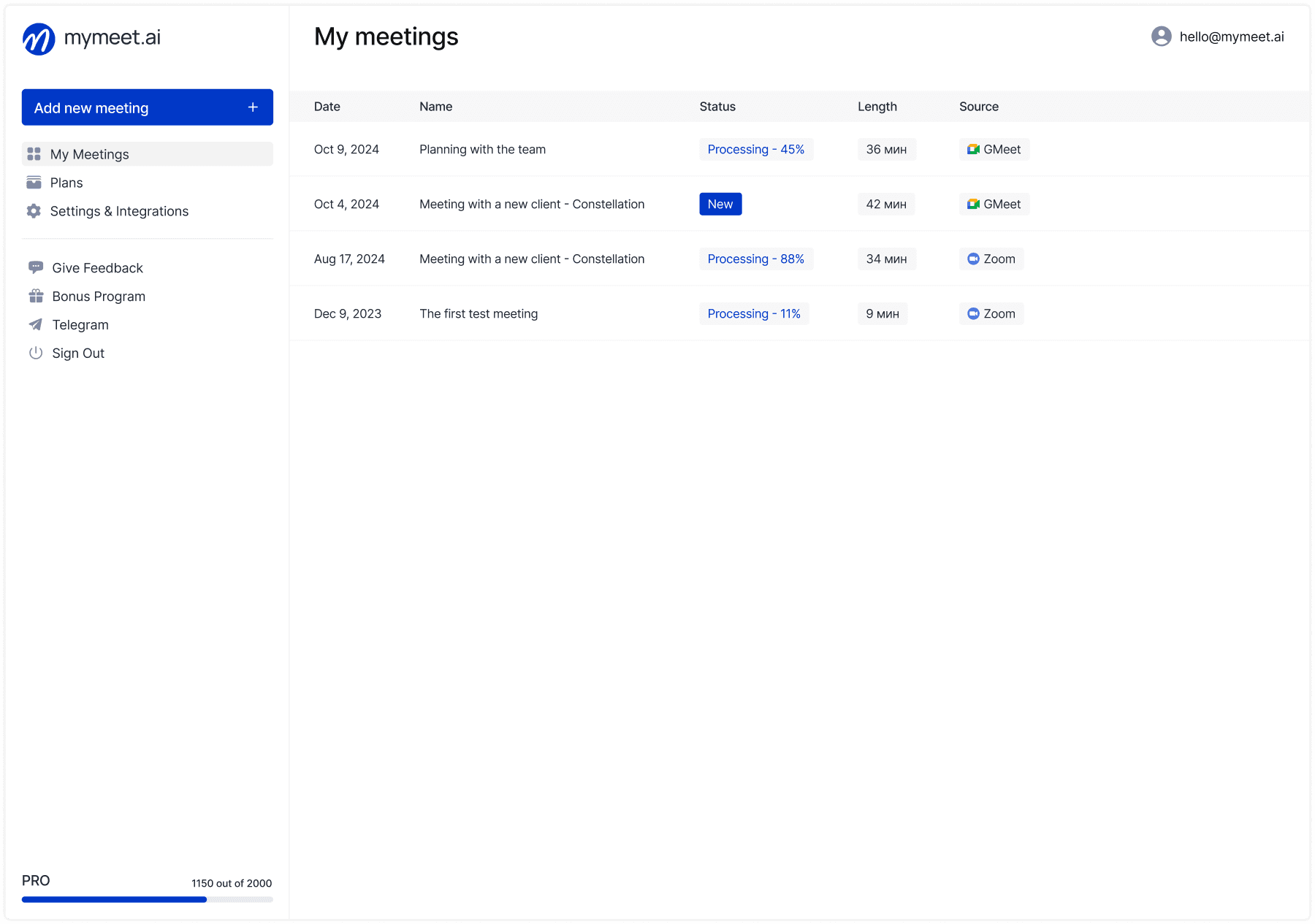
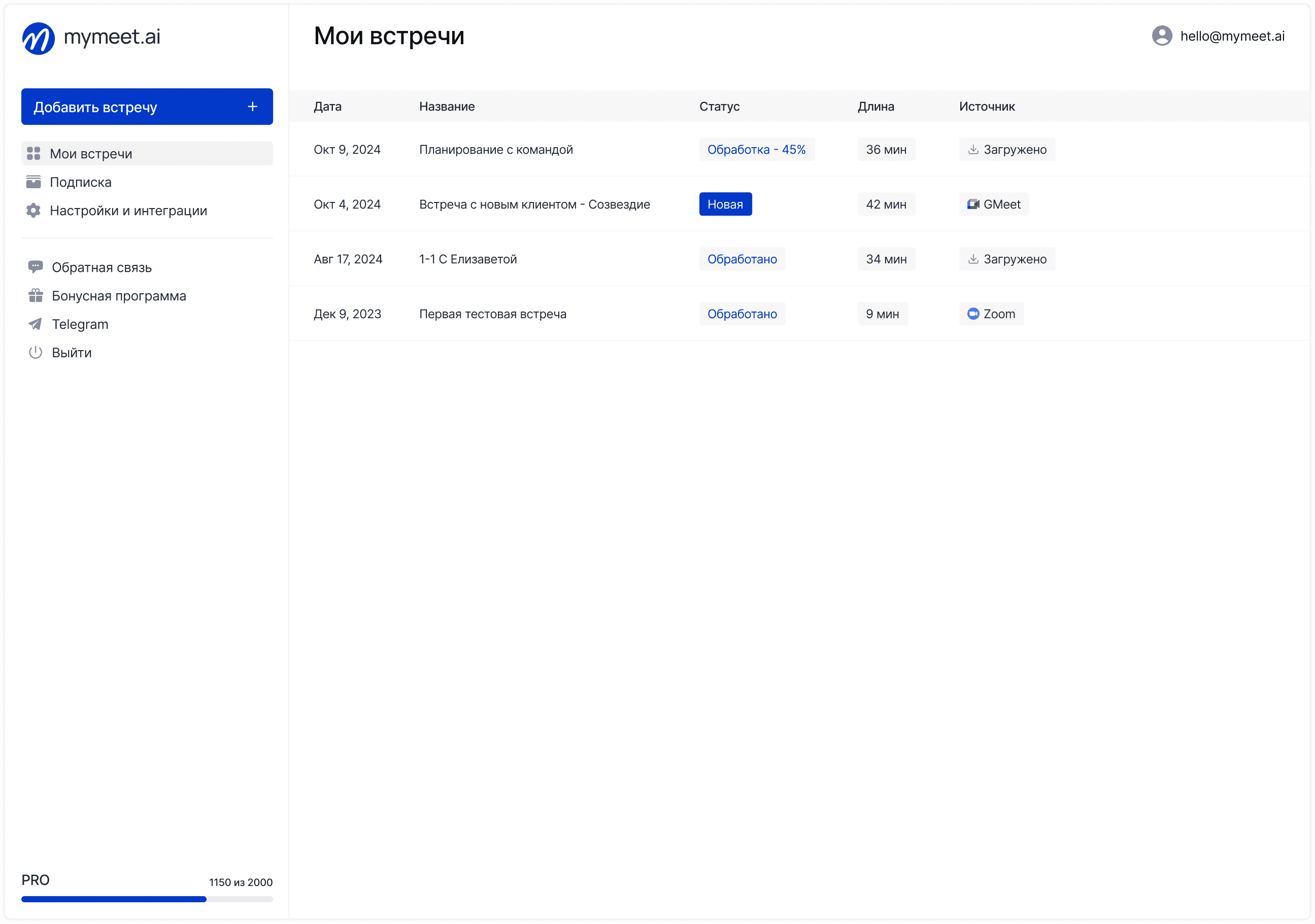
mymeet.ai connects to meetings in Zoom, Google Meet, Microsoft Teams, or Yandex.Telemost (Russian video conferencing service) through calendar integration and automatically records, transcribes, and analyzes the call. After the meeting, the dashboard shows a complete transcript with speaker separation, a structured report, and a task list with assignees and deadlines.
Case Study: How BigDigital Saved 50 Hours Monthly on Video Conferences
Digital agency BigDigital with a 40-person team was conducting over 80 meetings per month. Minutes were kept manually, a third of meetings ended without documented outcomes — there simply wasn't enough time or someone willing to take on that role. Tasks got lost, the same questions were discussed repeatedly.
After connecting mymeet.ai, summaries for every meeting started appearing automatically within minutes after the call ended. The team stopped spending time on manual documentation and gained a complete meeting archive with AI chat search capability. Savings totaled over 50 hours monthly on documentation alone.
✅ Automatic meeting recording in Zoom, Google Meet, Teams, Yandex.Telemost
✅ 96-98% transcription accuracy with speaker separation
✅ Automatic task extraction with assignees and deadlines
✅ 11 AI report formats for different meeting types
✅ AI chat for searching across all meeting archives
✅ Integration with amoCRM and Bitrix24 (popular CRM systems)
✅ 180 minutes free, no credit card required
When outcome documentation happens automatically, an entire class of mistakes disappears: no summaries, no tasks, repeated discussions of the same things. The team focuses on work, not documentation.
Conclusion
Most video conference mistakes aren't technical or accidental — they're systematic. Meetings go poorly for the same reasons: no agenda, no moderator, no documentation of results. Each can be eliminated organizationally — it's a matter of habits and agreements within the team.
Start with one or two changes, not all at once. Introduce a mandatory agenda an hour before the meeting — and this alone will noticeably change discussion quality. Add automatic outcome documentation — and half the tasks will stop getting lost. Gradually, good practices become the norm, and meetings transform from a source of exhaustion into a working tool.
Frequently Asked Questions About Video Conference Mistakes
Why are video conferences less effective than in-person meetings?
Online, nonverbal communication is lost, it's easier to get distracted, and harder to maintain shared focus. This requires clearer structure and more active moderation compared to live meetings.
What's the most common video call mistake?
No agenda. A meeting without a clear goal and question list almost always ends without concrete decisions — regardless of how experienced the participants are.
What's the optimal number of people for a video conference?
For a working meeting with decision-making, 3-7 people is optimal. With more, some participants inevitably drop out of discussion and attend only formally.
How do you document video conference outcomes quickly?
Either assign someone responsible for minutes before the meeting, or use automatic tools like mymeet.ai — the service generates a structured report with tasks within minutes after the call ends.
How do you combat participant distractions on video calls?
Cameras on, specific questions to specific participants, and short meetings with a packed agenda. The less "dead time" in the call, the less temptation to get distracted.
How often should you hold video conferences?
As often as needed to solve specific tasks — no more. A good criterion: if a meeting can be replaced by an email or async message without quality loss, the meeting isn't needed.
What do you do if meetings constantly run over time?
Assign a moderator with explicit authority to stop discussion when time runs out, limit the agenda to a realistic number of questions that can be covered in the allotted time, add a 10-15 minute buffer between meetings.
How do you avoid repeatedly discussing the same questions?
Clearly document decisions with specific wording, assign responsible parties with deadlines, and check task completion at the start of the next meeting. A past meeting archive helps quickly find when and what was decided.
Should video conferences be recorded?
Yes, if the meeting contains important decisions or agreements. Recording and transcript allow returning to exact wording, quickly bringing up to speed those who weren't present, and avoiding misunderstandings.
How do you implement good video conference practices in a team?
Start with one or two changes: mandatory agenda and outcome documentation. Hold a retrospective after several meetings, discussing what's working. Gradually add new practices — abrupt changes to everything at once rarely stick.
Radzivon Alkhovik