Meeting Tips

Radzivon Alkhovik
·
Updated on

A manager is meeting with a client. The client describes a problem while the manager is already mentally formulating a solution. Five minutes later, the client stops mid-sentence and asks: "Are you even listening to me?" The manager flinches — he really only listened to the first two sentences, then spent the rest of the time thinking about his response.
We hear words but don't listen to meaning. While someone speaks, we prepare counterarguments, check our phones, and think about our own affairs. Then we wonder why negotiations fall through, conflicts escalate, and teams don't understand tasks. The problem isn't that people explain poorly. The problem is that we've forgotten how to listen.
The mymeet.ai team works with business professionals who consciously develop active listening skills. This isn't an innate talent — it's a technique that can be learned and one that radically transforms communication quality.
What Is Active Listening
Active listening goes beyond simply perceiving words. It's a conscious process of fully immersing yourself in what the speaker is saying, aiming to understand not just the content but also emotions, intentions, and context.
Definition of Active Listening
Active listening is a communication technique where the listener fully concentrates on the speaker, understands the message, retains the information, and provides feedback demonstrating comprehension.
The word "active" is key — this isn't passive reception of sounds but active work. You ask clarifying questions, paraphrase what you've heard, reflect the speaker's emotions, and summarize key points. The speaker feels genuinely heard.
Three components of active listening:
Receiving information — hearing words without distortion
Processing information — understanding meaning and context
Confirming understanding — showing the speaker they've been heard
Difference Between Active and Passive Listening
Passive listening is mechanical perception of sounds without deep engagement. The person nods, looks in your direction, but their thoughts are elsewhere. A minute after the conversation, they don't remember what was discussed.
Active listening requires complete concentration on the speaker. You don't think about your response while the person is talking. You don't evaluate what you hear through the lens of your own experience. You simply listen with genuine desire to understand.
The difference is immediately apparent. With passive listening, speakers feel they're talking into a void. With active listening, they feel connection, understanding, and respect for their words.
Why Active Listening Matters in Business
Research shows that executives spend 70-80% of their work time on communication. Of this time, 45% is spent listening. But most people listen with only 25% effectiveness — three-quarters of information is lost.
Active listening solves concrete business problems. Clients feel understood and are more willing to buy. Employees receive clear tasks without misunderstandings. Conflicts resolve faster because each party feels heard.
In negotiations, active listening provides an advantage. While competitors talk non-stop, you listen and learn their true needs, fears, and motivations. This information becomes the foundation for an offer that's hard to refuse.
Principles of Active Listening
Techniques only work on a foundation of basic principles. Without an internal orientation toward understanding, any methods appear formulaic and fail to create connection.
Complete Attention to the Speaker
Remove all distractions before important conversations. Close your laptop, put your phone face down, disable notifications. Every glance at the screen signals to the speaker — you're not as important as these messages.
Look at the person, not the space beside them. Eye contact doesn't mean drilling into them without pause. Natural contact means looking at the speaker most of the time, occasionally looking away to process information.
Set aside your internal monologue. The main enemy of active listening is the voice in your head that comments on what you hear, prepares responses, evaluates. If you notice you've drifted into your thoughts — gently return to the speaker's words.
Understanding Without Judgment
Listen to understand, not to respond. The difference is enormous. When you listen to respond, you spend half your time preparing your arguments. When you listen to understand, you're completely open to information.
Suspend judgment while listening. Your task isn't to agree or refute but to understand the speaker's point of view. You can evaluate later, after you truly understand their position.
Feedback and Confirmation of Understanding
Give verbal signals of understanding — "uh-huh," "I see," "go on." These short sounds show you're following the thread of conversation. But don't overdo it — constant automatic "uh-huh" is as bad as silence.
Nonverbal feedback is sometimes more important than words. Nods, leaning toward the speaker, open posture, facial expression changes in response to emotional moments — all of this shows engagement.
Active Listening Techniques
Specific techniques transform the abstract principle of "listening attentively" into practical actions. Each technique serves its own purpose in the communication process.
Paraphrasing
Paraphrasing is restating what the speaker said in your own words. This isn't being a parrot that repeats verbatim. You formulate what you heard differently, showing you understood the meaning.
"If I understand correctly, you're saying that..." — the classic paraphrasing formula. Then you state the speaker's main idea in your own words. If you understand correctly, the speaker confirms. If not, they clarify, and you avoid misunderstanding.
Example of paraphrasing:
Client: "We need a solution that implements quickly and doesn't require training the entire team. We simply don't have time for lengthy setup."
Manager: "So your key criteria are launch speed and ease of use, so the team can start working without extensive training?"
Clarifying Questions
Open questions help speakers explore topics more deeply. "Tell me more," "What do you mean by...," "How did that look in practice?" — such questions invite detailed responses.
Closed questions clarify specific details. "Did this happen last month?" "Have you tried contacting support?" Use them sparingly — a series of closed questions turns dialogue into interrogation.
Don't ask questions when you're packaging your own thesis. "Don't you think the problem is that..." — this isn't a question, it's a veiled assertion. A genuine clarifying question is born from sincere desire to understand.
Reflecting Emotions
Name the emotion you see or hear from the speaker. "You seem upset," "I sense this situation angered you," "You're talking about this with enthusiasm."
Reflecting emotions doesn't mean agreeing with their position. You simply acknowledge the person's right to feel what they feel. This is a powerful tool for reducing tension in conflict conversations.
Be careful with interpretations. "You're upset" is safer than "You're upset because..." Name the observed emotion, don't make up the reasons.
Summarizing
Summarizing helps structure long conversations. After 15-20 minutes of discussion covering multiple topics, it's useful to provide an interim recap. "Let me summarize what we've discussed so far..."
At the end of a meeting, summarizing is mandatory. List key points, agreements, and next steps. This ensures both parties understand the conversation's outcomes the same way.
Nonverbal Signals of Attention
Body language speaks louder than words. You can repeat all the right phrases, but if you're sitting leaned back with crossed arms and a wandering gaze — the speaker sees lack of interest.
Open posture — body turned toward the speaker, arms uncrossed, slight forward lean. Head nods at key moments. Facial expressions matching the content — serious when discussing problems, smiling at positive moments.
Active listening techniques with examples:
Technique | When to Use | Example Phrase | Effect |
Paraphrasing | After an important point | "If I understand correctly, you're saying..." | Confirms understanding |
Clarifying questions | When information is incomplete | "Tell me more about..." | Deepens understanding |
Reflecting emotions | During emotional storytelling | "I see this upset you" | Creates empathy |
Summarizing | After a long story | "Let me summarize..." | Structures information |
Silence | After a question or statement | (3-5 second pause) | Space for thought |
Methods for Developing Active Listening Skills
Active listening is a skill trained through practice. Knowing techniques doesn't make you a good listener — you need deliberate training.
Exercises for Training Attention
"Retelling" exercise. After a conversation with a colleague, spend a minute mentally retelling the main points of the discussion. What did the person say? What arguments did they make? What emotions did they express? If you can't remember — you weren't listening attentively enough.
"No response preparation" exercise. In your next conversation, consciously forbid yourself from thinking about your response while the speaker talks. Just listen. Only formulate your answer after the person finishes. You'll notice how difficult it is to resist internal monologue.
Practicing Mindful Listening
Choose one meeting per day for 100% active listening practice. Don't try to listen actively for all 8 hours — you'll burn out. One meeting where you consciously apply all techniques.
Record your meetings (with participants' consent) and periodically review them. You'll see yourself from the outside — how often you interrupt, when you get distracted, what nonverbal signals you send. Recording is a mirror that doesn't lie.
Working with Internal Dialogue
The internal commentator is active listening's main enemy. The voice in your head that constantly evaluates: "that's stupid," "I would have done it differently," "they're wrong," "I need to object." This voice interferes with listening.
Notice-without-judgment technique. When you catch yourself in an internal monologue, simply notice it without self-criticism. "Aha, I drifted into my thoughts." Then gently return attention to the speaker's words. Don't berate yourself — it's normal for attention to wander. What matters is bringing it back.
Barriers to Active Listening
Understanding what interferes with listening helps you consciously eliminate obstacles. Barriers can be internal and external.
Internal Barriers (Biases, Response Preparation)
Biases filter information. If you've already decided the speaker is wrong, you only hear what confirms your position. You miss everything else.
Preparing responses while listening is a widespread problem. The person speaks while you're already formulating counterarguments. You lose half the information because your attention resources are split between listening and generating a response.
Emotional triggers block listening. The speaker said a word or phrase that hit a nerve — and that's it, you're no longer listening, just processing your internal reaction to the trigger.
External Barriers (Distractions, Multitasking)
The phone is active listening killer number one. Even a phone lying face-up on the table reduces communication quality. The brain periodically gets distracted checking if something important has arrived.
Multitasking is impossible for deep listening. You can listen to music and wash dishes simultaneously. You cannot actively listen to a speaker and check email. The brain switches between tasks, losing information with each switch.
Environments with distractions destroy concentration. A noisy open office, people moving around behind the speaker, loud music — all of this interferes with focus on the conversation.
How to Overcome Barriers
Create physical conditions for listening. Close the meeting room door, put away your phone, close your laptop. If the conversation is online — close all browser tabs except the video call, disable notifications.
Acknowledge your biases before conversations. "I tend to disagree with this person. Now I'll listen with an open mind to understand their position." Awareness of bias reduces its influence.
Active Listening in Different Contexts
Basic principles are the same, but technique application differs depending on the situation. Active listening in negotiations looks different than in a 1-on-1 meeting with an employee.
In Client Negotiations
Listen more than you talk in early negotiation stages. The 70/30 rule — the client speaks 70% of the time, you 30%. The more clients share, the more information you get about their needs, fears, and decision criteria.
Reflect the client's words in your proposal. If the client said "we need reliability," use that word in your solution presentation. "Our solution ensures reliability through..." People buy from those who understand them.
In Team Management
1-on-1 meetings require maximum active listening. This is the employee's time, not the manager's time for lectures. Ask questions, listen to answers, clarify, summarize. The employee should leave feeling heard.
In team conflicts, active listening is often the only resolution method. Let each side speak completely. Reflect emotions from both sides. Summarize each person's position. Often conflicts resolve simply because people feel heard.
In Interviews
The interviewer should listen 80% of the time. Your task is to evaluate the candidate, not talk about yourself. Asked a question — stay silent and listen to the full answer. Don't interrupt, even if the candidate thinks for a long time.
Listen not just to the answer but how the person thinks. Do they structure their response? Do they give specific examples or speak in generalities? This provides more information than just whether the answer is correct.
In Conflict Situations
Active listening de-escalates conflict. When someone is angry, the first thing needed is to let them vent. Don't justify yourself, don't argue, just listen. After the emotion is released, you can move to constructive dialogue.
Reflecting emotions is especially important in conflict. "I see this situation really upset you" — this phrase doesn't mean agreeing with the person's position. It acknowledges their right to the emotion. Often that's enough for the person to calm down.
mymeet.ai for Developing Active Listening Skills
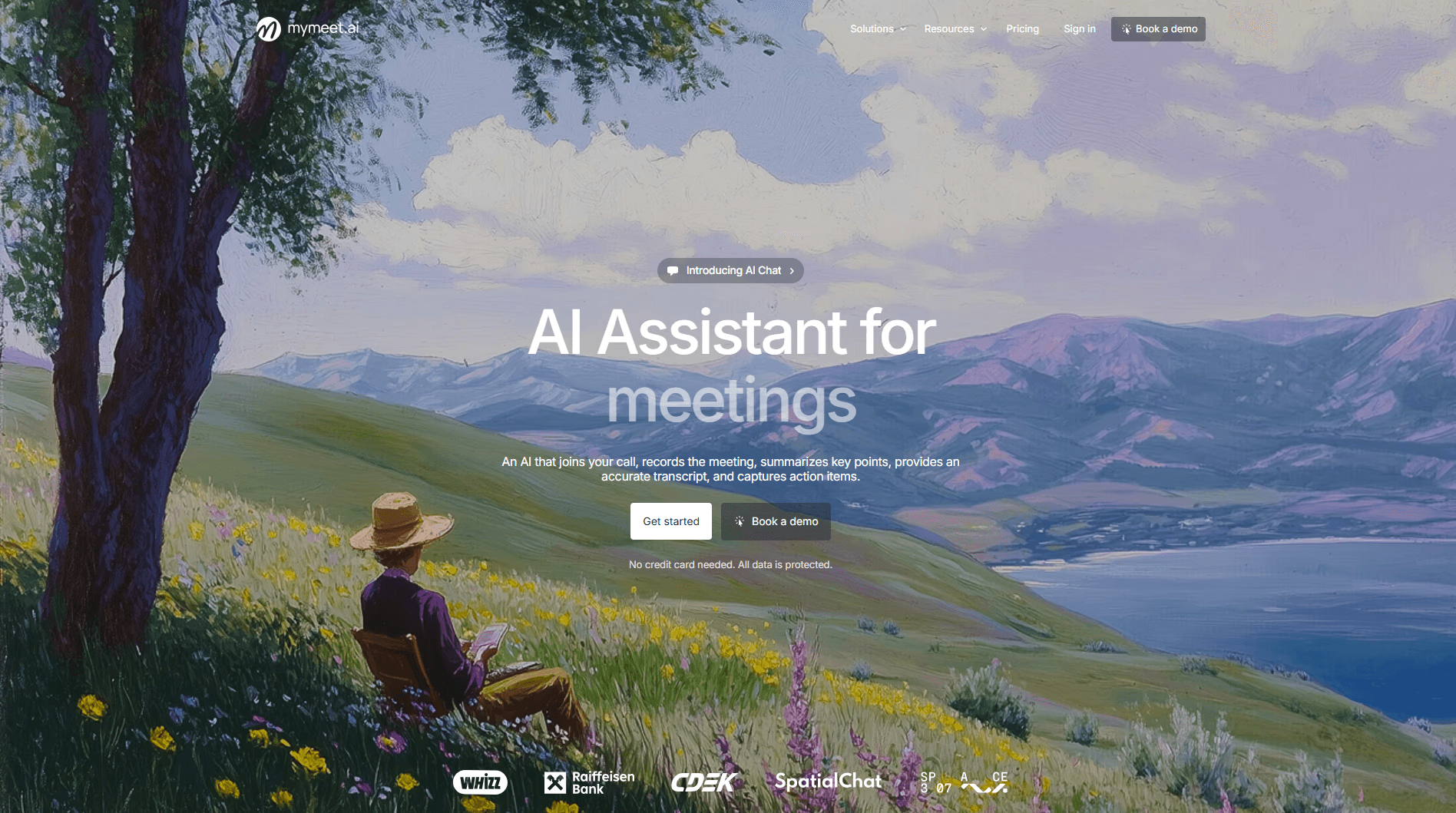
The paradox of developing listening skills — it's hard to assess your own progress. You don't hear yourself from the outside, you don't notice moments when you got distracted or interrupted. Self-assessment is subjective and often inflated.
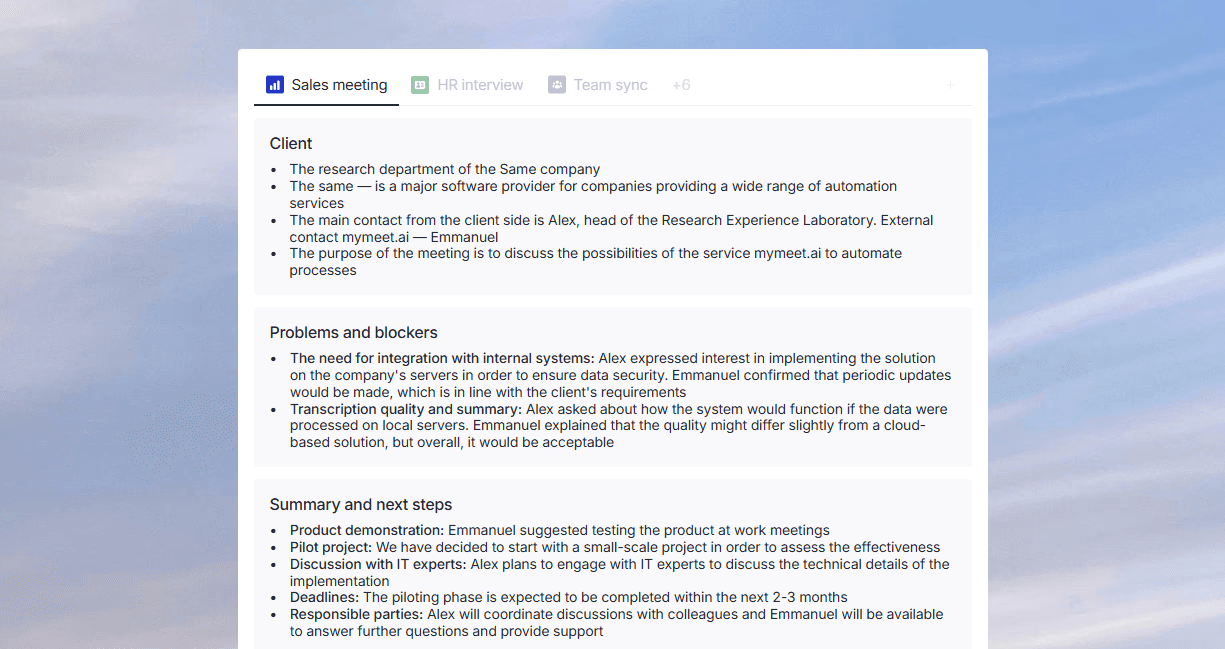
mymeet.ai capabilities for developing active listening:
✅ Meeting transcripts show the real picture — how often you interrupted, how much time you spoke vs listened, whether you asked clarifying questions
✅ Communication pattern analysis — AI identifies typical listening errors that repeat from meeting to meeting
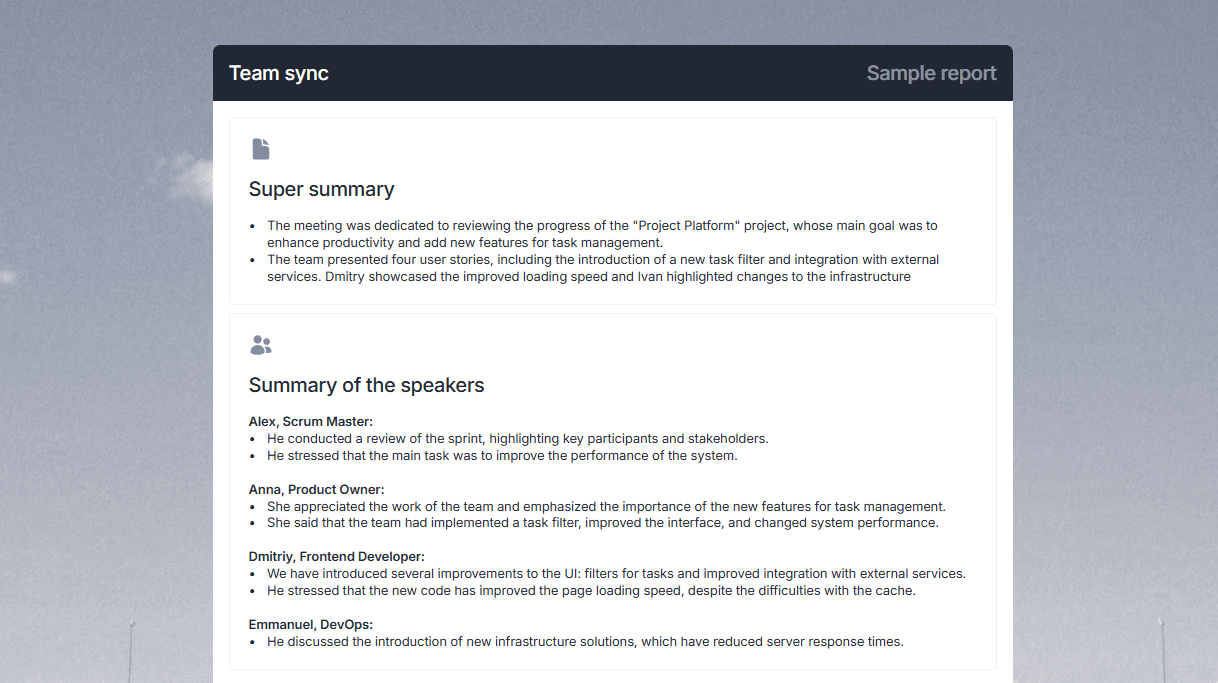
✅ Understanding verification through AI questions — after a meeting, you can ask the system about details that were discussed and check how well you listened
✅ Comparing versions of events — if there are multiple meeting participants, you can compare how each remembers the discussion and see discrepancies due to poor listening
✅ Recording promises and agreements — the system finds all commitments in the conversation, showing what you missed while listening
✅ Feedback on question quality — analysis shows whether you asked open clarifying questions or only closed ones
✅ Training through re-listening — you can return to the recording and hear what you missed during the live conversation
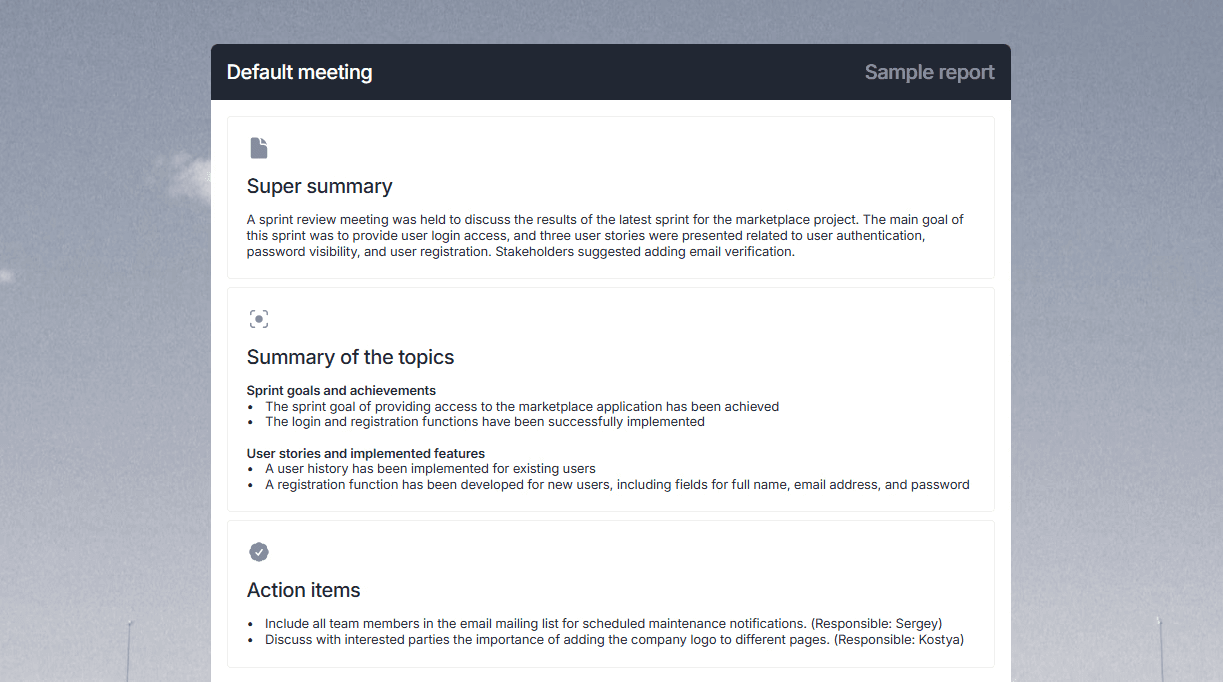
✅ Progress metrics — tracking how your speaking/listening ratio changes from meeting to meeting
Case Study: How a Manager Uses Transcripts to Analyze Their Listening
A product team manager conducted client meetings to gather feedback. After implementing mymeet.ai, he started receiving transcripts of every meeting and noticed a pattern — he interrupted clients every 2 minutes on average.
Transcript analysis revealed the problem. When clients started describing a problem, the manager immediately offered solutions without listening to the end. As a result, proposed solutions often missed the mark because the real problem was deeper than the first mentioned symptom.
After recognizing the pattern, the manager consciously trained the silence technique — let the client finish completely, then ask a clarifying question, and only then offer a solution. Two months later, transcripts showed change — clients' uninterrupted speaking time tripled, and the quality of collected feedback improved significantly.
Examples of Active Listening in Business Situations
Abstract techniques become clearer through concrete application examples. Let's see how active listening works in real situations.
Example 1: Meeting with an Unhappy Client
Situation: A client calls furious — the service hasn't worked for three days, project deadline is at risk.
Poor listening: "Yes, I understand, but we can't... We have problems too... Other clients aren't complaining..."
Active listening: "Tell me more about what exactly isn't working? (clarifying question) ...I understand, the situation is really critical, you have a deadline the day after tomorrow (reflection). Do I understand correctly — the main thing now is to restore data access, and other features can wait? (paraphrasing) ...Okay, here's what we'll do right now..."
The difference — in the second case, the client feels heard. Even if the problem isn't solved instantly, irritation levels decrease.
Example 2: Employee Feedback
Situation: An employee has been late with tasks for three sprints in a row.
Poor listening: "You're constantly late. You need to plan your time better. Let's in the next sprint..."
Active listening: "I noticed tasks have been closing later than planned for several sprints. Tell me what's happening? (open question) ...I understand, tasks turn out to be more complex than they seemed during planning (paraphrasing). What prevents you from asking for help when you realize you won't make it? (clarification) ...So you don't want to look incompetent to the team (reflecting emotion)? Let's discuss how we can change the process..."
In the second version, you learn the real cause of the problem, not just deliver a lecture.
Example 3: Deal Negotiations
Situation: A potential client doubts whether your solution is right for them.
Poor listening: "Our product is the best on the market. We have all the features you need..."
Active listening: "What's most important to you in a solution? (open question) ...Reliability and ease of implementation (summary). And what do you specifically mean by reliability? (clarification) ...So critical uptime of 99.9% and fast support when problems arise (paraphrasing)? Tell me about your current process — how do you solve this task now? (deepening understanding)"
You're not selling, you're listening and understanding. The sale happens later, when you know exactly what the client needs.
Mistakes in Active Listening
Even knowing techniques, it's easy to fall into typical errors. Awareness of these traps helps avoid them.
Interrupting the Speaker
Interrupting is the most obvious and frequent mistake. The person hasn't finished their thought, and you're already inserting yours. Even if your comment is valuable, interrupting breaks the narrative thread and shows disrespect.
Sometimes impatience to interrupt comes from already understanding where the speaker is heading. You think you know what they'll say next and want to speed things up. Don't do this. Often speakers go somewhere completely different than you thought. Let them finish.
Formal Phrases Without Understanding
Automatic "uh-huh" and "I see" without real listening creates an illusion of attention. Speakers sense the falseness. It's better to honestly say "sorry, I got distracted, please repeat" than create the appearance of understanding.
Paraphrasing for show doesn't work either. "Yeah-yeah, you said blah-blah-blah" (verbatim repetition) — this isn't paraphrasing. You need to reformulate in your own words, showing understanding of meaning, not just recorded words.
Advice Given Too Quickly
"I know what you should do" after 30 seconds of hearing about a problem — classic poor listening. Perhaps your advice is truly good. But the person came not just for advice — they need to be heard.
Let the person finish, ask clarifying questions, show you understand the problem in all its depth. Only then offer solutions. Often by that point, the person finds the answer themselves in the process of articulating it.
Focus on Yourself Instead of the Speaker
"Oh, I had the same story..." and then 10 minutes about yourself. This isn't active listening, it's topic hijacking. A short story to create empathy — fine. A detailed story after which you've forgotten what the speaker originally said — bad.
Filtering through your own experience is also a problem. "In your place, I would..." — you're not in their place. You have different experience, personality, resources. Listen to the person's position, don't automatically project onto yourself.
How to Measure Progress in Active Listening
Skill development requires feedback. Without measurement, it's hard to know if you're improving or standing still.
Self-Assessment
After important conversations, ask yourself questions. How many times did I interrupt? What percentage of time did I speak vs listen? Can I retell the speaker's main points? What emotions did they express? If you can't answer these questions — you listened poorly.
Keep a listening journal for at least a week. After each important meeting, record your listening assessment on a scale of 1-10 and specific moments where you got distracted or interrupted. After a week, you'll see patterns.
Feedback from Colleagues
Ask colleagues for feedback on your listening style. "Do you feel I listen to you in our meetings? Are there moments when it seems like I'm distracted?" Be prepared to hear the truth.
Record meetings and ask a colleague to watch a segment. Have them point out moments where your listening was especially good or, conversely, where you failed. An external view notices what you don't see yourself.
Communication Results
Improved listening yields measurable results. Conflicts resolve faster. Tasks get done right the first time because there's no misunderstanding. Clients agree to proposals more often. The team feels greater engagement.
Track indirect metrics — how many times in the last month did a task need redoing because requirements were misunderstood? How many conflict situations were resolved through conversation? How has the atmosphere changed in 1-on-1 meetings?
Conclusion
Active listening isn't an innate talent or a soft skill that can be ignored. It's a concrete technique that directly impacts career, team effectiveness, sales quality, and conflict resolution.
Start small — choose one technique (for example, paraphrasing) and practice it for a week in every important conversation. Then add the next one. After a month of deliberate practice, you'll notice changes — people share information more willingly, conflicts resolve more easily, your influence grows.
Ready to develop active listening skills systematically? Try mymeet.ai free — 180 minutes of meeting processing without credit card. Get transcripts of your conversations and analyze communication patterns for targeted skill improvement.
FAQ
What is active listening in simple terms?
Active listening is when you don't just hear words but fully concentrate on the speaker, understand meaning and emotions, ask clarifying questions, and show you've genuinely heard them. It's the opposite of "nodding while thinking about your own stuff."
How does active listening differ from regular listening?
With regular listening, you mechanically perceive sounds, often distracted by your own thoughts. With active listening, you're fully engaged, don't prepare responses while the speaker talks, and provide feedback through clarifications and paraphrasing. Speakers feel the difference immediately.
What are the main active listening techniques?
Five key techniques — paraphrasing (restating what you heard in your own words), clarifying questions, reflecting the speaker's emotions, summarizing long stories, and nonverbal attention signals (nods, eye contact, open posture). Each technique serves its own purpose in communication.
How do you develop active listening skills?
Start with one technique and practice it consciously for a week. Record meetings and analyze — how much time you spent speaking vs listening, how often you interrupted. Train the "no response preparation" exercise — forbid yourself from thinking about your answer while the speaker talks. Ask colleagues for feedback on your listening style.
What exercises help train active listening?
The "Retelling" exercise — after a conversation, mentally retell the main points. The "No response preparation" exercise — consciously don't think about your answer while listening. Recording and analyzing your own meetings. Practicing one meeting per day at 100% active listening instead of trying to always listen actively.
What interferes with actively listening to a speaker?
Internal barriers — biases, preparing responses while listening, emotional triggers. External barriers — phone, multitasking, noisy environment. The main enemy is the internal commentator who constantly evaluates what's heard instead of simply receiving information.
How do you apply active listening in negotiations?
Listen more than you talk in early stages (the 70/30 rule). Ask open questions about the client's needs. Reflect their words in your proposal. Don't rush to solutions until you fully understand the problem. The more the client talks, the more information you have for a precise offer.
Can active listening be used in online meetings?
Yes, and it's even more important than in in-person meetings. Online has more distractions and it's harder to read nonverbal signals. Close all unnecessary tabs, look at the camera during important moments, give more verbal feedback ("I see," "go on"), paraphrase more often to confirm understanding through the screen.
How can you tell if someone is really listening to you?
The listener asks clarifying questions about your story. They paraphrase what they heard, showing understanding. They don't interrupt and let you finish. They're nonverbally engaged — looking at you, nodding, facial reactions to emotional moments. After the conversation, they remember details and can accurately reproduce your position.
How long does it take to develop active listening skills?
Basic improvements are noticeable after 2-3 weeks of conscious practice. Forming a sustainable habit takes 2-3 months of regular technique application. But this is a skill that develops throughout life — there's always room to grow. The main thing is to start practicing consciously rather than waiting for the moment when you've "learned all the techniques."
Radzivon Alkhovik