Meeting Tips

Radzivon Alkhovik

A team of five developers gathers to discuss architecture for a new module. The manager isn't there—he's on vacation. The meeting lasts two hours, discussion is active, but at the end no one can clearly formulate what was decided. A week later it turns out each person started doing it their own way because there was no unified understanding of agreements.
The problem isn't the manager's absence—the problem is the team doesn't know how to organize meetings independently and document results. In modern teams practicing self-organization, the ability to conduct effective meetings without an external moderator becomes a critical skill.
Let's break down how to organize productive meetings in self-organizing teams, what roles and protocols are needed, how to properly document results so agreements aren't lost.
What Are Self-Organizing Teams
A self-organizing team is a group of specialists who independently plan work, make decisions, and coordinate actions without constant manager oversight.
Signs of Self-Organization
Team plans independently how to execute tasks and distributes work among participants.
Makes decisions on technical and process questions without escalating every issue to leadership.
Coordinates actions through regular meetings that participants organize themselves.
Bears collective responsibility for results, not shifting to manager.
Why This Matters
Decision speed — no need to wait for manager for every question, team decides on the spot.
Engagement — when people make decisions themselves, they're more engaged in results.
Resilience — team isn't paralyzed if manager is on vacation or unavailable.
Specialist growth — develop planning, decision-making, communication skills.
Self-Organization Challenges
Lack of structure — without moderator, meetings can turn into chaos.
Active participant dominance — those who speak louder control discussion.
Lost agreements — without capturing decisions, everyone remembers differently.
Conflicts — harder to resolve without neutral moderator.
Blurred responsibility — if everyone's responsible, no one's responsible.
Key Principles for Meetings Without Manager
For self-organizing team meetings to be effective, clear principles and protocols are needed.
Principle 1: Clear Meeting Goal
Without a manager setting the agenda, team must determine why they're gathering.
Before meeting, someone formulates:
What specifically we're discussing
What result should be at the end
Who should be present
Bad: "Gathering to discuss project"
Good: "Make decision on authorization module architecture—choose one of three options"
Principle 2: Role Rotation
Don't need permanent leader but roles must be distributed at each meeting.
Key roles:
Moderator — monitors discussion structure, gives floor to participants, keeps on topic
Timekeeper — tracks time, warns when block is ending
Documenter — captures decisions, tasks, agreements
Roles alternate between meetings to develop all participants' skills and not create dependence on one person.
Principle 3: Capturing All Decisions
Most common problem for teams without manager—lost agreements.
Must document:
What decisions were made
What tasks assigned and to whom
What questions remained open
When next meeting
Format doesn't matter (document, task tracker, chat), main thing is it's captured and accessible to all.
Principle 4: Equal Participation
Without moderator, easy to slide into situation where 2-3 people speak 80% of time.
Techniques for equal participation:
"Round-robin" format where each speaks
Direct questions to quiet participants
"One speaks—others listen" rule
Time limit per statement
Principle 5: Time Frames
Without manager tracking time, meetings stretch for hours.
Mandatory:
Total meeting time (maximum 60-90 minutes)
Time for each discussion block
Timekeeper who strictly stops
Roles at Self-Organizing Team Meeting
Role distribution is critical for structured meetings without manager.
Meeting Moderator
Responsibility:
Monitors structure and agenda — keeps discussion on topic
Manages speaking order — gives floor to participants
Engages silent participants — asks those who haven't spoken
Summarizes interim results of each block
Ensures discussion rules are followed
Important: Moderator doesn't dominate content-wise, only manages process. Their opinion isn't more important than others.
How selected: Rotation between meetings. This week moderator is Alexey, next week Maria, then Dmitry.
Timekeeper
Responsibility:
Tracks overall meeting time and time for each block
Warns 2-3 minutes before block ends
Strictly stops discussion when time expires
Helps team not drag out meeting
Why separate role: Moderator busy managing discussion, hard to simultaneously track time.
Tools: Timer on screen visible to all, phone app, online timer.
Documenter
Responsibility:
Captures key decisions in real-time
Records tasks with owners and deadlines
Notes open questions not resolved
After meeting, formats and sends summary to team
Important: Not protocol of every phrase, but key agreements.
Alternative: Automatic recording through mymeet.ai instead of manual capture.
All Participants
Each person's responsibility:
Come prepared if preparation needed
Actively participate in discussion
Respect others' time—don't go into details
Take specific tasks on themselves
Follow agreements after meeting
Protocol for Conducting Meeting Without Manager
Clear protocol helps structure meeting without external moderator.
Before Meeting (24 hours minimum)
Someone from team (meeting initiator):
Creates agenda with topics and time frames
Specifies meeting goal and expected result
Assigns roles (moderator, timekeeper, documenter) or reminds whose turn
Sends invitation with agenda to all participants
Attaches materials if preparation needed
Meeting Start (5 minutes)
Moderator:
Reminds meeting goal and expected result
Goes through agenda and time frames
Confirms roles (who's timekeeper, who documents)
Establishes discussion rules (one speaks, round-robin, signals for floor)
Checks readiness—does everyone understand what we're discussing
Main Part (by agenda blocks)
For each block:
Moderator announces topic and discussion time (e.g., "15 minutes to discuss architecture options")
Timekeeper starts timer
Team discusses topic using chosen format (free discussion, round-robin, brainstorm)
Moderator manages order, returns to topic if veered off
Timekeeper warns 2 minutes before end
Moderator summarizes block result—what decided or identified
Documenter captures decision
Meeting Conclusion (10 minutes)
Moderator:
Summarizes all key decisions made at meeting
Goes through task list—who, what, when
Captures open questions not resolved
Agrees on next meeting if needed
Thanks team and concludes
Documenter: Formats and sends summary to all participants within 2 hours after meeting.
Discussion Formats for Different Tasks
Different types of questions require different discussion formats.
Making Technical Decisions
Format: Structured discussion
How it goes:
Problem and context presentation (5 min)
Solution options presentation with pros and cons (10 min)
Open discussion—questions, risks, additions (20 min)
Each states their position round-robin (10 min)
Voting or consensus—option selection (5 min)
Total: 50 minutes
Brainstorming
Format: Idea generation + grouping
How it goes:
Silent phase—each silently writes ideas 10 minutes
Idea presentation—each presents their top 3 without discussion (10 min)
Grouping similar ideas (5 min)
Discussing most promising directions (15 min)
Voting for top 3 ideas for development (5 min)
Total: 45 minutes
Daily Synchronization
Format: Quick round-robin status
How it goes:
Each participant 2 minutes answers questions:
What I did yesterday
What I plan today
Are there blockers
Blocker discussion if any (5 min)
Coordination if needed (5 min)
Total: 15-20 minutes for 5-6 person team
Conflict Resolution
Format: Structured dialogue
How it goes:
Each side presents their position without interruption (5 min each)
Questions for understanding positions (10 min)
Finding common interests and goals (10 min)
Generating solution options (10 min)
Choosing solution satisfying both sides (5 min)
Total: 40 minutes
Important: In conflicts, moderator must be maximally neutral.
Documenting Meetings Without Manager
Without capturing results, meetings lose meaning.
What Must Be Documented
Minimum set:
Date, participants, meeting goal
Decisions made with rationale
Assigned tasks (who, what, deadline)
Open questions requiring further discussion
Next meeting date if scheduled
Not needed: Detailed protocol of every remark—waste of time.
Documentation Formats
Option 1: Structured document
Option 2: Task cards in tracker
Create task for each decision or action. In task description, indicate context from meeting. Link to meeting added in comment.
Option 3: Team chat message
For quick meetings, can send structured message:
When to Send Documentation
Ideal: Within 2 hours after meeting while everything fresh.
Maximum: By end of work day on meeting day.
Critical: Don't postpone to next day—details will be forgotten.
Recording and Automatic Meeting Transcription
Manual capture distracts one participant from discussion. Automation solves problem.
What Is mymeet.ai
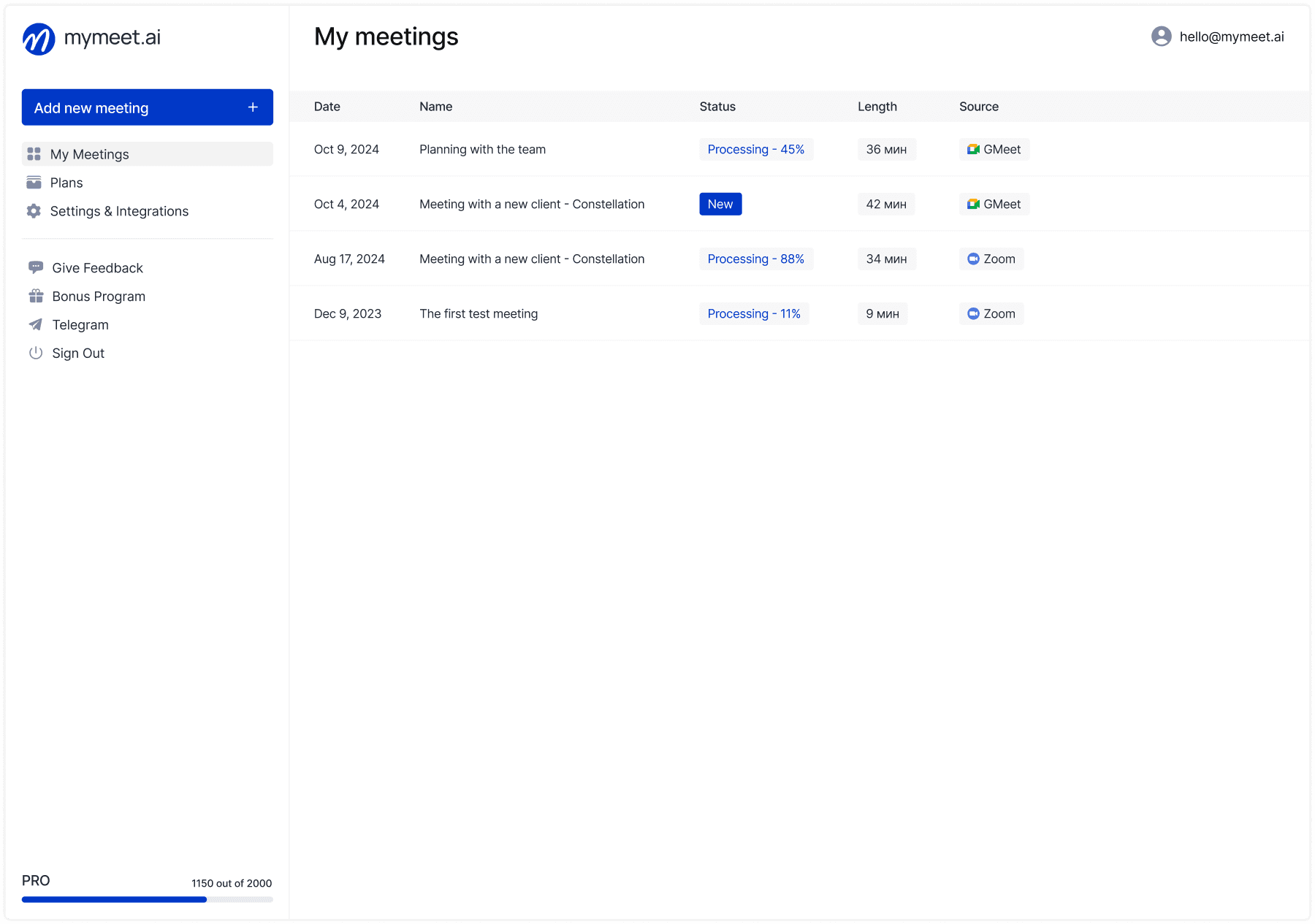
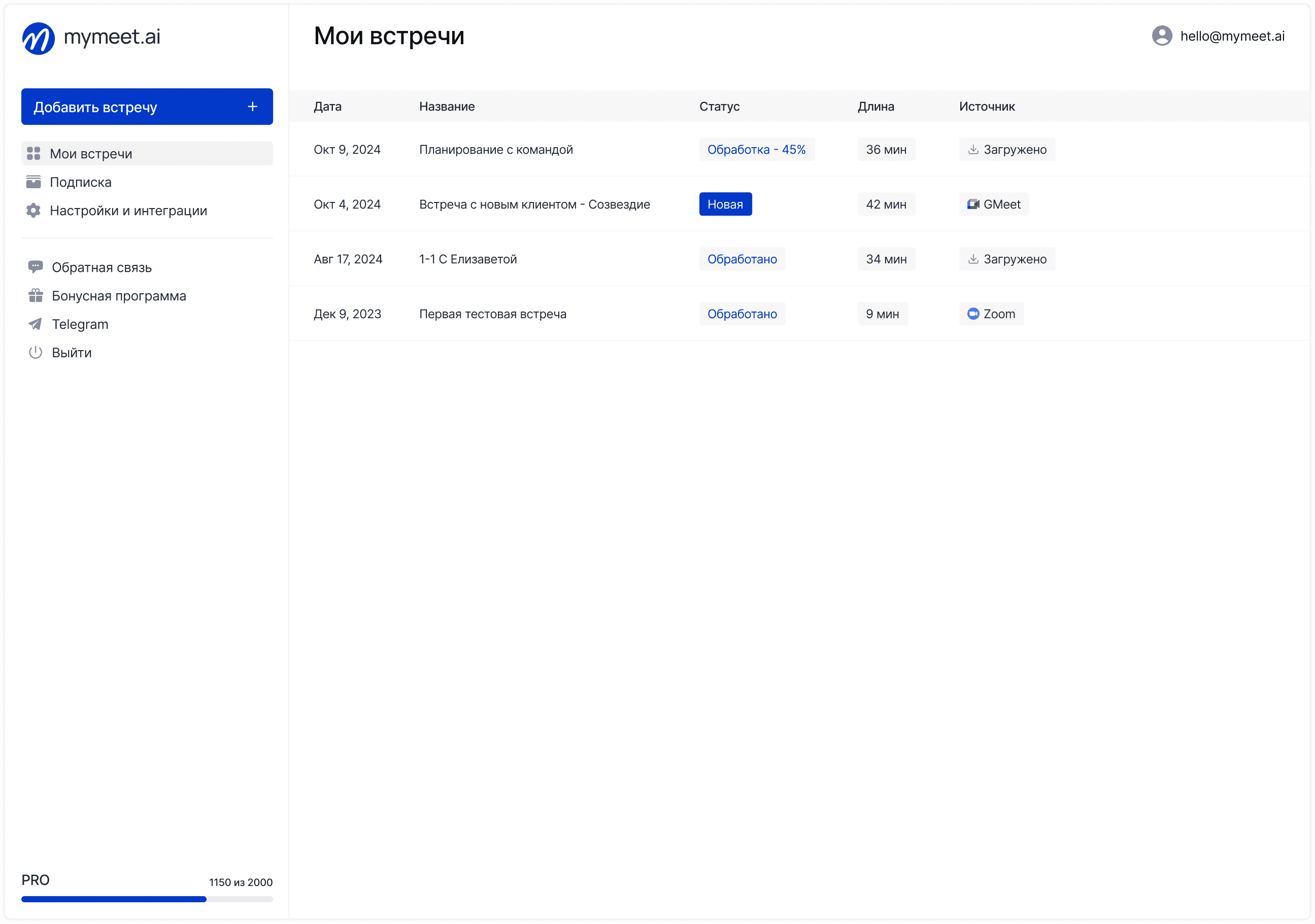
Mymeet.ai is an automatic meeting recording and transcription service. Works through personal account on website where all recordings are stored.
For Google Meet, there's Chrome extension for quick recording launch. For Zoom, Teams, Telemost, bot connects through personal account.
Benefits for Self-Organizing Teams
No dedicated documenter needed — all participants fully engaged in discussion.
Complete accuracy — details not missed, can return to exact formulations.
Automatic report — system highlights key decisions, tasks, open questions.
Content search — can find when specific question was discussed.
New participant training — can study how team makes decisions.
How to Use
Before meeting: Agree who starts recording (usually moderator).
At meeting start: Turn on recording through extension (for Google Meet) or bot automatically connects (for other platforms).
During meeting: Discuss calmly without being distracted by capture.
After meeting: In 5-10 minutes in personal account appears:
Full text transcription with speaker separation
Report with key moments
List of decisions and tasks
Moderator: Reviews report, supplements if needed, sends to team.
Solving "Lost Agreements" Problem
Typical situation:
Week later argument: "We agreed to do through API," "No, we decided to use webhook."
With recording: Open transcription, find discussion moment, see exactly what was decided and with what rationale.
Team knowledge base — all meeting recordings in one place, can return to any past decision.
Common Problems of Meetings Without Manager
Lack of Structure and Chaos
Problem: Meeting turns into unorganized discussion, jumping between topics, no one manages process.
Solution:
Mandatory moderator role at each meeting (rotation)
Clear agenda with time frames prepared in advance
Moderator strictly returns to topic when discussion veers off
Active Participant Dominance
Problem: 2-3 people speak 80% of time, others silent, their ideas not heard.
Solution:
"Round-robin" format where each must speak
Moderator actively asks quiet participants
Time limit rule per statement
Silent thinking phase before discussion
Lost Agreements
Problem: After meeting, different understanding of what was decided, tasks not clearly assigned.
Solution:
Mandatory documenter role or automatic recording
Key decision summary at meeting end aloud
Documentation sent within 2 hours after meeting
Understanding check: "Everyone agrees with this decision?"
Meeting Dragging
Problem: Hour meeting stretches to two, going deep into non-critical details.
Solution:
Mandatory timekeeper role with right to strictly stop
Timer visible to all on screen
"Discuss details separately" principle—take out to separate meetings
Maximum meeting duration 90 minutes, better 60
Unresolved Conflicts
Problem: Disagreement arises, team can't reach consensus, meeting reaches impasse.
Solution:
Moderator structures conflict—each side presents position
Search for common interests instead of positions
Voting if consensus impossible
Escalate to manager only critical conflicts
Postpone decision if more information needed
Low Engagement
Problem: Participants come unprepared, distracted by phones, don't actively participate.
Solution:
Culture of responsibility—if invited, actively participate
"Phones away" rule announced at start
Agenda in advance so can prepare
Role rotation—everyone sometimes moderator, this increases engagement
Practical Tips for Teams
Don't try to implement all practices at once.
Start with one type of regular meeting (e.g., weekly sync). Implement basic roles (moderator, documenter). After a month add timekeeper. Gradually spread to other meetings.
Conduct Meeting Retrospectives
Once a month discuss:
What works well in our meetings?
What can be improved?
What practices to add or remove?
Team evolves its own processes.
Create Templates
Standardize formats:
Agenda template for technical discussions
Results documentation template
Meeting preparation checklist
Discussion rules list
Store in shared access, anyone can use.
Train New Participants
When new person joins team:
Show examples of good meetings (can be recordings)
Explain roles and protocols
Let them be observer at 1-2 meetings
Then give simple role (documenter)
After a month, moderator role
Use Technology
Simplify processes:
Automatic meeting recording (mymeet.ai) instead of manual capture
Collaborative documents for agenda and documentation
Online timers visible to all
Calendars for planning next meetings
Conclusion
Meetings without manager in self-organizing teams can be highly effective with proper organization. Key elements: clear meeting goal, role distribution (moderator, timekeeper, documenter), role rotation among participants, mandatory decision and task capture, time frames.
Most common problems—lack of structure, active participant dominance, lost agreements. Solved through clear protocols, discussion formats for different tasks, automatic recording and documentation.
Start implementation with one meeting type, use basic roles, gradually add practices. Record meetings through mymeet.ai to not lose agreements and create team knowledge base. Conduct retrospectives and improve processes together.
Try mymeet.ai—180 minutes of meeting recording free. Free participants from manual capture, get automatic reports with decisions and tasks, create knowledge base of your self-organizing team's meetings.
Frequently Asked Questions
What is a self-organizing team?
A self-organizing team is a group of specialists who independently plan work, make decisions, and coordinate actions without constant manager oversight. Team organizes meetings itself, distributes tasks, and bears collective responsibility for results.
What roles are needed at meeting without manager?
Three key roles: moderator (manages process and discussion structure), timekeeper (tracks time), documenter (captures decisions and tasks). Roles rotate among participants. Can use automatic recording instead of manual capture.
How to document self-organizing team meetings?
Minimum: date, participants, decisions made, assigned tasks with owners and deadlines, open questions. Send within 2 hours after meeting. Formats: structured document, tasks in tracker, chat message. Or use automatic transcription through mymeet.ai.
How to avoid chaos at meeting without leader?
Mandatory moderator role (rotation among participants), clear agenda with time frames prepared in advance, timekeeper who tracks time, discussion rules (one speaks, round-robin format), block result summarizing by moderator.
What if participants dominate discussion?
Use "round-robin" format where each must speak, moderator actively asks quiet participants with direct questions, limit time per statement (2-3 minutes), add silent thinking phase before discussion where all silently write ideas.
How to record team meeting for documentation?
Use mymeet.ai: for Google Meet install Chrome extension, for Zoom/Teams/Telemost connect bot through personal account. After meeting get text transcription and automatic report with decisions and tasks. No dedicated documenter needed—all engaged in discussion.
How long should meeting without manager last?
Optimally 45-60 minutes, maximum 90 minutes. Longer meetings lose productivity. Timekeeper strictly monitors time. If didn't finish—schedule continuation, don't stretch current meeting. Take detailed discussions to separate meetings.
How to resolve conflicts in self-organizing team?
Moderator structures conflict—each side presents position without interruption (5 min each), questions for understanding, finding common interests and goals, generating solution options, choosing option satisfying both sides. If consensus impossible—voting. Escalate critical conflicts to leadership.
Is manager needed for effective team meetings?
No, with proper organization team conducts effective meetings independently. Needed: clear protocols and roles, moderation skills among participants (develop through role rotation), documentation tools, culture of responsibility. Manager needed for strategic decisions and resolving critical conflicts.
How to implement meeting self-organization in team?
Start with one type of regular meeting, implement basic roles (moderator, documenter), use simple agenda templates, record meetings for analysis, after a month conduct retrospective on what works, gradually add practices, spread to other meeting types. Train new participants on examples.
Radzivon Alkhovik