Meeting Tips

Andrey Shcherbina
A development team meeting runs for an hour—discussing technical architecture, diving into details, drawing diagrams. A sales team meeting runs for an hour—quickly running through 15 deals, discussing objections, sharing cases. Same duration, completely different formats and dynamics.
The problem for most companies is using a universal agenda template for all meeting types. "Project status," "Task discussion," "Next steps"—sounds universal, but in practice developers need depth and time to think, marketers need creative discussions and brainstorms, salespeople need speed and specifics.
Let's break down how to optimize meeting agendas for the specifics of three key team types: IT/development, marketing, and sales. We'll show structures that actually work considering the peculiarities of each function.
What Is a Meeting Agenda and Why It's Needed
An agenda is a structured list of topics to be discussed at a meeting with time allocated for each topic and expected results.
Basic Elements of Any Agenda
Regardless of team type, an effective agenda includes:
Meeting goal — clear formulation of why we're gathering. Not "discuss projects," but "make decisions on choosing technology stack."
Topic list — what specifically we're discussing, in what order
Time for each topic — strict time frames prevent dragging on
Discussion format — presentation, discussion, brainstorm, demonstration
Expected result — decision, plan, task list, consensus
Responsible parties — who leads each discussion block
Why an Agenda Is Needed
Without an agenda, meeting turns into chaos:
Discussion jumps between topics unsystematically
Most important questions don't get discussed
Those who speak loudest dominate
No concrete results at the end
Half the participants don't understand why they came
With proper agenda:
Everyone knows what to expect and can prepare
Time used effectively—each topic gets needed attention
Concrete results achieved
Participants understand meeting value
Why Universal Agenda Doesn't Work
Different teams work at different rhythms:
IT teams need time for deep dive — can't discuss architectural decisions in 5 minutes. I need diagrams, code, and technical discussion.
Marketing works with creativity — need space for ideas, discussing concepts, visualization. Too rigid structure kills creativity.
Sales works at high pace — 10 deals in 30 minutes, quick decisions, specifics, minimal abstractions.
Universal template ignores these differences and makes meetings ineffective for everyone.
Specifics of IT and Developer Meetings
Development teams have unique characteristics that should be reflected in agenda structure.
IT Team Work Characteristics
Deep dive into details — technical solutions require discussing implementation details, architecture, potential problems. Surface discussion is useless.
Visual thinking — developers think in diagrams, schemes, code. Discussion without visualization is less effective.
Asynchronous preferable — many discussions can be conducted asynchronously in documents or chats. Synchronous meetings for decisions requiring quick interaction.
Context above all — can't discuss a task without understanding why and how it fits into the big picture.
Silence = thinking — pauses in discussion don't mean people checked out. Developers need time to consider options.
IT Team Meeting Types
Technical discussions and architectural decisions — deep dive into technical solutions, evaluating options, choosing approaches.
Sprint planning — breaking down sprint tasks, estimating complexity, distributing across teams.
Daily standups — quick sync on what's done, what's in progress, what blockers.
Code reviews and technical demos — demonstrating implementation, discussing code quality, identifying problems.
Retrospectives — analyzing what worked and what to improve in team processes.
Incident discussions (postmortem) — breaking down what went wrong and how to prevent it in future.
Optimal Agenda for Technical Discussion
Meeting: Architectural Decision
Duration: 90 minutes
Participants: 4-6 developers
1. Context and Problem (10 min)
Format: Presentation
Leader: Task author
Result: Everyone understands problem essence
2. Proposed Solution Options (20 min)
Format: Presentation with diagrams
Leader: Architect or senior developer
Result: 2-3 options on table
3. Technical Discussion (40 min)
Format: Free discussion with drawing schemes
Key questions:
- Pros and cons of each option
- Technical debt and support
- Performance and scalability
- Implementation risks
4. Decision Making (10 min)
Format: Voting or consensus
Result: Chosen approach
5. Implementation Plan (10 min)
Format: Task capture
Result: Task list with owners
Key principles:
Large time block for discussion without strict frames
Visualization mandatory—board or schemes
Silence acceptable—people thinking
Focus on technical depth
Optimal Agenda for Sprint Planning
Meeting: Sprint Planning
Duration: 2 hours (for two-week sprint)
Participants: Entire development team
1. Review of Last Sprint Results (10 min)
- What completed, what didn't
- Team velocity
2. Sprint Priorities (15 min)
Format: Presentation from product owner
Result: Understanding main goals
3. Task Breakdown (60 min)
Format: Discussion of each task
For each task:
- What needs to be done
- Technical questions
- Complexity estimate (planning poker)
- Dependencies and risks
4. Forming Sprint Backlog (20 min)
- Which tasks we take into sprint
- Is load realistic
5. Task Distribution (15 min)
- Who takes what
- Pairs for complex tasks
Key principles:
Time for detailed discussion of each task
Complexity estimation through poker—engages everyone
Realism more important than ambition
Optimal Agenda for Daily Standup
Meeting: Daily Standup
Duration: 15 minutes maximum
Participants: Development team
Format: Each in turn answers 3 questions (2 min per person)
1. What did I do yesterday?
2. What do I plan today?
3. Are there blockers?
Rules:
- Facts only, no detailed discussions
- If need to discuss details—separate meeting after
- Timer for 15 minutes strictly
Key principles:
Strict time limit
No going into details
Focus on blockers
Marketing Meeting Specifics
Marketing teams work with creativity and data—completely different dynamics than developers.
Marketing Team Work Characteristics
Creativity requires space — can't come up with a good campaign concept in 10 minutes with rigid frames. Need brainstorms, discussions, idea experiments.
Visual perception — marketers think in images, concepts, visual solutions. Discussion without mockups or references is less productive.
Data + intuition — decisions based on metrics but also require creative vision. Balance of analytics and creativity.
Fast iterations — marketing moves quickly, tests hypotheses, changes course. Meetings should support dynamism.
Interdisciplinary — content, design, analytics, SMM work together. Meetings are often cross-functional.
Marketing Team Meeting Types
Campaign brainstorms — generating ideas for new campaigns, concepts, creatives.
Metrics review and analytics — analyzing results of current campaigns, A/B tests, conversion rates.
Content planning — planning content for month/quarter, distributing responsibility.
Creative reviews — discussing design, copywriting, visual concepts.
Sync with sales/product — alignment between marketing and other functions.
Optimal Agenda for Campaign Brainstorm
Meeting: Q1 Campaign Brainstorm
Duration: 90 minutes
Participants: Marketing team 6-8 people
1. Context and Goals (10 min)
- What problem we're solving
- Target audience
- KPIs to achieve
- Budget and constraints
2. Inspiration and References (10 min)
- Show 3-5 examples of successful campaigns
- What can be taken as foundation
3. Silent Brainstorming (15 min)
- Each silently writes ideas on sticky notes
- Minimum 10 ideas from each
- No discussions yet
4. Idea Presentation (20 min)
- Each presents their 2-3 best ideas
- No criticism at this stage
- Grouping similar ideas
5. Discussion and Development (25 min)
- Choose 3-5 most promising directions
- Develop each—what will it look like
- What resources needed
6. Voting and Next Steps (10 min)
- Dot voting—each gets 3 votes
- Top 2 ideas go to development
- Assign owners for concept
Key principles:
Silent phase first—gives introverts opportunity
No criticism at idea generation stage
Visualization—sticky notes, board, sketches
Time for developing ideas, not just generation
Optimal Agenda for Metrics Review
Meeting: Weekly Marketing Review
Duration: 60 minutes
Participants: Marketing team
1. Week's Key Metrics (10 min)
Format: Dashboard on screen
- Traffic, Leads, Conversion rate
- What grew, what fell vs last week
- Quick insights
2. Deep Analysis (25 min)
Format: Discussion
A) What Worked Well (10 min)
- Which campaigns/channels performing
- Why it worked
- How to scale
B) What's Not Working (15 min)
- Where we're underperforming
- Hypotheses why
- What we test for improvement
3. A/B Tests and Experiments (15 min)
- Current test results
- What tests we launch next week
4. Quick Decisions and Tasks (10 min)
- What we stop/change
- What we double down on
- Tasks for week with owners
Key principles:
Data on screen—visualization mandatory
Balance of successes and problems
Focus on actions, not just analytics
Optimal Agenda for Content Planning
Meeting: Monthly Content Planning
Duration: 90 minutes
Participants: Content marketer, copywriters, designer, SMM
1. Last Month Review (10 min)
- What we published
- Top 3 content by engagement
- What didn't work
2. Month's Goals and Priorities (10 min)
- Key themes and campaigns
- SEO priorities
- Product announcements
3. Topic Generation (30 min)
Format: Brainstorm
- Each proposes 5-7 topic/format ideas
- Grouping by weeks
- Choosing 15-20 topics for month
4. Responsibility Distribution (20 min)
- Who writes which materials
- Deadlines for drafts and finals
- Who does design
5. Distribution by Weeks (15 min)
- Creating publication calendar
- Checking no overload
6. Next Steps (5 min)
- Who creates tasks in Asana/Trello
- When next check-in
Key principles:
Creative phase for topic generation
Clear distribution—who, what, when
Visual content calendar
Sales Department Meeting Specifics
Sales works at the fastest pace—every minute is worth gold, meetings must be maximally effective.
Sales Team Work Characteristics
High speed and specifics — salespeople operate with concrete numbers, deals, clients. Abstractions don't work.
Focus on actions — each meeting should end with concrete actions. "We'll think about it" isn't an option.
Experience exchange critical — best salespeople share techniques, cases, approaches. Peer learning is more important than theory.
Motivation through results — visibility of progress and wins motivates the team. Meetings should support this.
Time = money — each minute in a meeting is time not spent calling clients. Meetings should be short and valuable.
Sales Team Meeting Types
Morning huddles — quick sync for the day, team motivation.
Pipeline reviews — analyzing deal status, where stuck, what to move.
Deal analysis (win/loss review) — analyzing why won or lost deals.
Role-play sessions — practicing pitches, objection handling.
One-on-ones with managers — individual coaching of salespeople.
Optimal Agenda for Morning Huddle
Meeting: Daily Sales Huddle
Duration: 15 minutes strictly
Participants: Sales team 8-10 people
1. Yesterday's Results (5 min)
- Team overall: how many calls, meetings, closed deals
- Top 3 wins yesterday (who closed deals)
- Brief celebration of wins
2. Today's Focus (5 min)
- Team goals for day
- Who has critical meetings/calls today
- Who needs support
3. Quick Questions and Blockers (5 min)
- Any urgent problems requiring solution
- Who needs colleague help
- Announcements (new materials, product changes)
Rules:
- Timer for 15 minutes strictly
- Everyone stands (so not to drag out)
- No detailed discussions—taken offline
Key principles:
Energy and motivation in morning
Celebrating wins
Strict time limit
Optimal Agenda for Pipeline Review
Meeting: Weekly Pipeline Review
Duration: 60 minutes
Participants: Sales team + manager
1. Overall Pipeline Overview (10 min)
On screen: CRM dashboard
- How many deals at each stage
- Conversion between stages
- Month/quarter forecast
- Where bottlenecks
2. Major Deal Breakdown (30 min)
Format: Quickly in circle, each 3-4 minutes
For each deal >$X:
- Status and next step
- Deal loss risks
- What needed for closing
- Who can help
3. Stuck Deals (15 min)
- Deals long at one stage
- What blocks movement
- Unblocking plan
4. Actions for Week (5 min)
- Top 3 priority deals for team
- Who needs manager help
- Concrete actions
Key principles:
CRM on screen—everyone sees numbers
Fast pace—don't get stuck on one deal
Focus on actions to move deals
Optimal Agenda for Deal Analysis
Meeting: Win/Loss Review
Duration: 30 minutes
Participants: Salesperson + manager + 2-3 colleagues
1. Deal Context (5 min)
- Who is client, what task
- Deal size and sales cycle
- Competitors in deal
2. Timeline (10 min)
- How deal developed from first contact
- Key meetings and turning points
- Objections and how worked with them
3. Why Won/Lost (10 min)
Discussion:
- What was deciding factor
- What did right
- What could have done differently
- Lessons for team
4. Actions (5 min)
- What we change in approach
- What materials needed
- Who we inform (product, marketing)
Key principles:
No blame—focus on learning
Concrete lessons for whole team
Analyze both wins and losses
Optimal Agenda for Role-Play Session
Meeting: Pitch and Objection Practice
Duration: 45 minutes
Participants: 4-6 salespeople
1. Session Focus (5 min)
- What situation we're practicing
- Typical objections or deal stage
- Session goal
2. Role-Play Rounds (30 min)
Format: Pairs, 3 rounds of 10 minutes
Each round:
- One plays salesperson, other client
- 5 minutes role-play
- 3 minutes feedback from observers
- 2 minutes switch roles
3. Pattern Discussion (10 min)
- Which approaches worked best
- Phrases and techniques that work
- What to avoid
- Recording best practices
Key principles:
Practice in safe environment
Constructive feedback
Capturing working techniques
General Principles of Effective Agenda
Regardless of team type, there are universal principles that make agenda effective.
Send Agenda in Advance
Minimum 24 hours before meeting. Participants should have time to:
Understand what will be discussed
Prepare materials if needed
Formulate thoughts and questions
Without advance agenda: People come unprepared, first 10 minutes spent understanding context, decisions made impulsively.
With agenda day ahead: Everyone knows what's discussed, prepared, and discussion more deep and constructive.
Specify Time for Each Block
Not just "Task discussion" but "Task discussion (20 minutes)".
Time frames:
Discipline discussion
Help understand if agenda realistic
Give participants opportunity to plan contribution
Tip: Leave a 5-10 minute buffer for unforeseen events.
Define Expected Result for Each Block
Not "Architecture discussion" but "Architecture discussion → Decision: chosen approach A or B".
Clear result:
Focuses discussion
Gives success criterion for block
Helps not go off-topic
Result types:
Decision made
Plan created
Tasks assigned
Ideas list collected
Consensus reached
Assign Owner for Each Block
Who leads the discussion of each topic. Not necessarily the facilitator of the entire meeting.
This:
Distributed load
Gives ownership for block result
Helps leader prepare
Start with Most Important
Don't postpone critical topics to the end. By the end, energy drops, time may run out.
Principle: Most important and complex—in the first third of the meeting when everyone is fresh and focused.
Leave Time for Next Steps
Last 5-10 minutes always reserve for:
Summary of key decisions
Task list with owners and deadlines
Agreement on next meeting if needed
Meeting without clear next steps = waste of time.
How mymeet.ai Helps Optimize Team Meetings
A proper agenda is half the success. Second half—analyzing what worked and constant improvement of meeting structure.
Automatic Meeting Result Capture
Problem: Even with a good agenda, it is hard to capture all discussions, decisions, and tasks manually. Someone must take minutes and miss part of the discussion.
Solution through mymeet.ai:
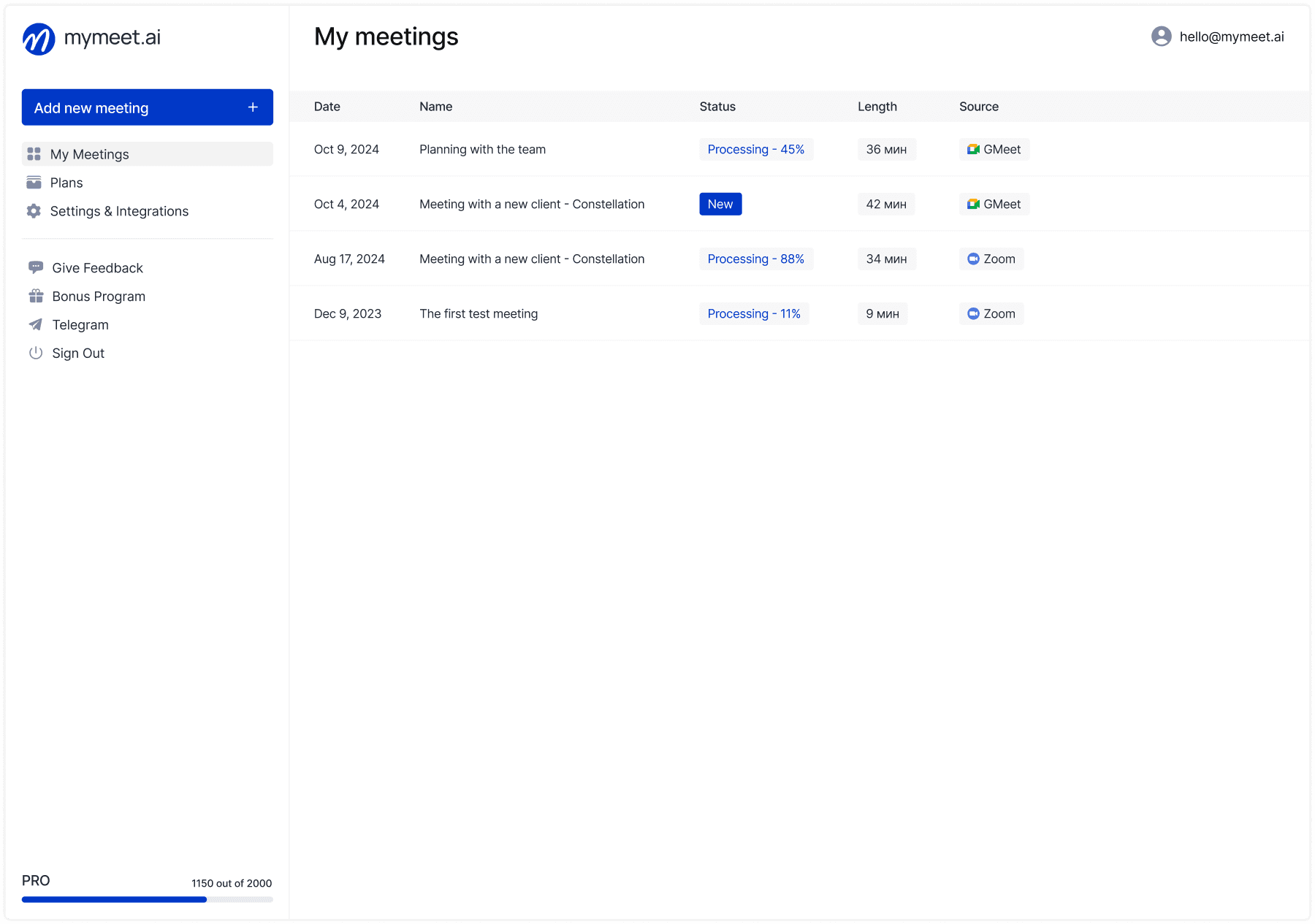
Record meetings automatically—for Google Meet use Chrome extension, for Zoom/Teams/Telemost connect bot through personal account.
After meeting get:
Full text transcription with speaker separation
AI report with extracted decisions and tasks
Key discussion moments
No need to assign someone to take minutes—everything captured automatically.
Agenda Effectiveness Analysis
Problem: Hard to tell if your agenda works. Did you manage to discuss all topics? Were time frames followed? Who dominated discussion?
Solution through mymeet.ai:
Analyze meeting recordings to see:
Time distribution by topics — how much actually spent on each agenda block vs planned. If I constantly don't fit—I need to adjust time frames.
Each team member participated — what percentage of time each spoke. If one person 70% of the meeting—problem with engaging others.
Where discussion went off topic — see in transcription moments when discussion deviated from agenda. Can improve moderation.
Were results achieved — AI report shows decisions made and tasks assigned. Does this match the expected results from the agenda?
Knowledge Base from Meetings
Problem: Decisions made at meetings are forgotten or lost. New employees don't know the context of past discussions.
Solution through mymeet.ai:
All meeting recordings saved in a personal account with search capability. Can find:
When discussed specific topic
What decision made and why
Who participated in discussion
Example use by team types:
IT teams: Base of technical discussions and architectural decisions. New developers can study why they chose a certain approach.
Marketing: History of campaign discussions. See what ideas tested, what worked, what hypotheses were.
Sales: Base of deal analyses. Can find how to work with similar objections or client types.
Improving Agenda Based on Data
Iterative process:
Create agenda with time frames
Conduct meeting with recording through mymeet.ai
Analyze: fit in time, achieved results, everyone spoke
Adjust agenda for next meeting
Repeat cycle
After 3-4 iterations, find optimal structure for your team.
Example: Development team allocated 30 minutes for technical discussion. Analysis actually takes 45 minutes and this is normal—discussion deep and valuable. Adjusted agenda—now allocate 45 minutes and don't try to artificially shorten.
Conclusion
Effective agenda isn't a universal template but adaptation to your team specifics. IT teams need deep technical discussions with time for thinking. Marketers work with creativity and require space for ideas. Salespeople operate at high pace with focus on specifics and actions.
Key principles regardless of team type: send agenda in advance, specify time for each block, define expected results, start with important, reserve time for next steps.
Constantly improve your agendas through analysis. Record meetings through mymeet.ai, analyze what worked and what didn't, adjust structure. After several iterations, find the optimal format for your team.
Start small: Take one regular team meeting, apply principles from this article, record meetings and analyze results. Adjust and try again. Gradually optimize all regular meetings.
Try mymeet.ai—180 minutes of meeting recording and analysis free. Record several meetings, analyze how your agenda works, and find improvement points.
Frequently Asked Questions
How does the IT meeting agenda differ from the sales agenda?
IT meetings require more time for deep technical discussion (40-60 minutes per topic), visualization through schemes, pauses for thinking. Sales works at a fast pace—10-15 deals in 30 minutes, focus on specifics and actions, no abstractions.
How to create meeting agendas correctly?
Specify clear meeting goals, list topics in priority order, allocate time for each topic, define expected result for each block, assign owner for leading block, send minimum 24 hours ahead. Reserve the last 5-10 minutes for summary and next steps.
How many topics can be discussed in one meeting?
Depends on topic complexity and meeting duration. For an hour meeting, realistic 3-4 topics with deep discussion or 8-10 for quick review. IT topics require more time (20-30 minutes per topic), sales discussions faster (3-5 minutes per deal).
Is the agenda needed for short meetings (15 minutes)?
Yes, especially for short meetings. Clear structure critical to fit in time. For daily standup: each 2 minutes answers 3 questions. For sales huddle: 5 minutes results, 5 minutes focus for day, 5 minutes questions.
How to adapt the agenda for the marketing team?
Marketers need space for creativity: brainstorms with silent phases (everyone writes ideas silently first), time for developing ideas not just generation, visualization through mockups and boards, balance of metrics analytics and creative discussion. Don't pressure rigid frames on the creative phase.
What if we don't manage to discuss all topics from the agenda?
This signals an agenda that is too ambitious. Options: reduce number of topics (better 3 topics quality than 6 superficially), increase meeting duration, split into two meetings, check for off-topic discussions and eat time. Analyze meeting recordings to understand where we are losing time.
How to engage silent participants through agenda?
Use formats engaging everyone: round-robin (each speaks in turn), silent brainstorming (everyone writes silently first), breakout rooms for small groups, direct questions by name. The agenda indicates each will get a floor—this prepares people.
How far in advance to send a meeting agenda?
Minimum 24 hours for regular meetings, 2-3 days for complex strategic discussions where preparation is needed. This gives participants time to study materials, formulate thoughts, and prepare questions. An hour before a meeting is useless.
How to record and analyze agenda effectiveness?
Use mymeet.ai: record meeting (extension for Google Meet or bot for other platforms), get transcription and report, analyze how much time actually went to each block vs planned, who spoke how much, were expected results achieved. Adjust agenda based on data.
Is a different agenda needed for regular vs one-time meetings?
Yes. Regular meetings (daily standup, weekly review) use standardized agenda—everyone knows the format. One-time meetings require a custom agenda for specific goals and context. But principles are the same: time for blocks, expected results, send in advance.
Andrey Shcherbina