Meeting Tips

Ilya Berdysh

A meeting with a key client ended an hour ago. Everyone went their separate ways to their tasks. A week later, it turns out the salesperson understood one thing, the tech led another, and the manager a third. They sent the client a proposal that didn't match what was discussed. The deal fell through.
The problem wasn't the meeting itself—it went well. The problem was there was no debrief immediately after. The team didn't synchronize on understanding what happened, what agreements were reached, who did what next.
A debrief after important meetings is a critical but often skipped practice. Let's break down what a debrief is, when it's needed, how to organize it properly, and what templates to use.
What Is a Meeting Debrief
A debrief is a short team meeting immediately after an important meeting to synchronize understanding of what happened, analyze results, and plan next steps.
Difference from a Regular Meeting Summary
Meeting summary — a document that records what was discussed and what decisions were made. Sent to all participants.
Debrief — a live team discussion immediately after the meeting where:
Synchronize on understanding (did everyone understand the same thing?)
Analyze what worked and what didn't
Identify risks and opportunities
Plan specific actions
Key difference: Debrief is discussion and analysis, summary is result documentation.
Why Debriefs Are Needed
Without a debrief:
Different understanding of agreements among different participants
Missed important details (client said something important between the lines)
Unclear priorities—what to do first
Lost opportunities (client hinted at additional need)
Uncoordinated team actions
With a debrief:
Unified understanding of meeting results
Identified hidden signals and risks
Clear action plan with priorities
Quick response to opportunities
Team acts in coordination
Research shows: Teams practicing regular debriefs are 25% more effective in executing agreements and 30% faster at identifying problems.
When a Debrief Is Needed
Not every meeting requires a debrief. Let's define criteria for when it's critical.
Types of Meetings Requiring a Debrief
Meetings with key clients — negotiations about major deals, requirements discussion, solution presentations.
Important internal meetings — strategic sessions, making critical decisions, crisis discussions.
Investor meetings — project presentations, discussing rounds, negotiating terms.
Complex personnel meetings — interviews for key positions, performance evaluation of difficult cases.
Partner meetings — discussing cooperation terms, conflict resolution.
Incident analysis — analyzing what went wrong and how to prevent it.
Criteria for Debrief Necessity
A debrief is needed if the meeting:
Affects significant decisions or resources (large budget, lots of team time)
Includes many participants from different sides (sales + technical team + leadership)
Contains complex or contradictory information
May lead to different understanding of agreements
Requires quick coordinated response afterward
Is part of a critical process (sale, hiring, investment)
Rule: If you wondered "do we need a debrief?"—you probably do.
Recording Meetings for Effective Debriefs
Quality debriefing requires accurate information about what was in the meeting.
What Is mymeet.ai
Mymeet.ai is a service for automatic meeting recording and transcription that helps teams conduct objective debriefs based on facts, not just memories.
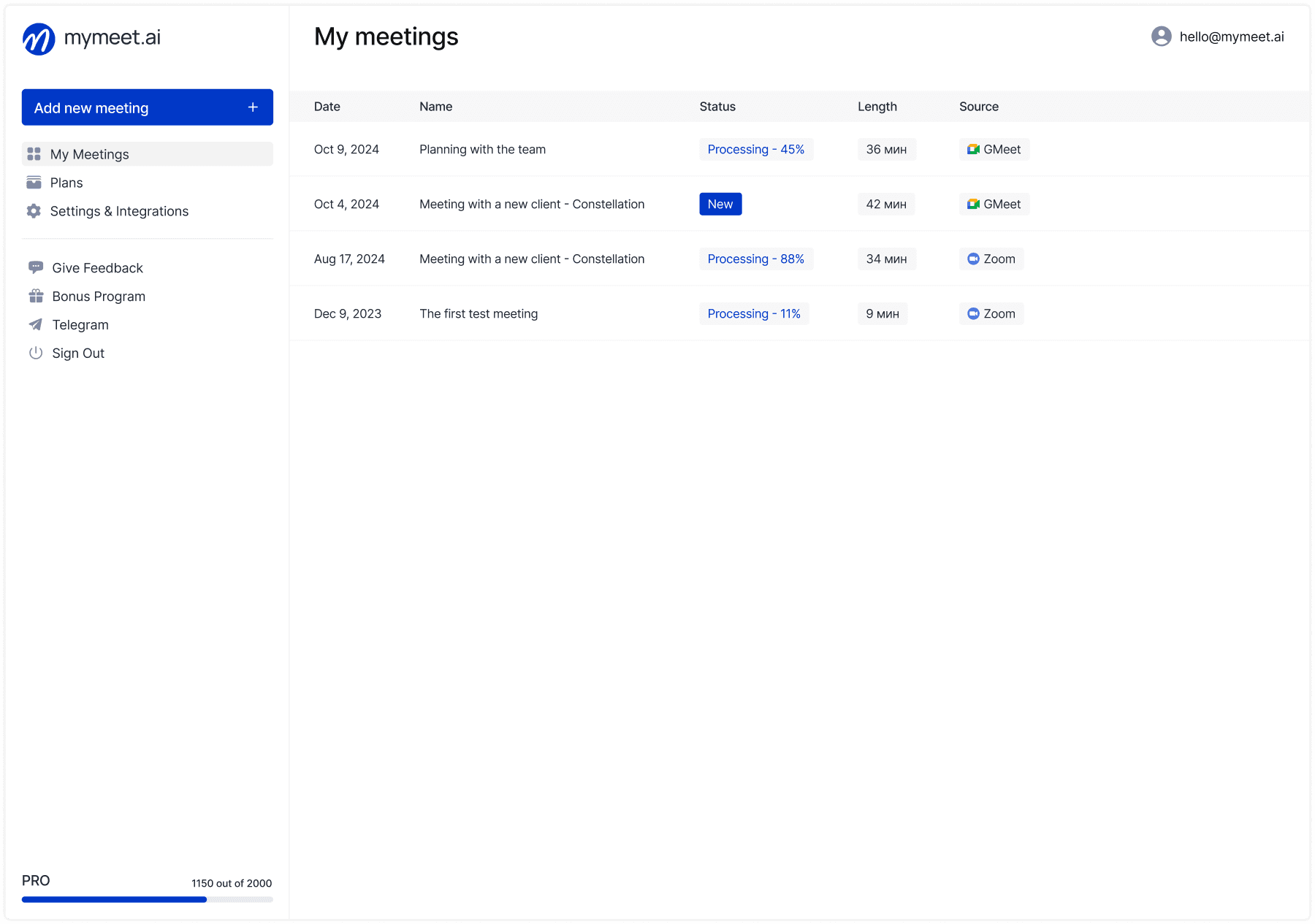
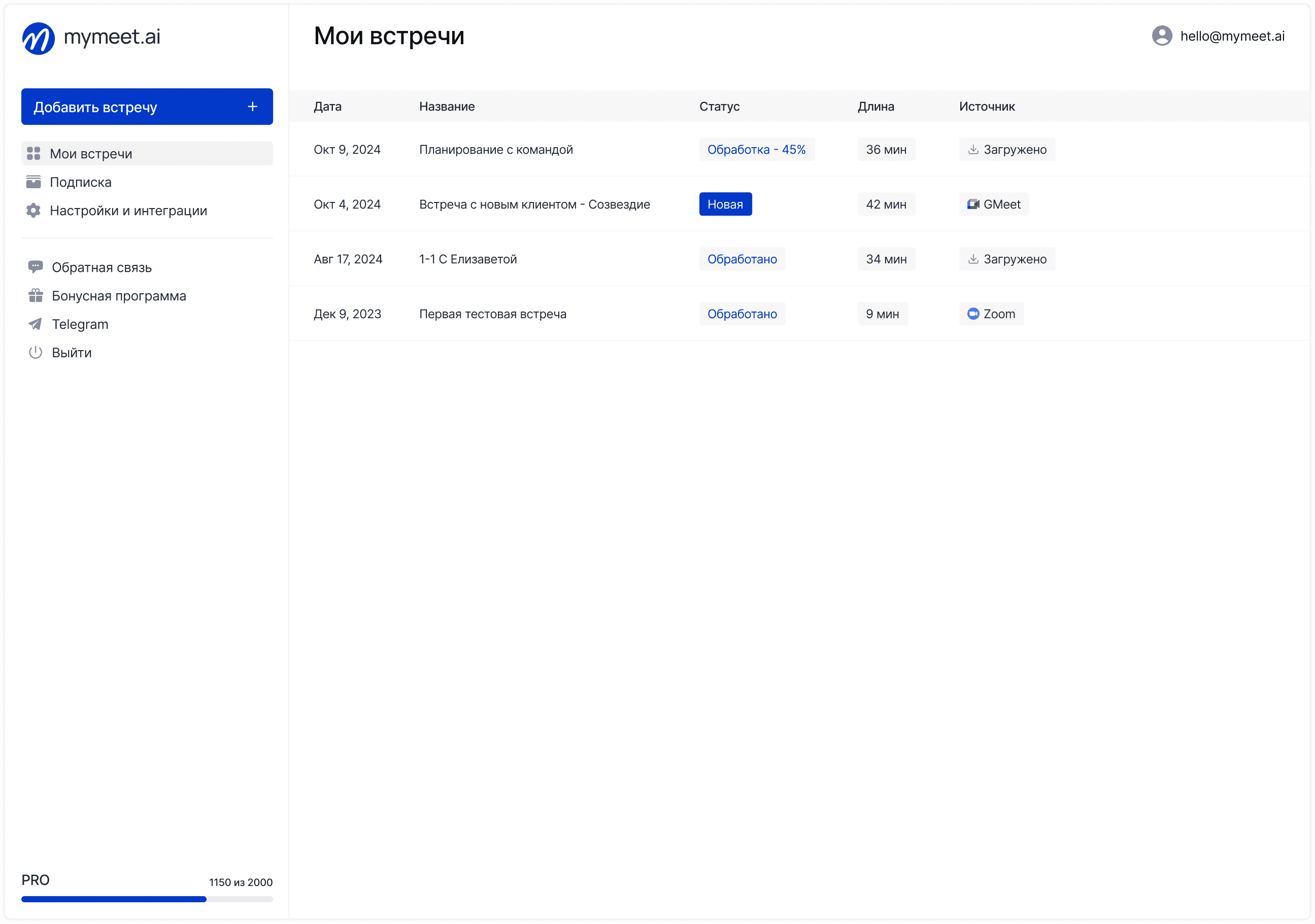
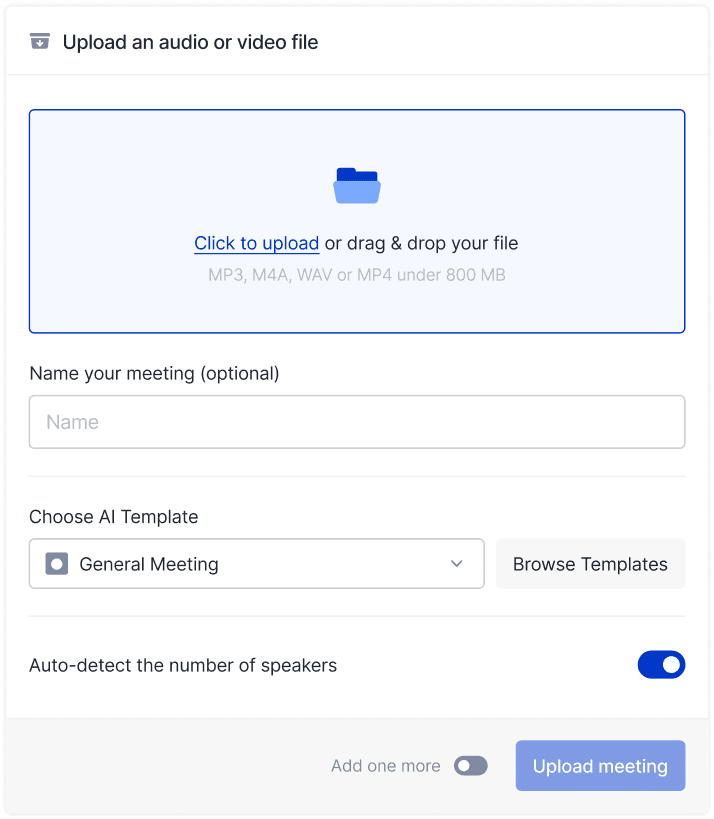
Works as a website with a personal account where all recordings are stored. For Google Meet, there's a Chrome extension for quick recording. For Zoom, Teams, Telemost, a bot connects through your personal account.
Meeting Recording as Foundation for Debrief
Problem: In a stressful or intense meeting, participants miss details, remember what was said differently.
Solution: Record important meetings through mymeet.ai.
At the debrief you have:
Full text transcription—can quickly find what exactly the client said
Report with key moments—won't miss important things
Ability to replay specific moment—check intonation
Example usage:
"The client said budget isn't a problem, but I felt he was hesitant. Let's listen to that moment."
Find it in the text, listen—turns out there was a long pause before the answer. That's a red flag.
Structured Report for Debrief
The mymeet.ai report automatically highlights:
Key decisions made at the meeting
Assigned tasks and owners
Open questions
Objections and concerns raised by the client
Use as the basis for debrief—no need to restore context, immediately move to analysis.
Debrief Database
All meeting and debrief recordings are saved in your mymeet.ai personal account.
Value:
Can return to past debriefs and check what was decided
New employee can study past deal debriefs for training
See patterns—what signals at meetings are associated with success or failure
Automatic Summary for Team
After the debrief:
Meeting summary (from report)
Debrief results (what was discussed, what decisions)
Action list with owners
Sent to the team automatically—no need to spend time on formatting.
When to Conduct a Debrief
Timing is critically important for debrief effectiveness.
Ideal: Immediately After Meeting
Within 15-30 minutes after the meeting ends while all impressions are fresh.
Why it's critical to do immediately:
Details in memory—everyone remembers nuances, intonations, nonverbal signals
Emotions are fresh—can discuss what participants felt
Context not lost—no need to restore what was discussed
Can quickly make decisions about immediate actions
How to organize:
Reserve +30 minutes after important meeting in all participants' calendars
Immediately after client meeting—15 minutes debrief in same room or call
Don't disperse until you've held a quick debrief
Acceptable: End of Day
If immediately impossible—gather a team at the end of the workday.
Maximum 4-6 hours later while memory is still fresh.
Problem: Some details already forgotten, emotional context lost, may have already taken uncoordinated actions.
Ineffective: Next Day
After 24+ hours, debrief loses most of its value:
Important details and nuances forgotten
Participants already acted based on their understanding
Have to spend time restoring context
Emotional component lost
Exception: If the meeting was emotionally difficult (conflict, bad news)—may be useful to give a night to think before debriefing.
Structure of Effective Debrief
Debrief should be structured to fit in 15-30 minutes and get value.
Stage 1: Facts and Observations (5 minutes)
Goal: Synchronize understanding of what happened.
Questions:
What was discussed at the meeting? (quick summary)
What key moments did you notice?
Were there any surprises?
Format: Each participant in turn shares 1-2 key observations.
Rule: Only facts for now, no interpretations and evaluations.
Stage 2: Interpretations and Conclusions (10 minutes)
Goal: Discuss what observations mean, identify what's hidden.
Questions:
What did the client/partner really mean?
What signals did we receive (verbal and nonverbal)?
What remained unsaid or unclear?
What risks do you see?
What opportunities opened up?
Format: Open discussion, everyone speaks up.
Example conclusions:
"Client mentioned budget constraints three times—this is the main objection"
"Technical director asked many questions about security—this is his key pain point"
"They're rushing with the decision—competitor is pressuring, need to act quickly"
Stage 3: Decisions and Actions (10 minutes)
Goal: Determine what to do next specifically.
Questions:
What next steps did we agree on at the meeting?
What else needs to be done based on what we learned?
Who is responsible for what?
What are the deadlines?
Who else needs to be informed?
Format: Creating task list with owners.
Result:
List of specific actions with owners and deadlines:
Alexey: Send proposal focused on security | by Friday
Maria: Prepare similar client case | by Wednesday
Ivan: Coordinate discount possibility with finance | by Thursday
Stage 4: Communication Agreement (5 minutes)
Goal: Synchronize who communicates what to whom.
Questions:
Who sends a meeting summary to a client?
What do we include in summary, what don't we?
Who inside the company needs to be informed?
When is the next meeting or check-in?
Debrief Templates for Different Meeting Types
Basic structure adapts to meeting specifics.
Template: Client Meeting Debrief
DEBRIEF: Meeting with [Company Name]
Date: [DD.MM.YYYY]
Debrief Participants: [List]
1. BRIEF MEETING SUMMARY
- Who was present from client side
- What was discussed (main topics)
2. KEY OBSERVATIONS
- What does the client really want?
- Main pain points identified
- Objections and concerns
- Positive signals
3. DEAL PROBABILITY ASSESSMENT
- How interested (1-10)
- What increases chances
- What risks losing the deal
4. ACTIONS
- [Name]: [Action] | Deadline: [Date]
- [Name]: [Action] | Deadline: [Date]
5. NEXT STEPS WITH CLIENT
- Next meeting: [Date and goal]
- What we send to client and when
Time: 20 minutes
Template: Interview Debrief
DEBRIEF: Interview [Candidate Name]
Position: [Title]
Date: [DD.MM.YYYY]
Interviewers: [List]
1. OVERALL IMPRESSION
Each interviewer (2 minutes):
- Overall evaluation (Hire / Don't hire / Maybe)
- Main impression
2. EVALUATION BY CRITERIA
- Technical skills: [Rating and comments]
- Culture fit: [Rating and comments]
- Communication: [Rating and comments]
- Motivation: [Rating and comments]
3. CONCERNING MOMENTS
- What raises concerns?
- What risks do we see?
4. STRENGTHS
- What particularly impressed you?
- Candidate's unique advantages
5. DECISION
- Hire / Don't hire / Need another round
- Next steps
- Who sends response to candidate
Time: 15 minutes
Template: Strategic Session Debrief
DEBRIEF: [Strategic Session Name]
Date: [DD.MM.YYYY]
Participants: [List]
1. KEY DECISIONS
- What decisions were made?
- Is there unified understanding among everyone?
- What remains unclear?
2. ALIGNMENT CHECK
- Does everyone agree with the direction?
- Are there unvoiced concerns?
- What might prevent execution?
3. PRIORITIES
- Top 3 most important actions
- What do we do first?
- What are we giving up?
4. COMMUNICATION
- What do we communicate to the team?
- What remains confidential?
- Who communicates and when?
5. NEXT STEPS
- Owner of each initiative
- Key milestone deadlines
- When is next strategic meeting
Time: 30 minutes
Roles in Debrief
Clear role distribution makes debrief more structured.
Facilitator
Responsibility:
Leads debrief following structure
Tracks time
Engages all participants
Prevents getting lost in details
Who: Usually the most senior or most experienced meeting participant.
Note-Taker
Responsibility:
Captures key moments
Records decisions and actions
Sends debrief summary to team
Who: Any participant or use recording through mymeet.ai
All Participants
Responsibility:
Actively share observations
Voice concerns and ideas
Take responsibility for actions
Common Debrief Mistakes
Skipping Debrief Due to Rush
Mistake: "We all understood, let's get straight to actions, no time for debrief"
Problem: Different understanding, uncoordinated actions, missed details.
Solution: Reserve time for debrief in advance. 15 minutes of debrief saves hours of fixing mistakes.
Turning into Long Meeting
Mistake: Debrief stretches to an hour, going deep into details.
Problem: Loses value of quick synchronization, people get tired.
Solution: Strict time limit of 30 minutes. Move detailed discussions to separate meetings.
One Voice Dominates
Mistake: Most senior or most active speaks 80% of the time.
Problem: Important observations from other participants not heard.
Solution: Facilitator actively asks each participant. "Round-robin" format at beginning.
Focus Only on Negative
Mistake: Entire debrief about what went wrong.
Problem: Lowers team motivation, misses successes.
Solution: Discuss in balance what worked and what to improve.
No Specific Actions
Mistake: Discussion without capturing next steps with owners.
Problem: Nothing changes after debrief.
Solution: Always end with an action list with owners and deadlines.
Lack of Psychological Safety
Mistake: People afraid to voice concerns or criticism.
Problem: Real risks not identified.
Solution: Facilitator creates safe space: "All opinions matter, criticism is welcome, focus on improvement."
Practical Tips for Organizing Debriefs
Create Debrief Culture
Do it regularly for all important meetings. After 2-3 months it becomes a team habit.
Leader sets example: If leader always conducts debrief—team adopts the practice.
Adapt to Your Team
Use templates as foundation but adapt to specifics:
Sales can add "Deal Probability Assessment"
Product team—"Insights About User Needs"
HR department—"Culture Fit and Risks"
Use Debrief Checklist
Print or save a short checklist that's always at hand.
☐ Meeting summary (2 min)
☐ Key observations from each (5 min)
☐ Hidden signals and risks (5 min)
☐ Actions with owners (10 min)
☐ Communication plan (3 min)
Start with Pilot Project
Don't try to implement debriefs everywhere at once.
Choose one meeting type (e.g., client meetings). Conduct debriefs after 5 such meetings. Collect team feedback on what works. Adjust approach. Expand to other meeting types.
Conclusion
Debriefing after important meetings is a simple but powerful practice that sharply increases team effectiveness. 15-30 minutes of structured discussion immediately after a meeting synchronizes understanding, identifies hidden risks and opportunities, ensures coordinated actions.
Key principles: conduct immediately after meeting (maximum 4-6 hours later), use structure (facts → interpretations → decisions → communication), engage all participants, capture specific actions with owners, stay within 30 minutes.
Start implementing debriefs with one type of important meeting. Use templates from this article as foundation. Record meetings through mymeet.ai to have full context for debrief. After a month of practice, this becomes a natural part of the process.
Try mymeet.ai—180 minutes of meeting recording free. Record important meetings, conduct debriefs based on accurate information from transcriptions and reports, and create a knowledge base of your team's debriefs.
Frequently Asked Questions
What is a meeting debrief?
A debrief is a short structured team meeting (15-30 minutes) immediately after an important meeting to synchronize understanding of what happened, analyze hidden signals, identify risks, and plan specific actions. Differs from regular meeting summary in that it's live discussion and analysis.
When should you conduct a debrief after a meeting?
Ideally—within 15-30 minutes immediately after the meeting while all impressions are fresh. Acceptable—at the end of the workday (after 4-6 hours). After 24+ hours, debrief loses most of its value as details are forgotten.
How long should a debrief last?
Optimally 15-30 minutes depending on meeting complexity. Client meeting debrief—20 minutes, interview—15 minutes, strategic session—30 minutes. More than 30 minutes—loses value of quick synchronization.
What is the structure of a meeting debrief?
Four stages: (1) Facts and observations—what happened (5 min), (2) Interpretations and conclusions—what it means (10 min), (3) Decisions and actions—what to do next (10 min), (4) Communication—who communicates what to whom (5 min). Total 30 minutes maximum.
How to record a meeting for debrief?
Use mymeet.ai: for Google Meet install Chrome extension, for Zoom/Teams/Telemost connect bot through personal account on the website. After the meeting, get a text transcription and report with key moments for objective debrief.
Is a debrief needed after every meeting?
No, only after important meetings: with key clients, strategic sessions, investor meetings, interviews for important positions, partner meetings. Criterion—meeting affects significant decisions or requires coordinated team actions.
Who should lead the debrief?
Usually the most senior or most experienced meeting participant acts as facilitator—follows structure and time, and engages everyone. One participant records key moments (or uses automatic recording). All participants actively share observations.
What mistakes are most common in debriefs?
Main mistakes: skipping debrief due to rush, stretching to an hour instead of 30 minutes, one person dominating, focusing only on the negative, absence of specific actions with owners and deadlines, unsafe atmosphere where people fear voicing concerns.
How to implement debriefs in a team?
Start with a pilot project: choose one type of important meeting, conduct debriefs after 5 meetings, collect team feedback, adjust approach, expand to other types. The leader should set an example. After 2-3 months it becomes a habit.
How does a debrief differ from a meeting summary?
Meeting summary is a document recording what was discussed and what decisions were made. Debrief is live team discussion where they synchronize on understanding, analyze hidden signals, identify risks, plan actions. Debrief is analysis process, summary is documentation result.
Ilya Berdysh