Meeting Tips

Radzivon Alkhovik
Two salespeople sell the same product. The first closes 20% of leads, the second—60%. Both know the product, both completed training, both are experienced. The difference isn't in product knowledge but in how they communicate. Specific words, pauses, questions, the ratio of speaking to listening—this determines the result.
Traditionally, negotiation analysis was subjective—"I think he was convincing" or "the client looked interested." But with the emergence of automatic meeting transcription, it became possible to objectively analyze thousands of negotiations and find specific patterns that lead to success.
Let's break down which specific communication patterns distinguish successful negotiations from unsuccessful ones based on analysis of real meeting transcripts.
What Are Communication Patterns
Communication patterns are repeating behavioral models in communication that can be measured and analyzed: the ratio of speaking to listening, types of questions asked, use of certain words and phrases, pauses, reactions to objections.
Why Analyzing Patterns Matters
Subjective perception is deceptive. After negotiations, a salesperson thinks "I presented the product well" but transcript analysis shows they spoke 80% of the time without letting the client get a word in. The feeling of success doesn't match reality.
Objective transcript analysis shows:
Exact ratio of who spoke how much
What questions were asked and how they were answered
When and how objections arose
Which words triggered positive or negative reactions
How many pauses there were and how they were used
This transforms the "art of negotiation" into a measurable skill with specific metrics that can be improved.
How Data Is Collected
Modern tools automatically record and transcribe negotiations:
Meeting is recorded (online or offline). Text transcription is created with speaker separation. Metrics are analyzed: duration of each participant's speech, types of questions, keywords, pauses, emotional coloring.
Analysis of hundreds or thousands of negotiations reveals patterns: what all successful negotiations have in common and what's missing in unsuccessful ones.
Speaking-to-Listening Ratio: The 43/57 Rule
The most important pattern revealed by analyzing thousands of negotiations.
What the Data Shows
Research shows that successful negotiators speak 43% of the time and listen 57%. This isn't a random ratio—it repeats across different industries and sales types.
Unsuccessful negotiations: Seller speaks 65-75% of the time, client stays silent or responds monosyllabically.
Successful negotiations: Client speaks more, seller asks questions and listens attentively.
Why This Works
When the client speaks more:
Reveals their real needs and pain points that you might not guess
Feels heard and understood—trust is built
Convinces themselves by voicing problems aloud
Gets emotionally involved in the conversation
When the seller speaks too much:
Doesn't learn the client's real needs
Presents features the client doesn't care about
Client tunes out and stops listening
No engagement or trust
How to Measure
Record negotiations and analyze the transcript. Count the number of words from each participant (or use automatic analysis through mymeet.ai which shows the percentage of time each speaker talked).
If your ratio is 70/30 in your favor—you're talking too much. Need to ask more questions and listen.
How to Improve the Ratio
Ask more open-ended questions that require detailed answers:
"Tell me about your current process for working with X?"
"What problems are you currently experiencing in this area?"
"How do you envision the ideal solution?"
Make pauses after responses—don't rush to comment immediately. Often the client will add important information if given space.
Summarize what you heard instead of new information: "Do I understand correctly that your main problem is X?" This shows you're listening and gives the client more speaking time.
Question Types: Open vs. Closed
Not all questions are equally useful. Analysis shows a critical difference between question types.
Open-Ended Questions
Open-ended questions require detailed responses, starting with "How," "What," "Why," "Tell me."
Examples:
"How is your sales process currently organized?"
"What's most important to you in choosing a solution?"
"Tell me about the problems you're currently experiencing"
Why they're effective:
Client opens up, provides detailed information
You learn real needs and pain points
Client voices problems that your product solves
Closed Questions
Closed questions require "yes/no" answers or short facts.
Examples:
"Do you have a CRM system?" (yes/no)
"How many people on the team?" (number)
"Are you satisfied with the current solution?" (yes/no)
Problem: Stop dialogue, don't reveal details, create interrogation dynamics.
What Analysis Shows
Successful negotiators: 60-70% open questions, 30-40% closed (for clarifying specific facts).
Unsuccessful: 70% closed questions, dialogue turns into interrogation, client responds monosyllabically.
How to Use Correctly
Start with open-ended to understand the big picture: "Tell me about your business and current challenges"
Use closed to clarify specific details: "How many leads do you process per month?"
Return to open-ended to dig deeper: "How does this affect your team's work?"
Active Listening: Acknowledgments and Summaries
Listening doesn't mean staying silent. Successful negotiators actively demonstrate they're listening.
Verbal Acknowledgments
Short phrases that show you're following the conversation:
"I understand"
"Interesting"
"I agree, that's important"
"Tell me more"
What analysis shows: In successful negotiations, such acknowledgments appear every 30-60 seconds of client speech. They maintain conversation flow.
In unsuccessful ones: Seller stays silent while client talks, then abruptly switches to their pitch. Client feels unheard.
Summarizing What Was Heard
Periodically summarize what you heard in your own words:
"If I understand correctly, your main problem is the team spends 10 hours per week on manual data entry, and this slows down the sales process. Right?"
Why this works:
Shows you listened attentively
Gives client opportunity to correct if you misunderstood
Emphasizes the pain you'll be solving
Client hears their problem from your mouth—strengthens problem awareness
Frequency: Summarize after each major information block from the client (every 3-5 minutes of active talking).
Handling Objections: The Acknowledge-Explore-Answer Pattern
Objections are inevitable. The difference is in how you react to them.
Ineffective Pattern: Immediate Defense
Client: "This is expensive"
Bad reaction (immediate defense): "No, it's actually not expensive if you calculate ROI..."
Problem: Sounds like an argument, client feels their opinion is ignored, objection intensifies.
Effective Pattern: Acknowledge-Explore-Answer
Step 1: Acknowledge "I understand your concern about the price"
Shows you heard, not arguing, not ignoring client's feelings.
Step 2: Explore "Help me understand—what are you comparing it to? Or do you have a specific budget in mind?"
Dig into the real reason for the objection. Often "expensive" isn't about absolute price but about not understanding value or comparing with something.
Step 3: Answer "If we look at your team's time savings—10 hours per week is 40 hours per month, which at the cost of a manager's hourly rate pays for the solution in 2 months"
Answer the real objection with context you learned in step 2.
What Analysis Shows
Successful negotiators: Use the three-step pattern 85% of the time. Objection turns into productive discussion.
Unsuccessful: Immediately defend or argue 70% of the time. Objection intensifies, client closes off.
Using Pauses and Silence
Silence is a powerful tool but most are afraid to use it.
Why Pauses Are Needed
After a question: Give the client time to think. A 3-5 second pause feels like eternity but is normal. Don't rush to fill the silence.
After the client's answer: Pause shows you're considering what was said. Often the client will add important information during the pause.
Before an important statement: Pause before a key phrase attracts attention and gives weight to words.
What Analysis Shows
Successful negotiators: Average 12-15 pauses of 3+ seconds per hour-long meeting.
Unsuccessful: Fear silence, fill every pause with words. Average number of pauses: 3-5 per meeting.
How to Use Correctly
Asked a question → pause 3-5 seconds → if client doesn't answer, can rephrase
Client answered → pause 2-3 seconds → summarize or ask clarifying question
Client said something important → pause → "That's interesting, tell me more"
Emotional Coloring: Positive vs. Negative
Words carry emotional charge that affects negotiation outcomes.
Positive vs. Negative Vocabulary
Negative vocabulary: "Problem," "difficulty," "but," "impossible," "expensive"
Positive vocabulary: "Opportunity," "solution," "and," "we can do," "investment"
Example of the difference:
Negative: "Yes, this is a difficult problem and solving it won't be easy"
Positive: "This is an interesting challenge, and we have experience solving similar situations"
Focus on Solutions Not Problems
Ineffective: "Your current system is bad, it has a bunch of problems, it's outdated"
Effective: "I see the current system creates certain limitations. Let's discuss how a new solution can open new opportunities"
Using "We" Instead of "You vs. Us"
Creates partnership: "Let's look together at how we can solve this challenge"
Instead of opposition: "We offer you this solution"
What Analysis Shows
Emotional word coloring analysis in transcripts shows:
Successful negotiations: Ratio of positive to negative words 3:1. Focus on opportunities and solutions.
Unsuccessful: Ratio 1:1 or even more negative words. Emphasis on problems without transition to solutions.
Negotiation Structure: Opening-Discovery-Solution-Close
Successful negotiations follow a certain structure. Transcript analysis shows clear phases.
Opening — 10% of Time
Task: Establish contact, create trust, outline meeting goal.
What happens:
Brief small talk (1-2 minutes)
Meeting agenda: "Today I want to understand your challenges and see if we can help"
Permission for questions: "Can I ask a few questions to better understand the situation?"
Discovery — 40-50% of Time
Task: Understand client's needs, pain points, context.
What happens:
Open-ended questions about current situation
Deep listening
Clarifying questions
Summarizing what was heard
This is the most important phase. If discovery goes poorly, you'll fail afterward.
Solution — 30-40% of Time
Task: Show how your solution addresses specific client pain points.
What happens:
Solution presentation through the lens of what you learned in discovery
Linking each feature to specific client pain point
Demonstration if applicable
Answering questions
Key: Not a generic pitch, but a customized solution.
Close — 10% of Time
Task: Define next steps.
What happens:
Summary of agreements
Discussing next steps
Scheduling next meeting or determining decision timeline
Clear actions with deadlines
What Analysis Shows
Successful negotiations: 10-50-30-10 time distribution. 50% on discovery is key.
Unsuccessful: Often 5-15-70-10. Little time understanding needs, too much on presentation that misses pain points.
How mymeet.ai Helps Analyze Patterns
Manual transcript analysis takes hours. Automation makes it fast and scalable.
Automatic Negotiation Transcription
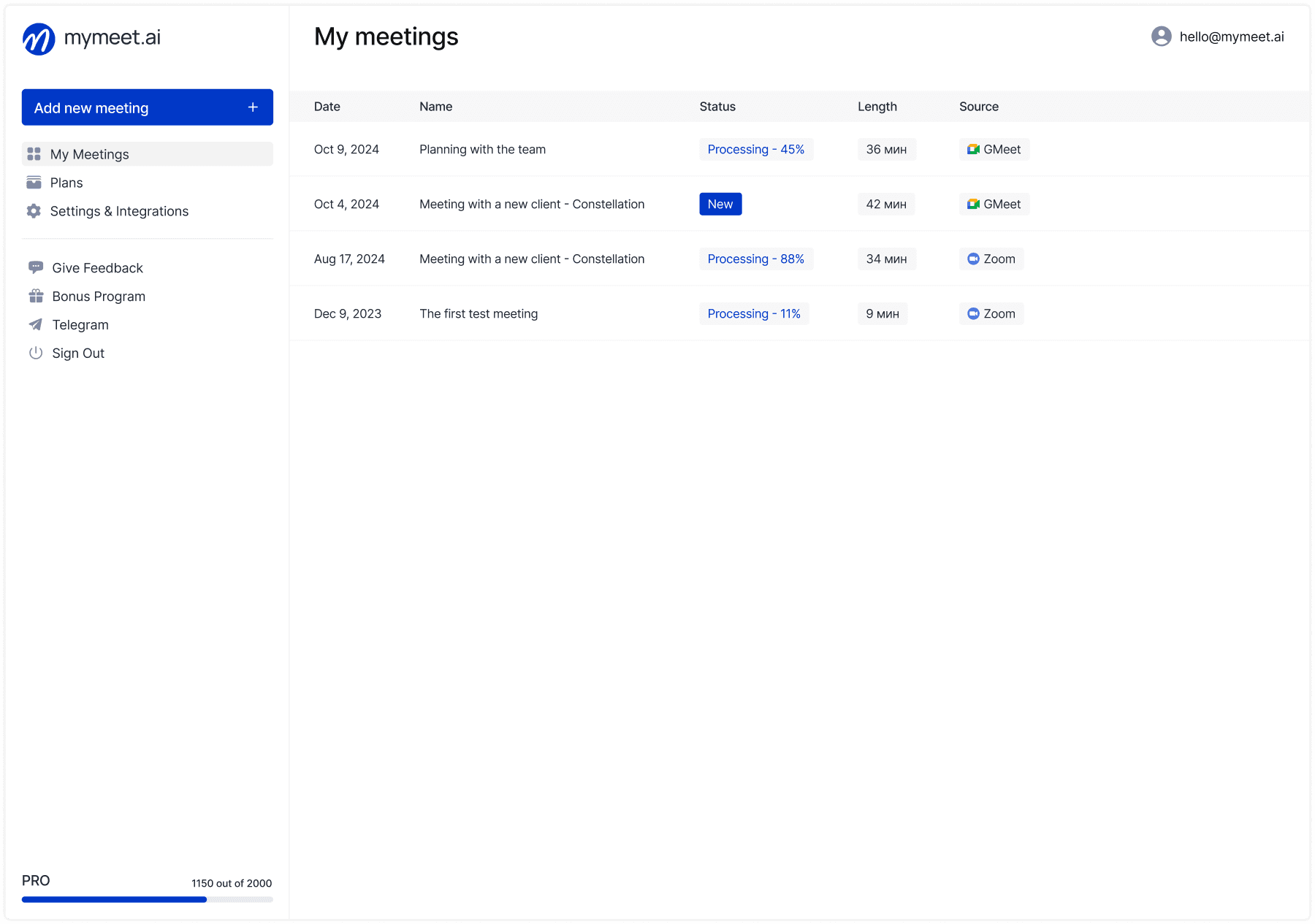
Record client meetings through mymeet.ai:
For Google Meet: Chrome extension
For Zoom/Teams/Telemost: bot through personal account
After the meeting, get text transcription with speaker separation in 5-10 minutes.
Key Metrics Analysis
Speech ratio: What percentage of time you spoke vs. client. See immediately if you're overdoing monologues.
Key moments: AI automatically highlights important discussion moments, client objections, decisions made.
Content search: Can find all moments where client spoke about specific pain point or objection.
Knowledge Base of Successful Negotiations
Accumulate records of all negotiations in your personal account:
Won deals: Review what worked. What questions were asked? How did you handle objections? What arguments worked?
Lost deals: Where did you lose the client? At what moment did the discussion go wrong?
Training Teams on Real Examples
Onboarding new salespeople: Have them listen to 5-10 recordings of the top salesperson's best negotiations. They'll hear real patterns, questions, objection handling.
Coaching: Review specific negotiations with salesperson. Not abstract advice "need to listen more," but "here at the 15-minute mark the client started talking about pain, but you interrupted and went into pitch."
Finding Team Best Practices
Analyze 50 negotiations: 25 won and 25 lost. Look for patterns:
What questions are asked more often in won deals?
What phrases correlate with success?
At what phase do you usually lose the client in lost deals?
Turn findings into a checklist or script for the team.
Practical Steps for Improvement
Step 1: Record 5 of Your Negotiations
Don't analyze yet, just collect data. Choose different types: successful and unsuccessful, with different clients.
Step 2: Analyze Patterns
For each recording, look at:
Your speech vs. client ratio (goal 43/57)
How many open vs. closed questions you asked
How you reacted to objections
How many pauses you used
Time distribution by phases (opening-discovery-solution-close)
Step 3: Find Your Main Weakness
What repeats in unsuccessful negotiations?
Talk too much?
Too few open-ended questions?
Argue with objections?
Move to pitch too quickly?
Step 4: Focus on Improving One Pattern
Don't try to change everything at once. For the next 10 negotiations: set one goal.
Example goals:
Achieve 43/57 speech ratio
Ask minimum 10 open-ended questions
Use acknowledge-explore-answer on every objection
Make minimum 10 pauses of 3+ seconds
Step 5: Record and Measure Progress
Continue recording negotiations. Analyze whether the target pattern is improving. Once mastered—move to the next one.
Conclusion
Successful negotiations aren't magic or innate talent. They're a set of specific measurable communication patterns that can be learned and improved.
Key patterns: 43/57 speech ratio (client talks more), 60-70% open-ended questions, three-step objection handling (acknowledge-explore-answer), using pauses, positive emotional coloring, opening-discovery-solution-close structure with 50% time on discovery.
Start by analyzing your current negotiations. Record 5 meetings, find your weak patterns, focus on improving one pattern at a time. Measure progress through recordings of subsequent negotiations.
Try mymeet.ai—180 minutes of recording and analysis free. Record your negotiations, get transcripts, analyze patterns, improve results.
Frequently Asked Questions
What are communication patterns in negotiations?
Communication patterns are repeating behavioral models in communication that can be measured: ratio of speaking to listening, types of questions, objection handling, use of pauses, emotional word coloring. Transcript analysis shows which patterns lead to success.
What's the ideal speaking ratio in negotiations?
Successful negotiators speak 43% of the time and listen 57%. When the client speaks more—they reveal real needs, feel heard, convince themselves by voicing problems. If you speak 70%+ of the time—you're talking too much.
How to properly handle client objections?
Use the three-step pattern: (1) Acknowledge—recognize the objection "I understand your concern," (2) Explore—investigate the real reason "Help me understand what you're comparing to?," (3) Answer—respond with context. Don't argue or defend immediately—this intensifies the objection.
What questions to ask in negotiations?
60-70% should be open-ended questions (starting with "How," "What," "Why," "Tell me") that require detailed answers and reveal needs. 30-40% closed for clarifying specific facts. Avoid turning dialogue into interrogation.
Why are pauses needed in negotiations?
Pauses give the client time to think, show you're considering what was said, attract attention before important statements. Successful negotiators make 12-15 pauses of 3+ seconds per hour. Don't fear silence—often the client will add important information during the pause.
How to analyze negotiation transcripts?
Record negotiations through mymeet.ai (extension for Google Meet or bot for other platforms), get text transcription. Analyze: percentage of time each speaker talked, types of questions, objection handling, time distribution by phases, emotional word coloring.
What's the structure of successful negotiations?
Opening (10%)—establish contact, Discovery (50%)—understand client needs through questions, Solution (30%)—show solution through lens of their pain points, Close (10%)—define next steps. Key—50% time on discovery.
Can you improve negotiation skills through recording analysis?
Yes, it's one of the most effective methods. Record negotiations, analyze patterns, find weak spots, focus on improving one pattern at a time, measure progress. Also study recordings of team's best negotiators.
How to use mymeet.ai to improve negotiations?
Record all client negotiations, get transcripts and analysis of each speaker's time, look for patterns in won vs. lost deals, create team best practices base, use top salespeople's recordings to train newcomers.
How many negotiations need to be analyzed to find patterns?
Start with 5 of your own negotiations to find personal weaknesses. To find team patterns, need minimum 20-30 negotiations (won and lost). More data—clearer patterns.
Radzivon Alkhovik