Technology & AI

Fedor Zhilkin
·
Updated on

You open a weather app on your phone — it shows the temperature. But where does that data come from? The app itself doesn't measure the weather. It sends a request to a third-party service, receives a response, and displays the result. An API is what makes that exchange possible.
APIs exist in every service you use every day. Logging into a website with your Google account — that's an API. The map inside a ride-hailing app — that's an API. Paying by card in an online store — that's an API. Let's break down what an API is, how it works, and why it matters for business.
Defining an API: What Is an Application Programming Interface
An API (Application Programming Interface) is a set of rules that allows one program to communicate with another. When two programs have an API agreement in place, they can exchange data and call each other's functions.
The word "interface" itself means a point of contact. The buttons on your phone are an interface between you and the device. An API is an interface between two programs.
How an API Transfers Data Between Programs
Think of ordering food at a restaurant. You don't walk into the kitchen yourself — you place your order through a waiter. The waiter passes the order to the kitchen, picks up the finished dish, and brings it to you. An API works the same way: it accepts a request from one program, passes it to another, and returns the result. The client program doesn't need to know how the other system works internally — it simply makes a request according to a clear set of rules and receives data in return.
API Request and API Response: How the Data Exchange Works
Every interaction through an API consists of two parts — a request and a response.
A request contains:
the address (endpoint) the program is calling
the method (retrieve data, send, update, or delete)
parameters (what exactly is needed)
an access key (if the API is private)
A response contains:
a status (success or error)
data in a format both programs understand — typically JSON
The entire exchange happens in milliseconds. You press a button — the program sends a request — receives a response — displays the result.
How an API Works: The Request Processing Logic
Let's look at a concrete example. Suppose you're using an analytics service that pulls data from multiple sources. The service itself doesn't store your CRM or messenger data — it fetches it through APIs every time you open the dashboard.
The process looks like this: your browser loads the page, the analytics service sends requests to the CRM API, the messenger API, and the spreadsheet API, collects the responses, and displays everything together. On screen, this takes a second. Behind the scenes — dozens of simultaneous requests.
GET, POST, PUT, DELETE: Core HTTP Methods in APIs
Most modern APIs operate over HTTP — the same protocol used to load websites. Requests are divided into types based on the action needed:
GET — retrieve data
POST — create a new record
PUT — update an existing record
DELETE — remove a record
These four methods cover the majority of use cases. You "read" a list of meetings with GET, "create" a new record with POST, "update" data with PUT, and "delete" with DELETE.
JSON Format in APIs: How Programs Exchange Data
When programs exchange data through an API, they need a shared format. Today's standard is JSON (JavaScript Object Notation). It looks like readable text with key-value pairs:
{
"meeting": "Team Sync",
"date": "2026-06-22",
"duration": 45,
"participants": ["Rodion", "Andrey", "Maria"]
}
Every modern programming language understands this format. A program sends JSON — receives JSON — parses it and uses the data as needed.
Types of APIs: REST, GraphQL, SOAP, and Their Differences
Not all APIs are built the same way. There are several architectural approaches, each with its own area of application. The most widely used is REST API. It uses HTTP methods, returns JSON, and doesn't store state between requests. When people say "API" without further specification, REST is almost always what they mean.
Type | Where It's Used | Data Format | Complexity |
REST | Most apps and services | JSON | Low |
GraphQL | Flexible queries on complex data | JSON | Medium |
SOAP | Banking, enterprise systems | XML | High |
gRPC | Fast server-to-server communication | Protobuf | High |
WebSocket | Chats, real-time streaming | JSON | Medium |
For most tasks — service integrations, automation, working with data — understanding REST API is sufficient. Other types appear in specialized enterprise or high-load systems.
API Examples in Popular Services and Apps
APIs are so deeply embedded in digital products that we use them constantly without noticing.
Logging in with Google on another site. You click "Sign in with Google" on a third-party service. The service calls the Google API, Google verifies your account and returns a confirmation. You're authenticated — no registration, no new password.
Maps inside a ride-hailing app. Yandex Go doesn't build its own maps — it uses Yandex Maps through an API. The app sends coordinates, receives a route, and displays it on screen.
Checkout in an online store. The store doesn't store your card details. At checkout, it calls the payment service API, which processes the transaction and returns a status.
Using APIs to Integrate Workplace Tools
In a work context, APIs are used to automatically transfer data between services. A few common scenarios:
A CRM automatically receives new user data from an app
A task tracker creates tickets based on events in other systems
An analytics platform pulls data from multiple sources into one dashboard
Notifications from one service appear in a corporate messenger
An AI agent queries external data sources and answers questions based on them
In all of these cases, no one is copying data manually — programs handle it through APIs.
Public, Private, and Partner APIs: Types of Access
Not all APIs are equally accessible. By access level, they fall into a few categories.
Public (open) APIs are available to any developer after registration — they typically require an API key for identification. Weather services, maps, and some AI services work this way.
Partner APIs are open only to verified partners — payment system APIs, for example, require a signed agreement.
Internal (private) APIs are used exclusively within a company: different apps or microservices within one team communicate with each other.
User-specific APIs are tied to a specific account. You receive a key that gives programs access to your personal data in a service — this is exactly how the mymeet.ai API works.
The mymeet.ai API for Working with Meeting Data
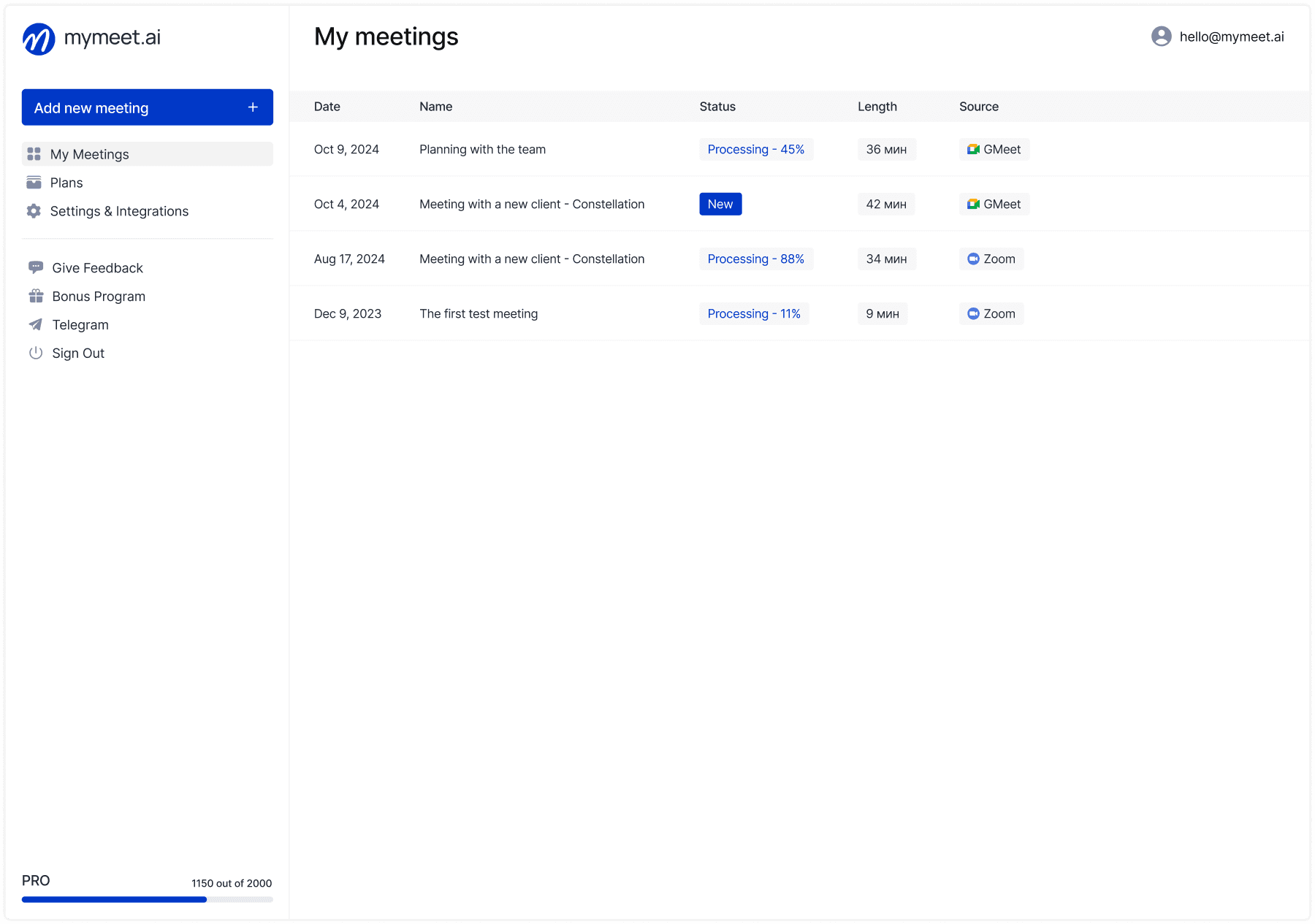
mymeet.ai is a service for automatic recording, transcription, and analysis of online meetings. With the release of an open API, meeting data is no longer locked inside the interface: it can now be retrieved programmatically, passed to other systems, and connected to AI agents.
Through the mymeet.ai API, external tools gain access to structured data from each meeting:
transcript with timestamps and speaker breakdown
AI summary and brief overview
participant list and duration
tasks and agreements extracted by AI
workspace data
This isn't raw text — it's already processed data, ready to use in other systems without additional handling.
Two Ways to Use the mymeet.ai API
Direct requests for developers. If your team includes a developer, they can call the API directly: retrieve transcripts, push meeting data to a CRM, create tracker tasks from call outcomes, build analytics dashboards. The API works in a standard way — key in the request header, response in JSON.
Connecting AI agents via MCP. For those who don't write code, mymeet.ai supports the MCP protocol (Model Context Protocol) — the standard for connecting AI agents to external data sources. ChatGPT, Claude, Cursor, and other compatible tools connect to meeting data without writing a single line of code — through integration cards in the Integrations section. Once connected, the agent answers questions about your meeting history in natural language.
What to know about your mymeet.ai API key:
✅ One key per user — generate it yourself in Settings, no requests or waiting required
✅ Tied to a workspace — switch workspaces, switch data context
✅ Regenerate in one click — the old key stops working instantly
✅ MCP integration works in desktop applications
✅ Available on Lite, Pro, and Business plans.
On the free plan, the key page is accessible — you can explore the documentation in advance
Summary: What an API Is and Why It Matters
An API is not a niche developer tool. It's the infrastructure that underpins most digital products and automation workflows. Understanding how APIs work helps you get more out of the services that provide them — and make informed decisions when choosing tools for your team.
If a service offers an API, its data isn't locked inside the interface. It can be retrieved programmatically, passed to another system, and connected to an AI agent. That's the difference between a tool that works in isolation and one that becomes a native part of your workflow stack.
Having covered what an API is in general, the natural next step is more specific territory: how REST API works, what the MCP protocol is, and how modern AI agents use APIs to work with data.
Frequently Asked Questions About APIs
What is an API in plain language?
An API is a set of rules that lets one program communicate with another. A program sends a request through the API and gets a response with data. For example, a weather app receives temperature data from a third-party service via API — the app itself doesn't measure the weather.
How is an API different from a website?
A website displays data to a person in the form of a page. An API passes data to another program in the form of structured text (usually JSON). The same service can have both a website for users and an API for developers.
What is a REST API?
REST API is the most common type of API. It operates over HTTP, returns data in JSON format, and doesn't store state between requests. Most modern services offer REST APIs.
What is an API key?
An API key is a unique string of characters that identifies requests coming from your program. The service sees who is making the request, counts usage against limits, and checks access permissions. Never share your API key with third parties — if it's compromised, someone else gains access to your data.
What is an endpoint in an API?
An endpoint is a specific URL address in an API that a program calls. For example, one endpoint returns a list of meetings, another returns the details of a specific meeting, and a third returns the transcript. Each endpoint handles its own task.
How do programs communicate through an API?
One program sends an HTTP request to an address (endpoint) with the necessary parameters and an access key. The other program processes the request and returns a response — typically in JSON format. The entire exchange takes milliseconds.
Why does a business need an API?
An API allows data to move automatically between services without manual copying. A CRM receives data from forms, a task tracker creates tasks from meetings, an analytics platform consolidates data from multiple sources — all through APIs, with no human involvement.
What is JSON in the context of an API?
JSON (JavaScript Object Notation) is a text-based format for transferring data between programs. It looks like key-value pairs inside curly braces. Every modern programming language understands it, which is why it became the standard for REST APIs.
What is MCP and how does it relate to APIs?
MCP (Model Context Protocol) is a standard for connecting AI agents to external data sources through APIs. ChatGPT, Claude, and Cursor use MCP to query data from third-party services and answer questions about it in natural language.
How do you get access to a service's API?
Usually, all it takes is signing up for the service and finding your key in account settings. Most services provide documentation with example requests. Some APIs require a separate application or contract — this applies to banks and payment processors.
Fedor Zhilkin