Technology & AI

Radzivon Alkhovik
·
Updated on

An AI agent, on its own, only knows what it was trained on. For it to answer questions about your actual data — meetings, files, tasks, messages — you need to connect MCP servers. The right set of MCP servers turns an agent from a smart chatbot into a tool that works with your specific context.
This article covers the best MCP servers for different tasks: from meetings and documents to code and databases. The list was compiled based on protocol maturity, documentation quality, and practical value for working teams.
What an MCP Server Is and Why You Need One
MCP (Model Context Protocol) is an open standard that allows AI agents to connect to external data sources. An MCP server is a program that implements the protocol on the side of a specific service. By connecting an MCP server to Claude Desktop or Cursor, you give the agent access to that service's data — without manual copying and without writing code.
The MCP server ecosystem is growing fast: hundreds of servers have been published openly, and major services are releasing official integrations. Figuring out which ones are genuinely useful is getting harder.
Criteria for Choosing an MCP Server
Before connecting the first server you come across, it's worth knowing what separates a good MCP server from an unfinished prototype.
Documentation quality is the first signal. A good MCP server has clear installation instructions, a description of available tools, and example requests. If the documentation is missing or incomplete, expect problems during setup.
Maintenance activity matters because MCP is a young, actively evolving standard. A server with its last update six months ago may not work with current versions of Claude Desktop or Cursor.
The type of data provided must match your needs. Some servers offer read-only access (Resources); others offer actions (Tools). For analytics, reading is enough; for automation, you need tools.
Security is what people often overlook. An MCP server receives the API key for your account. Official servers from the services themselves or established developers are more trustworthy than anonymous repositories.
Top MCP Servers for Work Tasks in 2026
Below are eight MCP servers that solve specific work problems. mymeet.ai takes the top spot as the most specialized tool for teams that work with online meetings.
1. Mymeet.ai MCP — Meeting Data and Transcripts for AI Agents
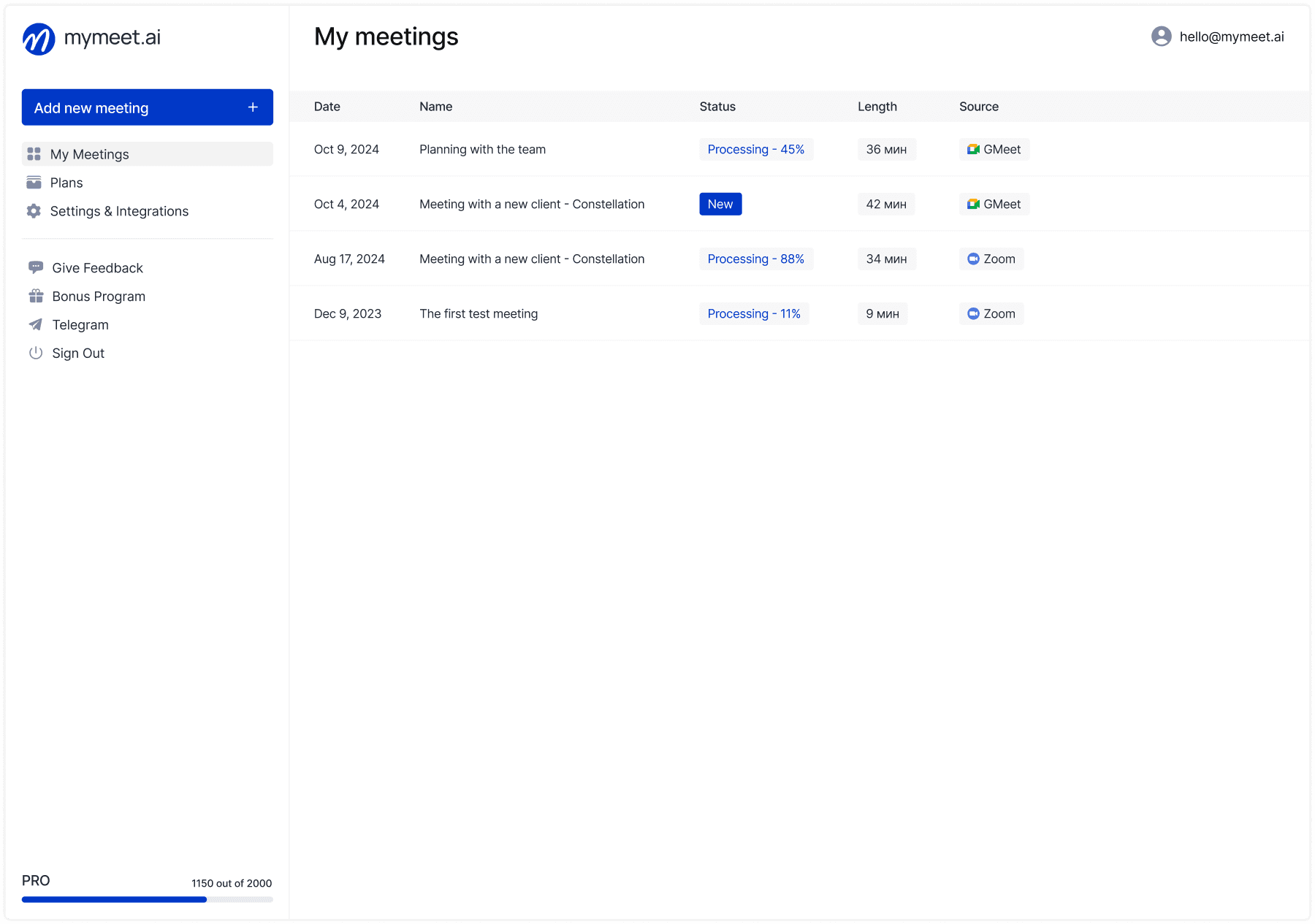
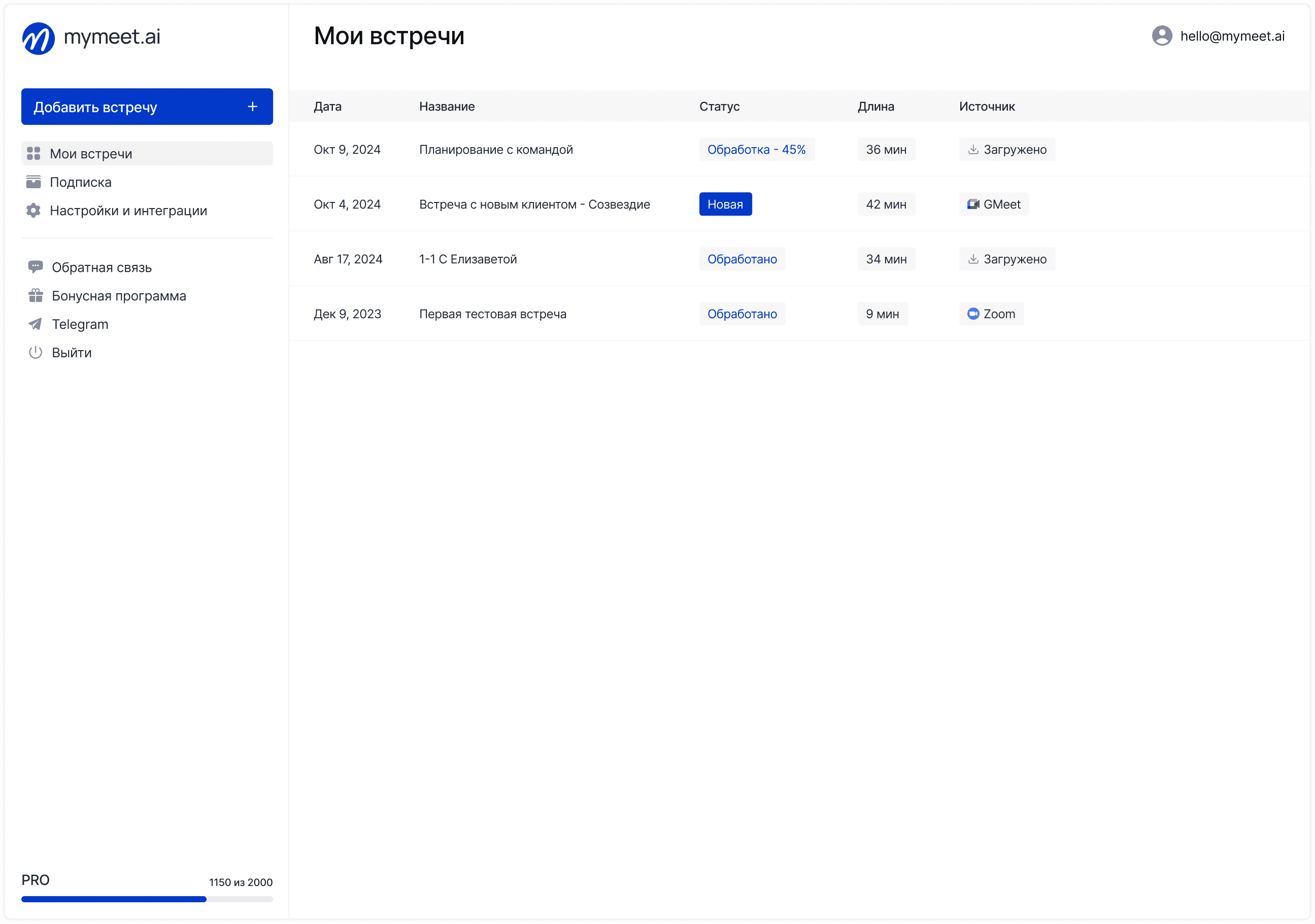
Mymeet.ai — a Russian-language service for recording, transcribing, and analyzing online meetings — provides an MCP server with access to meeting data. Once connected, an AI agent can work with transcripts, summaries, participants, and tasks from meetings in natural language.
mymeet.ai addresses a problem every team faces: meeting data stays inside the service and doesn't reach the AI agent automatically. With the mymeet.ai MCP server, the agent knows what was discussed at recent syncs, who took on which tasks, and what decisions were made — without manually copying transcripts.
Setup takes a few minutes: get your API key from Settings, copy the ready-made config from the relevant agent card in the Integrations section, and paste it into the MCP settings of your desktop application.
Available on Lite, Pro, and Business plans. On the free plan, integration cards and instructions are open for exploration.
2. Filesystem MCP — Access to Local Files and Folders
Filesystem MCP is an official server from Anthropic — one of the first in the ecosystem. It gives the AI agent access to files and folders on your computer within specified directories.
The agent can read files, browse folder structure, search by content, and create new documents. This makes Filesystem MCP essential for working with local projects, codebases, and documents.
Pros:
Official server from Anthropic, actively maintained
Flexible configuration of accessible directories
No external API keys required
Supports both reading and writing files
Cons:
Local files only — cloud storage is not supported
Requires careful permission setup to prevent accidental changes
No semantic content search with ranked results
Filesystem MCP is a foundational server worth connecting first. It gives the agent context about the local environment and works in combination with any other server.
3. GitHub MCP — Repositories, Issues, and Pull Requests for Developers
GitHub MCP provides access to repositories, issues, pull requests, code, and comments. Once connected, the agent can answer questions about code, analyze PRs, search for issues by criteria, and even create new issues.
For engineering teams, this is one of the most valuable MCP servers. The agent gets context across the entire repository and can assist with code reviews, finding similar tasks, and analyzing change history.
Pros:
Official server from GitHub
Access to all key objects: code, issues, PRs, comments
Supports both reading and creating objects (issues, comments)
Works with private and public repositories
Cons:
Requires a GitHub token with the appropriate access scopes
Large repositories may slow down agent responses
Does not directly support GitHub Actions or CI/CD
GitHub MCP is especially powerful when paired with Cursor or Windsurf — the agent simultaneously sees the code on disk and the tasks in the repository.
4. Brave Search MCP — Real-Time Web Search
Brave Search MCP gives the AI agent the ability to search for current information on the web. This addresses one of the core limitations of AI agents — knowledge is cut off at the training date.
With Brave Search MCP, the agent can check up-to-date information, look up documentation, find news, and compare information from multiple sources within a single conversation.
Pros:
Real-time web data in agent responses
Brave Search doesn't share query data with ad networks
Simple setup via API key
Supports both web and news search
Cons:
Requires a paid Brave Search API key at high volumes
Result quality depends on Brave's index, which has less coverage than Google
Cannot open and read specific pages — search results only
Brave Search MCP is a solid choice for anyone who wants to give the agent access to current data without relying on Google's tooling.
5. Notion MCP — Knowledge Base and Working Documents
Notion MCP gives the agent access to pages, databases, and blocks in your Notion workspace. This makes it particularly useful for teams that store knowledge, processes, and documentation in Notion.
The agent can find relevant pages, read their content, search databases, and create new records. For teams with large knowledge bases, it's one of the most in-demand MCP servers.
Pros:
Access to the team's full knowledge base
Supports search across page content and databases
Can create and update pages
Works with private and shared workspaces
Cons:
Speed depends on the Notion API, which can be slow at times
Complex blocks (synced blocks, certain table types) may not render correctly
Requires setting up a Notion integration with the right permissions
Notion MCP works best as a knowledge search tool: "find the page about our onboarding process" or "what does our code review guide say."
6. Slack MCP — Team Messages and Channels
Slack MCP gives the agent access to channels, messages, and direct conversations. Once connected, you can ask questions about message history, search discussions by topic, and send messages.
Pros:
Access to channel and conversation history
Keyword search across messages
Ability to send messages on behalf of the user
Works with private channels if permissions are granted
Cons:
Requires OAuth authorization with broad permissions
Message history is limited by the Slack plan (free plan: 90 days)
Allowing the agent to send messages requires care
Slack MCP is useful for analyzing conversations on a specific topic or finding decisions that were discussed in the past.
7. PostgreSQL MCP — Direct Database Access
PostgreSQL MCP gives the agent the ability to run SQL queries against your database. This enables natural-language data analytics: "how many users signed up in the last month" — and the agent forms the query itself.
Pros:
Direct data queries without writing SQL manually
Works with any PostgreSQL-compatible database
Reads schema and table structure
Useful for analytics and reporting
Cons:
Access to a production database carries risks — a read-only connection is strongly recommended
Complex queries may be formed incorrectly by the agent
Requires direct database access (IP, port, credentials)
PostgreSQL MCP is suited for analysts and developers who want to work with data without constantly writing SQL queries by hand.
8. Puppeteer MCP — Browser Control and Web Page Reading
Puppeteer MCP gives the agent the ability to control a browser: open pages, read their content, fill out forms, and take screenshots. This is useful for web scraping tasks and automation.
Pros:
Reads the content of any web page, including dynamic content
Can interact with the UI (click buttons, fill forms)
Takes screenshots of pages
Useful where Brave Search MCP only returns links
Cons:
Requires Puppeteer and Chromium installed on the computer
Slower than API-based search
Some websites block automated browsers
Giving the agent unrestricted browser actions is not recommended
Puppeteer MCP is a tool for advanced users who need access to page data where no open API exists.
Top MCP Servers: Key Parameter Comparison
Most teams start with 2–3 servers and add more gradually as needs arise. There's no need to connect everything at once — the agent works more effectively with a focused set of tools.
MCP Server | Data Type | API Key Required | Creates Objects | Best For |
mymeet.ai | Meetings, transcripts | Yes | No | All teams |
Filesystem | Local files | No | Yes | Everyone |
GitHub | Code, issues, PRs | Yes (token) | Yes | Developers |
Brave Search | Web | Yes | No | Everyone |
Notion | Docs, databases | Yes | Yes | Teams with Notion knowledge base |
Slack | Messages | Yes (OAuth) | Yes | Teams on Slack |
PostgreSQL | Databases | Yes | No (read-only) | Analysts, developers |
Puppeteer | Web pages | No | No | Advanced users |
How to Choose MCP Servers for Your Team
The choice of MCP servers depends on where your work data lives and what tasks you want the AI agent to handle.
If your team runs regular online meetings and wants the agent to work with their content — mymeet.ai MCP is the first pick. It gives the agent context from negotiations, syncs, and strategy sessions without manual copying.
For engineering teams, the baseline set is Filesystem + GitHub. The agent simultaneously sees the local code and repository tasks, making it genuinely useful for reviews and analysis.
If your team's knowledge lives in Notion — Notion MCP turns the agent into a search engine for your knowledge base. Instead of manually hunting for a page, just ask.
For analytics tasks, PostgreSQL MCP enables natural-language data queries without writing SQL — useful for ad-hoc analysis when you don't want to involve a developer every time.
Brave Search MCP is worth adding for almost everyone — it gives the agent current context from the web and compensates for the age of training data.
Summary: How to Get Started with MCP Servers
MCP servers change how AI agents operate in a work context. Instead of an agent that only knows what it was told, you get an agent that can see your meetings, files, tasks, and messages — and responds based on real data.
Getting started is straightforward: install Claude Desktop or ChatGPT Desktop, pick 2–3 MCP servers for your use cases, connect them following the instructions, and try talking to the agent about your real work data. The difference from the default mode is immediately noticeable.
The MCP server ecosystem keeps growing — new services publish official MCP integrations every week. Teams that start working with MCP today gain an advantage while competitors are still figuring out the protocol.
Frequently Asked Questions About MCP Servers
What is an MCP server and how does it work?
An MCP server is a program that provides an AI agent with access to the data or functions of a specific service via the MCP protocol. The agent connects to the MCP server through the settings of a desktop application and can then query that service's data when answering user questions.
Which MCP server should I connect first?
It depends on your team's needs. For most people — Filesystem MCP as a baseline for local file access, plus one specialized server for a specific need: mymeet.ai for meetings, GitHub for development, Notion for the knowledge base.
Do MCP servers work in the browser versions of Claude or ChatGPT?
No. MCP only works in desktop applications: Claude Desktop, ChatGPT Desktop, Cursor, Windsurf. The web versions at claude.ai and chatgpt.com do not support MCP servers.
How many MCP servers can be connected at the same time?
There's no limit. The agent can simultaneously have access to the file system, meetings, GitHub, and a database. That said, it's better to connect only the servers you actually need — this simplifies access management and speeds up the agent.
Is it safe to connect MCP servers to work data?
With proper setup — yes. Key rules: use official or verified servers, grant only the minimum necessary permissions, and use a read-only connection for databases. API keys are stored in a config file on your computer and are not shared with third parties.
Where can I find new MCP servers?
Anthropic maintains an official list on GitHub (repository: modelcontextprotocol/servers). Many services publish their own MCP servers in "Integrations" or "Developer" sections of their documentation.
Do you need programming skills to connect MCP servers?
To connect ready-made MCP servers — no. It's enough to copy the config from the documentation and paste it into the desktop application settings. Writing a new MCP server from scratch requires programming.
What's better: MCP or direct API integration?
For end users — MCP is more convenient because it requires no code. For developers building custom integrations, a direct API offers more control. mymeet.ai supports both options: MCP for AI agents and a REST API for developers.
Can one MCP server be used in multiple applications?
Yes. A single MCP server can be connected to multiple applications simultaneously — Claude Desktop, Cursor, Windsurf. Each application connects to the server independently through its own settings.
How do I know if an MCP server connected successfully?
In Claude Desktop, connected servers appear in the MCP settings. In Cursor — in the MCP section of settings. After connecting, ask the agent about data from the service — if it responds with real data, the server is working correctly.
Radzivon Alkhovik