Technology & AI

Radzivon Alkhovik
·
Updated on
A project manager opens their laptop Monday morning. Five tasks have piled up over the weekend: write an email to a client, process Friday's call outcomes, prepare a brief report for the director, structure notes from three different sources, and answer a dozen questions from the team. This used to take the entire first workday. Now — an hour and a half, because an AI assistant handles most of it.
The AI assistant market has grown so much over the past year that choosing the right tool without a clear understanding of your needs has become difficult. The mymeet.ai team tested dozens of solutions and compiled an honest rating of those that actually work in 2026.
How to Choose an AI Assistant: What to Look For
Before diving into the rating, it's important to understand: there's no single best AI assistant for everyone. There's only the best one for a specific task. A marketer, developer, and sales manager will choose different tools — and all three will be right.
Universal vs Specialized AI Assistants: What's the Difference
Universal assistants like ChatGPT or Claude cover a wide range of tasks: writing texts, analyzing documents, answering questions, generating code. Their main advantage is flexibility. One tool replaces a dozen narrow solutions.
Specialized assistants are tailored for specific scenarios. mymeet.ai records and analyzes business meetings, Notion AI works with knowledge bases, GitHub Copilot helps write code. Such tools deliver better results in their niche because they're trained specifically on that data and optimized for those tasks.
Practice shows that the best combinations are one universal assistant for various text tasks plus one or two specialized ones for key workflows.
What to Consider When Choosing an AI Assistant for Business
For companies handling personal data, specific requirements apply beyond standard selection criteria. Data protection compliance is mandatory if the assistant processes customer or employee personal data. Data storage location matters for companies with localization requirements.
Access reliability is also important: some services periodically restrict access from certain regions, creating unpredictable work interruptions. When choosing, check for local payment options and native language support — small details that become noticeable when something goes wrong.
Top AI Assistants in 2026
1. mymeet.ai — AI Assistant for Automatic Business Meeting Recording
Website: mymeet.ai
Cost: 180 minutes free, then paid plans
Languages: Russian, 73 languages total
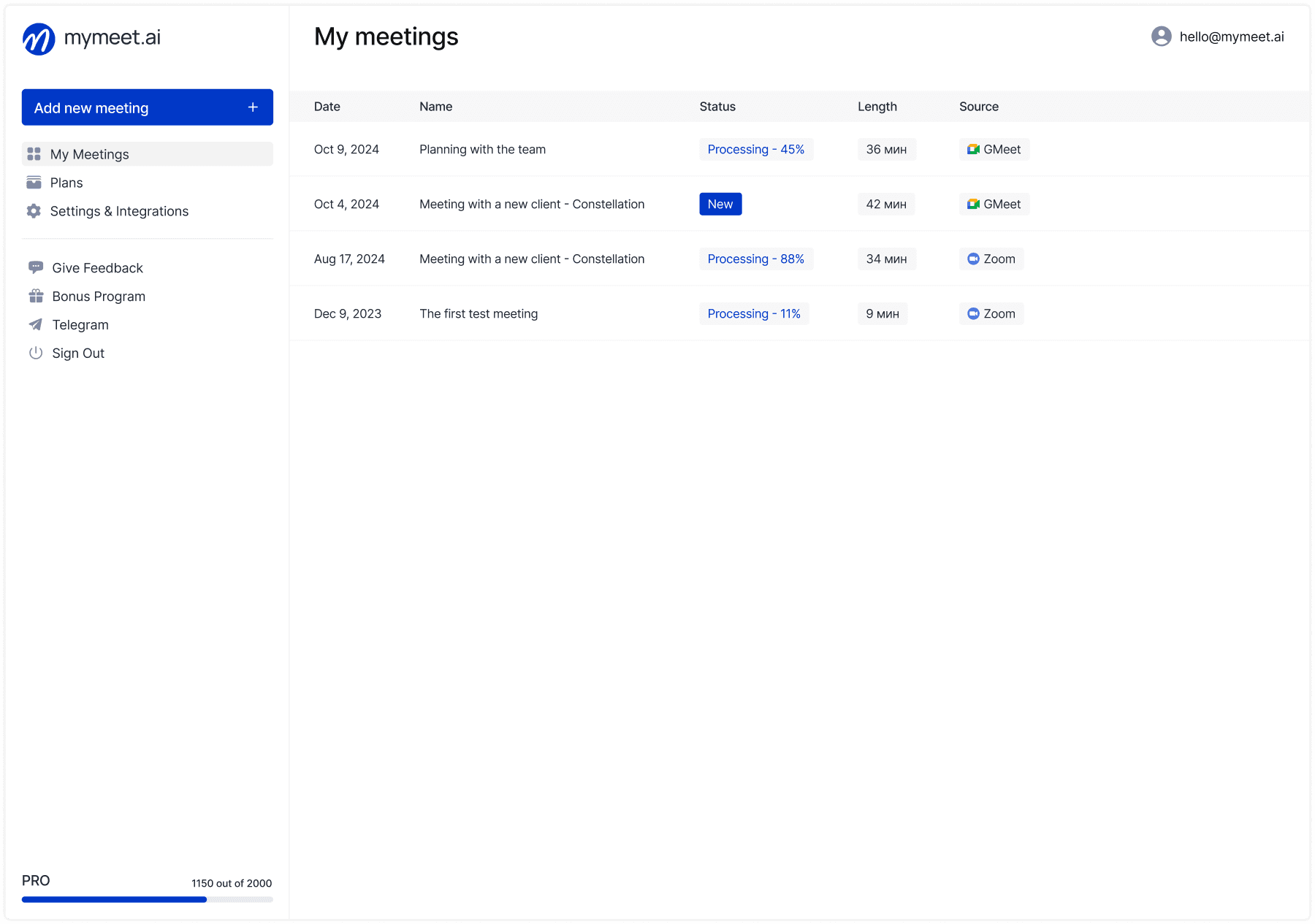
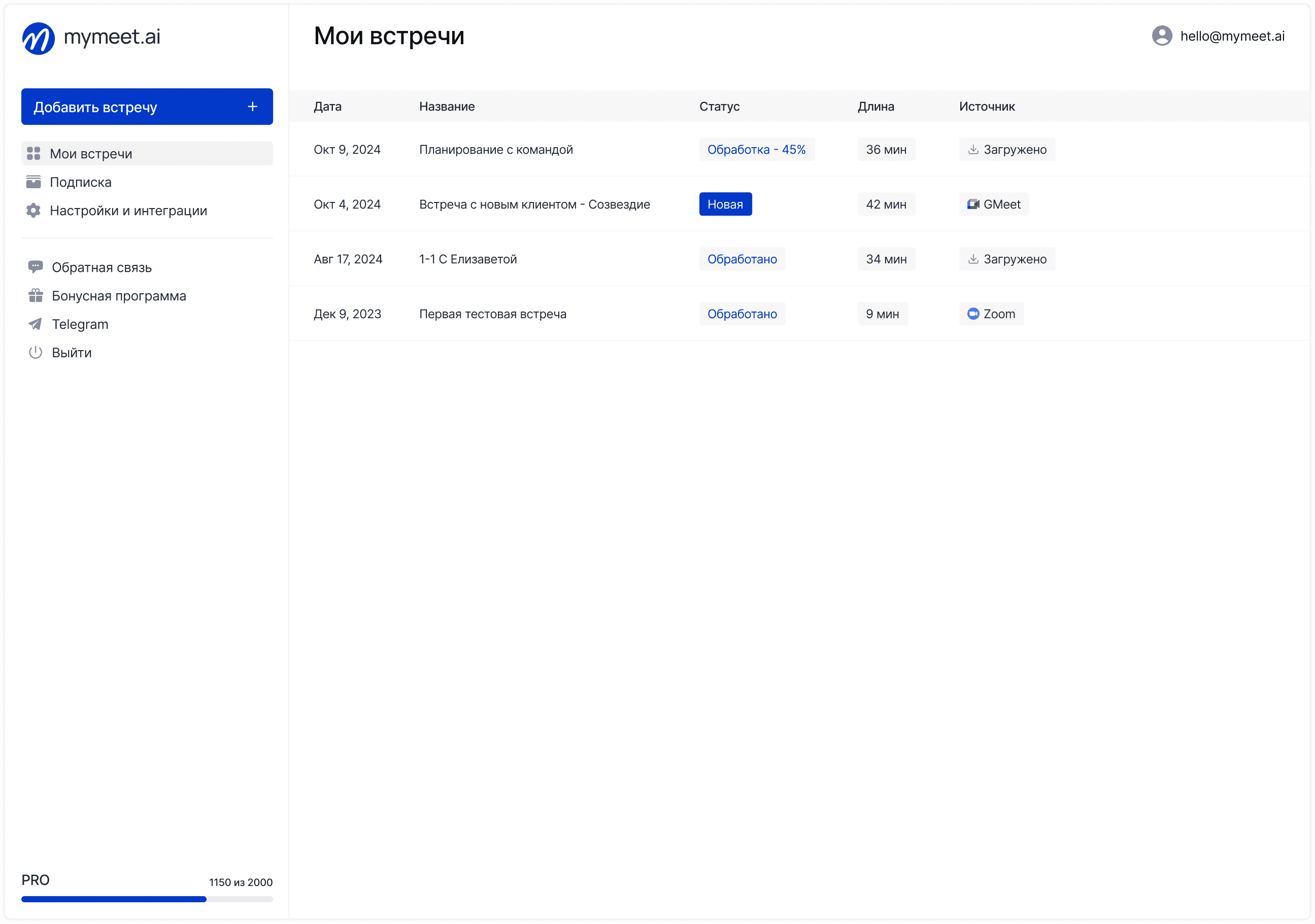
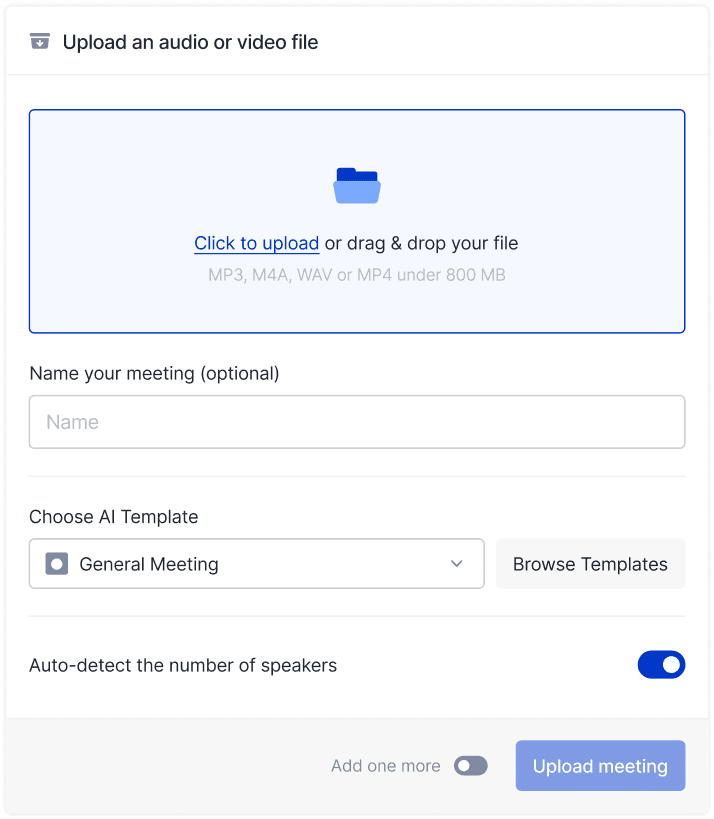
mymeet.ai solves a problem every team faces: information from meetings gets lost. Who said what, what decision was made, who's responsible for what — without documentation, all of this evaporates from memory within a few days. The service connects to Zoom, Google Meet, Microsoft Teams, Yandex.Telemost (Russian video conferencing service), and other platforms as a bot participant and automatically records the entire conversation.
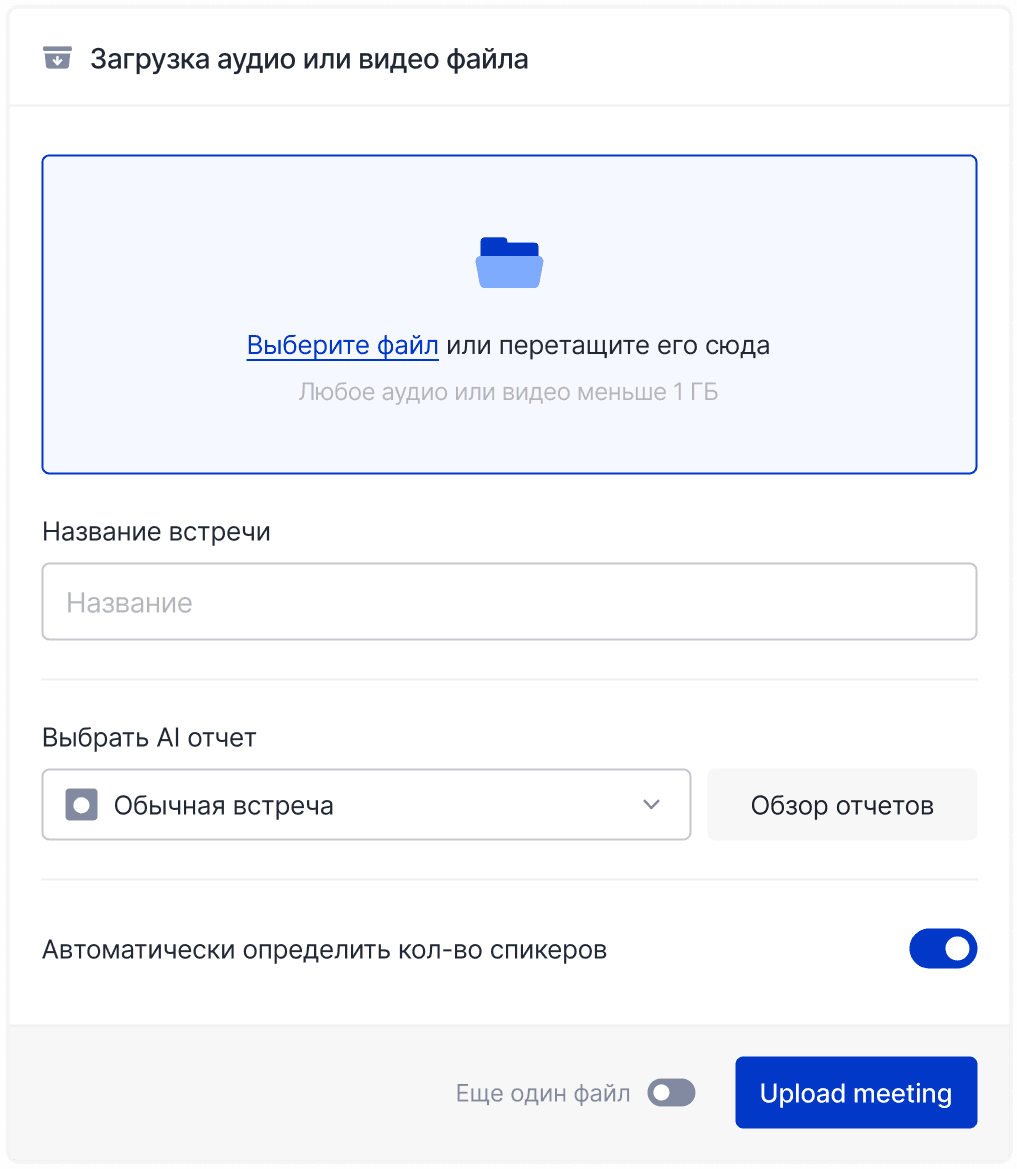
After the meeting ends, a transcript with 96-98% accuracy appears in the dashboard, divided by speakers with timestamps. Based on this, AI generates a structured report in one of 11 formats: Meeting Minutes, Client Meeting, HR Interview, Team Sync, Research, and others. Through AI chat, you can ask questions across the archive of all meetings and get precise answers with quotes.
Key features:
Auto-connection through Google Calendar, Outlook, Yandex Calendar, Microsoft Exchange
96-98% transcription accuracy with speaker separation
11 AI report types for different meeting formats
Automatic task extraction with assignees and deadlines
AI chat for searching information across meeting archives
Integration with amoCRM and Bitrix24 (popular Russian CRM systems)
Export to DOCX, PDF, MD, JSON
Full compliance with Russian data protection law (152-FZ), data stored on servers in Russia
180 minutes free, no credit card required
mymeet.ai suits teams of any size that hold regular client meetings, internal standups, or research interviews. Especially useful for sales departments, HR, and project managers — those for whom every meeting generates tasks and agreements that are important not to lose.
2. ChatGPT — Universal AI Assistant for Text Tasks
Website: chat.openai.com
Cost: Free tier, Plus from $20/month
Languages: Russian and 50+ languages
ChatGPT from OpenAI remains the most popular universal AI assistant in the world. In 2026, GPT-4o and GPT-4.5 models are available, handling a wide range of tasks well: writing texts, analyzing documents, answering questions, generating code, translation, brainstorming.
ChatGPT's main strength is versatility and quality of work with multiple languages. It understands complex requests, maintains context in long dialogues, and delivers structured responses. The free version is sufficient for most everyday tasks; the paid tier unlocks access to more powerful models and file analysis features.
Key features:
Works with text, code, data, images
Memory between sessions on paid tiers
Plugins and custom GPTs for specific tasks
Available via browser and mobile apps
The main downside for some users — data is stored on US servers, which raises questions when working with confidential corporate information.
3. Claude — AI Assistant for Document Work and Analysis
Website: claude.ai
Cost: Free tier, Pro from $20/month
Languages: Russian and 30+ languages
Claude from Anthropic stands out among competitors with a large context window and quality work with long documents. If you need to analyze a lengthy contract, summarize 50 pages of research, or structure a large dataset — Claude handles this better than most alternatives.
Another distinction: Claude provides more balanced and careful responses, hallucinates less frequently, and honestly admits when it doesn't know the answer. For tasks where accuracy matters more than speed, this is fundamental.
Key features:
Large context window — works with extensive documents
High quality analytical texts
Fewer hallucinations compared to competitors
Works well with multiple languages
4. Gemini — AI Assistant in the Google Ecosystem
Website: gemini.google.com
Cost: Free tier, Advanced from $19.99/month
Languages: Russian and 40+ languages
Gemini from Google is the optimal choice for those actively using Google Workspace. The assistant is built into Gmail, Google Docs, Sheets, Meet and works right inside familiar tools without switching between applications.
Gemini 2.5 Flash and 2.5 Pro models in 2026 show good results in multimodal tasks: understands text, images, audio, and video. The free Flash version works without request limits.
Key features:
Deep integration with Google Workspace
Multimodality — works with text, images, audio
Free version without request limits
Understands multiple languages well
5. GigaChat — Russian AI Assistant from Sber
Website: giga.chat
Cost: Free tier, business rates on request
Languages: Russian
GigaChat is Russia's flagship AI assistant, storing data on servers in Russia and complying with Russian data protection requirements (152-FZ). For companies with strict data localization requirements, this is a fundamental advantage over foreign alternatives.
In 2025, GigaChat 2.0 was released with improved text generation and multimodal capabilities. The assistant understands Russian language well, including professional vocabulary and industry terms.
Key features:
Data on Russian servers, 152-FZ compliance
Good understanding of Russian language and professional vocabulary
Integration with Sber ecosystem and corporate systems
Special rates for business and government organizations
6. Yandex GPT — AI Assistant in the Yandex Ecosystem
Website: ya.ru
Cost: Free through Alice and Yandex 360
Languages: Russian
Yandex GPT is built into the Yandex ecosystem: works through Alice (Yandex's voice assistant), Yandex 360, Yandex Browser, and other services. For companies already using Yandex corporate products, this is the simplest way to add an AI assistant to workflows without additional setup.
Particularly good at Russian-language tasks: text generation, answering questions, working with documents in Yandex.Disk. Data is stored in Russia, which matters for companies with localization requirements.
Key features:
Built into Yandex ecosystem without additional setup
Works through Alice on smartphones and smart speakers
Data on Russian servers
Available free within Yandex 360
7. Microsoft Copilot — AI Assistant for Office 365
Website: copilot.microsoft.com
Cost: Included in Microsoft 365 Business from $22/month per user
Languages: Russian and 30+ languages
Microsoft Copilot is built into Word, Excel, PowerPoint, Outlook, and Teams. If a team works in the Microsoft ecosystem, Copilot becomes a natural extension of familiar tools — no need to switch between applications.
In Word, it helps write and edit documents; in Excel, it analyzes data and builds formulas; in Outlook, it composes emails and summarizes correspondence; in Teams, it creates meeting notes. For enterprise clients, Microsoft also offers enhanced security and compliance capabilities.
Key features:
Built into the entire Microsoft 365 suite
Works with corporate data within a protected environment
Summarizes Teams meetings and emails
Unified licensing within Microsoft 365
8. Grok — AI Assistant from xAI with Access to Current Data
Website: grok.com
Cost: Free tier, Premium through X subscription
Languages: Russian and 20+ languages
Grok from xAI (Elon Musk's company) stands out among competitors with real-time access to current data from the X social network. This makes it useful for news monitoring, trend analysis, and tasks where information currency matters.
In 2025, Grok-3 was released with Think and Big Brain modes for complex analytical tasks. The assistant features a more direct and less cautious response style compared to ChatGPT and Claude.
Key features:
Real-time access to current X data
Deep reasoning modes for complex tasks
Direct response style without excessive caution
Multimodality — works with images
9. DeepSeek — Powerful Open-Source AI Assistant
Website: deepseek.com
Cost: Free
Languages: Russian, Chinese, English, and others
DeepSeek from a Chinese company became one of the major surprises of 2026: a free open-source assistant that competes with paid alternatives in response quality. Particularly strong in technical tasks: data analysis, mathematics, programming.
For companies that want to deploy an AI assistant on their own infrastructure, DeepSeek's open source is an attractive option. The model can be run locally, which solves data confidentiality concerns.
Key features:
Completely free access
Open source for local deployment
High quality in technical and analytical tasks
Model can be run on your own servers
10. Notion AI — AI Assistant for Knowledge Base Work
Website: notion.so
Cost: From $10/month as part of Notion Plus
Languages: Russian and 20+ languages
Notion AI is built directly into the Notion workspace and works with content already stored there. This is its main advantage: the assistant knows the context of your knowledge base and can answer questions based on your team's specific documents.
It helps write and edit texts directly in Notion, create page summaries, generate tables, and answer questions about knowledge base content. For teams already working in Notion, this is a natural extension without needing to switch between tools.
Key features:
Works with your Notion workspace content
Answers questions about knowledge base documents
Helps write, edit, and structure content
Built in without additional setup
Comparison Table of the Best AI Assistants in 2026
Choosing an AI assistant depends on the specific task, budget, and data security requirements. There's no universal winner: each tool on the list occupies its niche. The table below helps quickly compare key parameters and narrow the choice to 2-3 candidates for detailed testing.
Assistant | Specialization | Free Tier | Data in Russia | Russian Language |
mymeet.ai | Business meetings | 180 minutes | Yes | Excellent |
ChatGPT | Universal | Yes | No | Good |
Claude | Documents, analysis | Yes | No | Good |
Gemini | Google Workspace | Yes | No | Good |
GigaChat | Universal | Yes | Yes | Excellent |
Yandex GPT | Yandex ecosystem | Yes | Yes | Excellent |
Microsoft Copilot | Office 365 | No | Partial | Good |
Grok | Current data | Yes | No | Good |
DeepSeek | Technical tasks | Yes | No | Good |
Notion AI | Knowledge bases | No | No | Good |
For companies with data localization requirements, the choice narrows to mymeet.ai, GigaChat, and Yandex GPT. If localization requirements aren't critical, consider testing ChatGPT or Claude — they deliver high quality for most text tasks. The best way to choose is to run free versions of two or three candidates on real work tasks and compare results.
Which AI Assistant to Choose for a Specific Task
The most common question when choosing an AI assistant: "Which is best?" The better question is: "Best for what?" Tools from the top solve different problems and rarely compete directly.
For automatic business meeting recording and analysis, there's no alternative to a specialized assistant — mymeet.ai does this better than any universal tool. For writing texts, analyzing documents, and brainstorming, ChatGPT or Claude will cover 90% of needs. If the team lives in Google Workspace, Gemini integrates seamlessly. For companies with strict data localization requirements, GigaChat or Yandex GPT is the safest choice.
The optimal strategy for most teams: one specialized assistant for the key workflow plus one universal one for various text tasks. This covers most scenarios without overloading the tool stack.
Conclusion
AI assistants are no longer an experimental tool. In 2026, this is working infrastructure that affects team speed and work quality. Choosing the right tool for a specific task matters more than searching for "the best AI" in general.
Start with one scenario where routine takes the most time. For most teams, this is meeting documentation — mymeet.ai covers this task completely and offers 180 minutes free without requiring a credit card.
Frequently Asked Questions About Top AI Assistants
Which AI assistant is best in 2026?
There's no single answer — the best assistant depends on the task. For business meetings, it's mymeet.ai; for universal text tasks, ChatGPT or Claude; for working in the Google ecosystem — Gemini; for companies with data localization requirements — GigaChat or Yandex GPT.
Which AI assistants work without restrictions?
mymeet.ai, GigaChat, Yandex GPT, and DeepSeek work stably worldwide. ChatGPT, Claude, and Gemini are widely available. Microsoft Copilot is available through Microsoft 365 corporate licenses.
Which AI assistant complies with data protection requirements?
mymeet.ai, GigaChat, and Yandex GPT store data on Russian servers and comply with Russian data protection requirements (152-FZ). For companies in other regions, check each service's data processing policies and compliance certifications relevant to your jurisdiction.
Are there free AI assistants for business?
Yes. mymeet.ai gives 180 minutes free without requiring a credit card. ChatGPT, Claude, Gemini, and GigaChat offer free tiers with basic functionality. DeepSeek is completely free. Free versions are usually sufficient for evaluating tools against real tasks.
How does a meeting AI assistant differ from a universal assistant?
A universal assistant like ChatGPT doesn't connect to video calls and doesn't automatically record meetings. mymeet.ai specializes in exactly this: joins as a participant, transcribes speech with 96-98% accuracy, generates minutes, and extracts tasks. These are different tools for different scenarios.
Which AI assistant is best for sales teams?
mymeet.ai — for automatic client meeting recording, extracting needs and objections, auto-filling CRM. ChatGPT or Claude — for preparing commercial proposals, analyzing correspondence, generating scripts. Using both together is optimal.
How does an AI assistant help HR and recruiters?
mymeet.ai records interviews and generates structured candidate assessments using the HR Interview template. ChatGPT helps write job postings, prepare interview questions, and analyze resumes. A combination of both tools covers most HR team tasks.
How much does an AI assistant cost for a team of 10?
Depends on chosen tools. mymeet.ai — rates by minute volume, with team plans available. ChatGPT Plus — $20 per user per month, so $200 for the team. Microsoft Copilot — from $22 per user as part of Microsoft 365. GigaChat and Yandex GPT — business rates on request.
Can AI assistants replace employees?
No — at least not anytime soon. AI assistants take on routine and repetitive tasks: documentation, formatting, initial analysis. Tasks requiring judgment, empathy, negotiation, and non-standard solutions remain with people. The correct framing: an AI assistant amplifies an employee, not replaces them.
How do you start implementing an AI assistant in a company?
Choose one specific task with measurable results. For example, automating meeting minutes with mymeet.ai: launch in one department, measure how much time is saved per week, evaluate result quality. After getting the first measurable impact, scaling to the entire company becomes much easier.
Radzivon Alkhovik