Technology & AI

Ilya Berdysh
·
Updated on

The task is the same — turn audio into text. But there are dozens of APIs for doing it, and the differences between them are enormous: some work only in batch mode, others support real time; some are strong on Russian, others are built for English; some return plain text, others deliver a transcript with speaker diarization, timestamps, and AI analysis.
This article covers seven transcription APIs that are actively used in 2026. We break down what makes each one distinctive so you can choose the right tool for your specific task.
What to Look for When Choosing a Transcription API
The speech recognition API market has grown to the point where making the right choice is a non-trivial task. A few criteria will help you rule out the wrong options from the start.
Accuracy depends not just on the model's overall quality, but on the specific language and accent. A model with top scores in English may perform notably worse on Russian or mixed-language content. Before committing, test the API on real recordings from your domain.
Batch vs. streaming is a fundamental distinction. Batch transcription processes a completed file and returns the result. Streaming works in real time and is needed for live captions, voice bots, or instant transcription. Not all APIs support both modes.
Additional features often matter more than baseline transcription. Speaker diarization, timestamps, punctuation, task extraction, summaries — these are what turn raw text into structured data. Most APIs on this list don't offer them.
Pricing and limits affect the total cost at scale. What matters is not the per-unit price, but the cost at your actual usage volume.
Top APIs for Audio Transcription and Speech Recognition
Below are seven APIs covering different use cases. mymeet.ai takes the top spot as the only solution on this list that delivers not just text, but fully structured meeting data.
1. Mymeet.ai API — Structured Meeting Data: Transcript, Summary, Participants
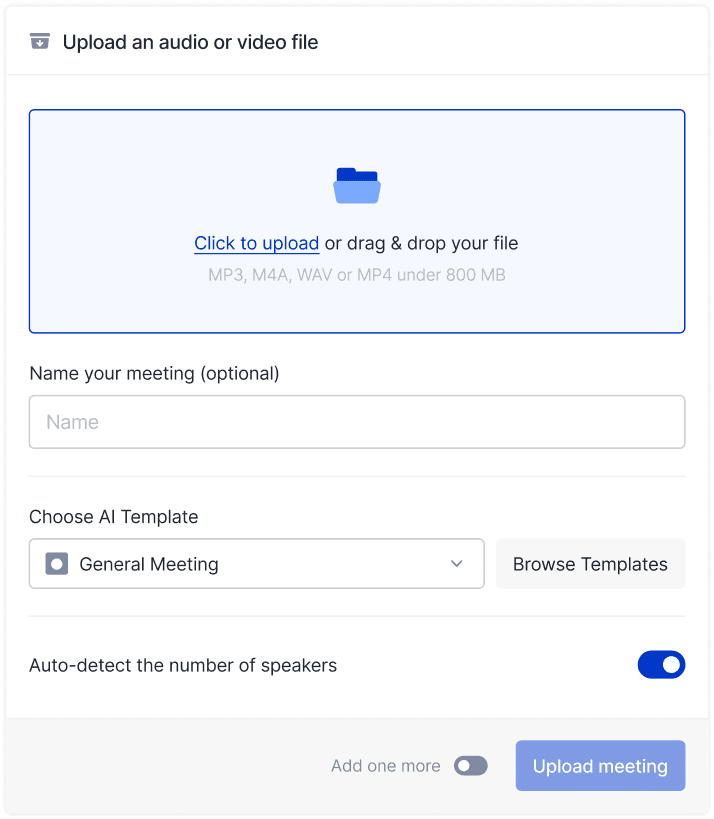
Mymeet.ai is not a transcription API in the traditional sense. Rather than accepting an audio file and returning text, mymeet.ai records and processes meetings itself — and then delivers ready-to-use structured data through its API: a speaker-attributed transcript, an AI summary, extracted tasks and decisions, and workspace metadata.
This is a fundamentally different level of data readiness. Instead of raw text that needs further processing, you receive a JSON with complete meeting information — ready to push directly into a CRM, task tracker, or AI agent. No pipeline to build.
✅ Transcript with speaker diarization and timestamps out of the box
✅ AI summary, tasks, and decisions — already structured in the response
✅ 73 languages supported, 96–98% accuracy
✅ REST API and MCP protocol for connecting to AI agents
✅ One key — one workspace, switch via the workspace selector
✅ Servers in Russia, compliant with 152-FZ
✅ 180 minutes per month free; paid plans: Lite, Pro, Business
mymeet.ai is the right choice for teams that need meeting data in other systems without building a transcription pipeline from scratch.
2. OpenAI Whisper API — Multilingual Batch Transcription
Whisper is OpenAI's speech recognition model. It supports over 99 languages and delivers solid accuracy on clean recordings with clear speech. It accepts an audio file and returns text.
And that's largely where the capabilities end. Whisper does not separate speakers, does not extract tasks, does not generate summaries — text only. For business meetings, this means additional post-processing is required.
Pros:
99+ languages supported, including Russian
Open-source model available for self-hosting
Good accuracy on clean audio
Cons:
No speaker diarization or timestamps in the base version
Batch mode only — streaming is unavailable
25 MB file size limit via the API
Whisper is suited for straightforward batch transcription when speaker breakdown and structured output are not required.
3. AssemblyAI — Transcription with Basic AI Analysis
AssemblyAI offers transcription with a set of additional features: speaker diarization, topic detection, sentiment analysis, and personally identifiable information (PII) redaction. By the standards of raw transcription APIs, it's a feature-rich option.
However, for Russian-language content, accuracy falls noticeably short of specialized solutions. Most advanced features — sentiment analysis, auto-chapters — work primarily for English. Total cost grows quickly with volume, as additional features are billed separately.
Pros:
Speaker diarization and timestamps
Batch and streaming modes supported
Additional AI features on top of transcription
Cons:
Noticeable quality drop on Russian
Advanced features work for English only
Cost scales up as additional features are enabled
AssemblyAI is a good fit for English-language projects that need transcription with basic AI analysis without building a separate pipeline.
4. Deepgram — Fast Transcription for Real-Time Applications
Deepgram is built around speed and streaming. The API processes faster than real time with minimal latency — exactly what's needed for voice bots and live captioning.
Beyond speed, the feature set is limited. Russian language support is weaker than competitors — there are no specialized models for Russian. For Russian-language business meetings, this is a significant constraint.
Pros:
Fastest processing among public APIs
Low latency in streaming mode
Specialized models for English-language content
Cons:
Weak Russian language support with no specialized models
No built-in content analysis
More limited language selection compared to Whisper
Deepgram is the right choice for English-language applications where speed is critical: voice assistants, live captions.
5. Google Speech-to-Text API — Transcription in the Google Cloud Ecosystem
Google Speech-to-Text is part of Google Cloud Platform. It supports 125+ languages, runs in both batch and streaming modes, and provides speaker diarization.
The entry barrier is higher than with specialized APIs — setup requires familiarity with GCP. Pricing at comparable volumes is higher than Deepgram or Whisper. For teams outside the Google ecosystem, it adds an unnecessary dependency with no obvious advantage.
Pros:
Broad language and dialect support
Deep integration with Google Cloud
Enhanced models for specialized use cases
Cons:
More complex to configure; high entry barrier
Higher cost than specialized APIs
Only makes sense for teams already on GCP
Google Speech-to-Text only makes sense for teams already operating on Google Cloud who want to avoid adding external dependencies.
6. Yandex SpeechKit — Russian Speech Recognition from Yandex
Yandex SpeechKit is Yandex's speech recognition API, part of Yandex Cloud. For Russian, it delivers some of the best accuracy among public APIs — its models are trained on a large corpus of Russian-language audio, accounting for conversational forms and regional accents. Data is processed on servers in Russia.
Beyond Russian, the picture is less encouraging. For international or multilingual projects, SpeechKit falls significantly behind Whisper in language coverage. Its integration ecosystem is considerably narrower than Western competitors.
Pros:
Best Russian-language quality among public APIs
Data processed on servers in Russia
Specialized models for different scenarios
Cons:
Weak results for languages other than Russian
Narrower integration ecosystem than Western alternatives
Requires a Yandex Cloud account
Yandex SpeechKit is the obvious choice for Russian-language projects with data localization requirements.
7. Azure Speech Services — Enterprise Transcription from Microsoft
Azure Speech Services is part of Microsoft Azure Cognitive Services. It supports 100+ languages, batch and streaming modes, and custom models for specialized vocabulary.
The service is aimed at large-scale enterprise deployments with existing Azure infrastructure. For smaller teams or startups — an overly complex and expensive option. Without prior Azure experience, setup takes significantly more time than with specialized APIs.
Pros:
Integration with the Microsoft and Azure ecosystem
Custom models for specialized vocabulary
Enterprise SLA and support
Cons:
High entry barrier without Azure experience
Excessive complexity for low-volume use cases
Higher cost than specialized APIs at comparable quality
Azure Speech Services is the choice for large enterprises on Microsoft Azure that need industry-specific vocabulary customization and enterprise-grade support.
Transcription API Comparison: Key Parameters
API | Russian | Streaming | Diarization | Data Structure | Best For |
mymeet.ai API | Excellent | Not needed | Yes | Transcript + summary + tasks | Teams with meetings |
OpenAI Whisper | Good | No | No | Text only | Simple batch transcription |
AssemblyAI | Fair | Yes | Yes | Text + basic analysis | EN projects with AI features |
Deepgram | Weak | Yes | Yes | Text only | Real-time English |
Google Speech-to-Text | Good | Yes | Yes | Text only | Google Cloud ecosystem |
Yandex SpeechKit | Excellent | Yes | Yes | Text only | RU projects, data localization |
Azure Speech Services | Good | Yes | Yes | Text only | Enterprise Microsoft stack |
The key differentiator for mymeet.ai versus everything else in the table: all other APIs return text — further processing is the developer's responsibility. mymeet.ai returns fully structured, ready-to-use meeting data.
How to Choose a Transcription API for Your Use Case
The choice comes down to three questions that immediately narrow the list to one or two candidates.
Do you need business meeting data in other systems? If yes — the mymeet.ai API delivers ready-to-use structured data without writing a custom processor. Every other API returns only text.
What is the primary language? For Russian — Yandex SpeechKit or mymeet.ai. For multilingual content — Whisper. For high-volume English — Deepgram.
Is real-time processing required? If yes — Deepgram, AssemblyAI, Google, or Azure. Whisper is batch-only.
For most teams working with online meetings who want to use that data in other systems, the shortest path is the mymeet.ai API. Instead of building a pipeline of "record → transcribe → diarize → analyze → store," you get a fully processed result in a single API call.
Summary: Transcription APIs in 2026
The speech recognition API market is mature and competitive. Basic transcription has become a commodity — most APIs handle it acceptably. The real difference lies in what happens next. Six of the seven APIs on this list return text and stop there. Everything else — diarization, summaries, structuring, analysis — has to be built separately.
mymeet.ai handles that entire pipeline internally and returns a finished, structured result through its API. For teams that run online meetings and want to work with that data in other tools, this represents a fundamentally different level of readiness — without the extra development work.
Frequently Asked Questions About Transcription APIs
What is a transcription API?
A transcription API is a software interface that accepts an audio or video file and returns a text transcription. Different APIs vary in supported languages, accuracy, processing speed, and additional features like speaker diarization or content analysis.
Which transcription API handles Russian best?
For Russian, the best results come from Yandex SpeechKit and mymeet.ai. Yandex SpeechKit is a specialized solution with models trained on a Russian-language corpus. mymeet.ai adds structured meeting data on top of accurate transcription. OpenAI Whisper also handles Russian reasonably well on clean recordings.
What is speaker diarization in transcription?
Speaker diarization is a feature that identifies who is speaking at each moment in a recording. The transcript is broken down by participant: "Speaker 1: ...", "Speaker 2: ...". This is essential for meeting and call transcription. Among the APIs on this list, diarization is supported by AssemblyAI, Deepgram, Google, Yandex SpeechKit, and mymeet.ai.
What's the difference between batch and streaming transcription?
Batch transcription processes a completed audio file and returns the result after full processing. Streaming accepts audio in real time and returns text as it comes in — with a fraction-of-a-second delay. Streaming is required for live captions and voice bots. Batch mode is sufficient for transcribing existing recordings.
Can transcription APIs be used for free?
Most APIs offer a free trial period or a limited free tier. mymeet.ai gives 180 minutes per month for free. OpenAI Whisper is available as an open-source model for self-hosting. Yandex SpeechKit provides starter credits upon registration in Yandex Cloud.
What is the OpenAI Whisper API?
Whisper is OpenAI's speech recognition model, available through their API. It's one of the most accurate public models for batch transcription, supporting over 99 languages. The source code is open — it can be deployed locally without restrictions. The main limitations are no streaming and no speaker diarization.
How do transcription APIs handle poor audio quality?
Modern APIs — especially Whisper and Deepgram — handle background noise and accents reasonably well. For the best results, use audio with minimal noise and a sample rate of at least 16 kHz. Deepgram's call center models are specifically trained on "difficult" audio with noise and crosstalk.
How is data protected when using a transcription API?
Different APIs offer different guarantees. Yandex SpeechKit and mymeet.ai store data on servers in Russia and comply with 152-FZ. Western providers (Google, Azure, OpenAI) offer GDPR compliance. When handling sensitive data, review each provider's policy on how long audio files are retained after processing.
How is a transcription API different from a meeting data API?
A transcription API accepts audio and returns text — everything else is on you. A meeting data API like mymeet.ai's returns a fully structured result: a speaker-attributed transcript, summary, and tasks. These represent different levels of data readiness for use in other systems.
Do you need programming skills to use a transcription API?
For direct API calls — yes, basic programming knowledge is required. The alternative is to use ready-made services built on top of transcription. mymeet.ai handles meetings automatically and provides structured data through its API, and also supports the MCP protocol for connecting AI agents without writing any code.
Which transcription API should I choose for online meetings?
For online meetings, the mymeet.ai API is the most direct solution. It doesn't require you to record audio and process it separately — the service joins the meeting itself, transcribes it, and structures the data. Through the API, you receive a ready-made speaker-attributed transcript, summary, and tasks that can be immediately pushed to a CRM or AI agents.
Ilya Berdysh