Task Management

Andrey Shcherbina

Half of development teams conduct retrospectives formally—they sit down, discuss what was good, what was bad, and disperse without concrete changes. Two weeks later at the next retro, the same problems surfaced again. Developers complain about unclear requirements, designers about late edits, testers about tight deadlines. Wrote it in minutes, dispersed, forgot.
Retrospective without actions turns into a checkbox ritual. The team spends an hour every two weeks discussing problems no one intends to solve. People stop believing in meeting value and participate formally—staying silent or saying general phrases to finish faster.
The mymeet.ai team works with development teams that transform retrospectives into real process improvement tools. Properly conducted retro gives concrete actions and measurable progress from sprint to sprint.
Sprint Retrospective - What It Is and Why It's Needed
Retrospective concludes the sprint and gives the team an opportunity to analyze their work. This is a meeting where they discuss not tasks and features, but processes, interaction, problems and ways to solve them.
What Is Retrospective in Agile
Sprint retrospective is a mandatory ceremony in Scrum that happens after sprint completion and before the next one starts. The team gathers to discuss how the sprint went, what worked well, what can be improved, and agree on concrete changes for the next sprint.
The main idea of retrospective is continuous improvement. Each sprint team becomes slightly more effective by solving one or two problems hindering work. Over a year accumulates 25-26 retrospectives, and if at least one real improvement is implemented at each, the cumulative effect is enormous.
Retrospective belongs to the team, not manager or Scrum Master. This is a safe space for honest conversation about what prevents working effectively. Without psychological safety, retro turns into formality.
Difference Between Retrospective and Other Meetings
Sprint review focuses on product—what's done, which features are ready, what to show customers. Retrospective focuses on process—how the team worked, what problems in interaction, what can be improved in approaches.
Daily standup solves operational issues of the current day. Retrospective looks at the entire sprint and seeks systemic patterns, not one-time problems. At standup discuss specific tasks, at retro—team processes and practices.
Benefits of Regular Retrospectives for Team
Teams conducting quality retrospectives gradually eliminate friction sources. Communication problems, technical debt, tools, processes—all identified and solved with small steps.
Psychological safety grows from retrospective to retrospective. When people see their remarks lead to real changes, they start speaking openly. The team learns to give and receive feedback without conflicts.
Shared process ownership appears through participation in improvement. When developers themselves propose changes in code review and the team implements it, they feel responsible for the result. Retrospective transforms the team from executors to process co-authors.
Preparing for Sprint Retrospective
Effective retrospective begins long before meeting itself. Preparation determines discussion quality and conclusion specificity.
When to Conduct Retrospective
Retrospective happens after sprint review, when the team already demonstrated sprint results. Optimal time—at the end of the sprint's last day or beginning of the next day, while impressions are fresh.
Duration depends on sprint length. For a two-week sprint, 1-1.5 hours is sufficient. For a monthly sprint, I can allocate 2-3 hours. Shouldn't be shorter—won't have time to deeply discuss problems. Longer is also bad—people tire and lose focus.
Who Should Participate
The entire development team must participate—developers, testers, designers, analysts. Everyone who worked in the sprint should be retro. The absence of even one person can distort the picture of what happened.
The Product Owner can participate if the team feels comfortable. In some teams PO presence hinders honest conversation about requirement problems. In others—PO is a full participant, and their absence is strange.
Managers and leaders usually don't participate. Their presence often blocks openness—people afraid to criticize processes or colleagues in front of management. If the manager wants to know what was discussed, it is better to get a summary after the meeting.
Gathering Data Before Meeting
Sprint metrics give an objective picture. How many tasks closed, how many postponed, what were blockers, how scope changed during the process. This data helps separate feelings from facts—sometimes sprint feels failed, but metrics show normal.
Pre-meeting team surveys save time at meetings. Can use a simple form where each writes what was good, what bad, what improvement ideas. The facilitator groups responses and sees main themes for discussion.
Classic Retrospective Formats
Retrospective format determines discussion structure. Different formats help look at sprints from different angles and avoid routine.
Start-Stop-Continue
Simplest and most universal format. Team discusses three categories:
Start - what need to start doing next sprint Stop - what need to stop doing because doesn't work Continue - what works well and should continue
Format works for any team and requires no preparation. Easy to explain to newcomers. Minus—can be too general if you don't specify each point with actions.
Mad-Sad-Glad
Emotional format helping team express feelings about sprint:
Mad - what caused anger or irritation Sad - what upset or disappointed Glad - what pleased or inspired
Format useful when tension accumulated in a team. Voicing emotions relieves stress and makes problems visible. It is important to move to concrete actions after emotions.
4L (Liked-Learned-Lacked-Longed for)
Format for focus on learning:
Liked - what liked about sprint Learned - what learned Lacked - what was missing Longed for - what would like in future
Suits teams wanting to grow professionally. Emphasis on learning and development, not just problems. Helps see team progress.
Sailboat
Visual journey metaphor. Team draws ship and discusses:
Wind in sails - what helped move forward Anchors - what slowed and hindered Rocks ahead - what risks we see Island-goal - what we're striving for
Game format relieves tension and makes discussion less formal. Visualization helps better remember agreements.
Retrospective Format Comparison:
Format | Duration | Complexity | When to Use | Focus |
Start-Stop-Continue | 60 min | Low | First retros, simple teams | Actions |
Mad-Sad-Glad | 75 min | Medium | Tension accumulated | Emotions |
4L | 90 min | Medium | Focus on development | Learning |
Sailboat | 90 min | Medium | Need atmosphere relief | Visualization |
Timeline | 60 min | Low | Analyzing specific events | Chronology |
Starfish | 75 min | High | Deep analysis | Detail |
What to Discuss at Sprint Retrospective
Right discussion topics determine retrospective usefulness. Too general conversations don't give concrete improvements, too narrow don't solve systemic problems.
Team Processes and Practices
Sprint planning - did we estimate tasks realistically, were there surprises, did we decompose large tasks correctly. If a team systematically underestimates or overestimates work volume, they need to discuss and adjust their approach.
Code review and code quality - how quickly reviews pass, is feedback constructive, is technical debt growing. If PRs hang for several days without review, this blocks work and requires a solution.
Definition of Done - do we follow readiness criteria, are they clear to all, maybe need revision. Tasks considered done but requiring rework next sprint signal DoD problems.
Communication and Interaction
Daily standups - do they bring value or turn into formality, aren't they too drawn out. If standup regularly goes into discussions or half team silent, format needs changing.
Interaction with Product Owner - are requirements clearly formulated, is PO available for questions, how quickly are decisions made. Requirement uncertainty—main cause of rework.
Collaboration within a team - do they help each other, share knowledge, is there individual participant isolation? If a developer works in a vacuum and no one knows what they're doing, it's a risk.
Technical Problems and Blockers
Infrastructure and tools - what technically slows work. Slow CI/CD pipelines, crashing test environments, inconvenient tools—all steal time and reduce motivation.
Technical debt - what debt accumulated in the sprint, what needs to be repaid next. If every sprint postpone refactoring "for later," at some point development speed will drop critically.
Dependencies on other teams - what blocked work externally, how to improve coordination. Waiting for API from another team or system access can consume half a sprint.
Achievements and Successes
What went well - must note successes, not just dig into problems. Closed complex tasks, implemented new practice, helped colleagues figure it out—all deserves recognition.
Progress on past improvements - which actions from last retro worked, what changed for better. This shows retrospective value and motivates me to continue.
Effective Retrospective Structure
Proven retrospective structure helps conduct meetings systematically and get concrete results. Five stages lead from setting context to actions.
Stage 1 - Set the Stage
Goal - create a safe atmosphere and tune the team for constructive discussion. It takes 5-10 minutes at the start of the meeting.
Facilitator reminds retrospective rules—confidentiality, focus on processes not people, constructiveness. Can start with a simple check-in where each describes the state in one word.
Stage 2 - Gather Data
The team collects sprint facts—what happened, what events, problems, successes. It takes 15-20 minutes.
Each participant writes stickers (physical or virtual) with observations per chosen format. It is important to collect data from everyone, not just the most active. Silent sticker filling gives voice to introverts.
Stage 3 - Generate Insights
Data analysis and pattern searching. Team groups similar stickers, discusses problem causes, seeks connections. It takes 20-30 minutes.
The facilitator helps the team dig deeper—if the problem is "slow review," they need to understand why. Maybe not enough time, maybe unclear standards, maybe fear of criticizing colleagues' code. The real cause is often hidden under symptoms.
Stage 4 - Decide What to Do
Choosing actions for the next sprint. The team decides which 1-3 changes to implement. It takes 15-20 minutes.
Actions must be concrete and measurable. Not "improve communication," but "add a Slack channel for urgent requirement questions and respond within an hour." Each action has the owner responsible for implementation.
The team votes for priority improvements if there are many proposals. Better to do one action quality than five actions formally.
Stage 5 - Close
Meeting wrap-up. The facilitator summarizes agreements, checks everyone understands actions the same way. It takes 5 minutes.
Can add retrospective or retrospective—quick feedback about how the meeting itself went, what to improve next time. This shows the team constantly improving all processes, including retros ones.
mymeet.ai for Retrospective Automation
Main retrospective problem—information lost right after meeting. Two weeks later half the team doesn't remember what actions agreed to implement. Discussion context disappears, and at next retro start from zero.
mymeet.ai Features for Sprint Retrospectives:
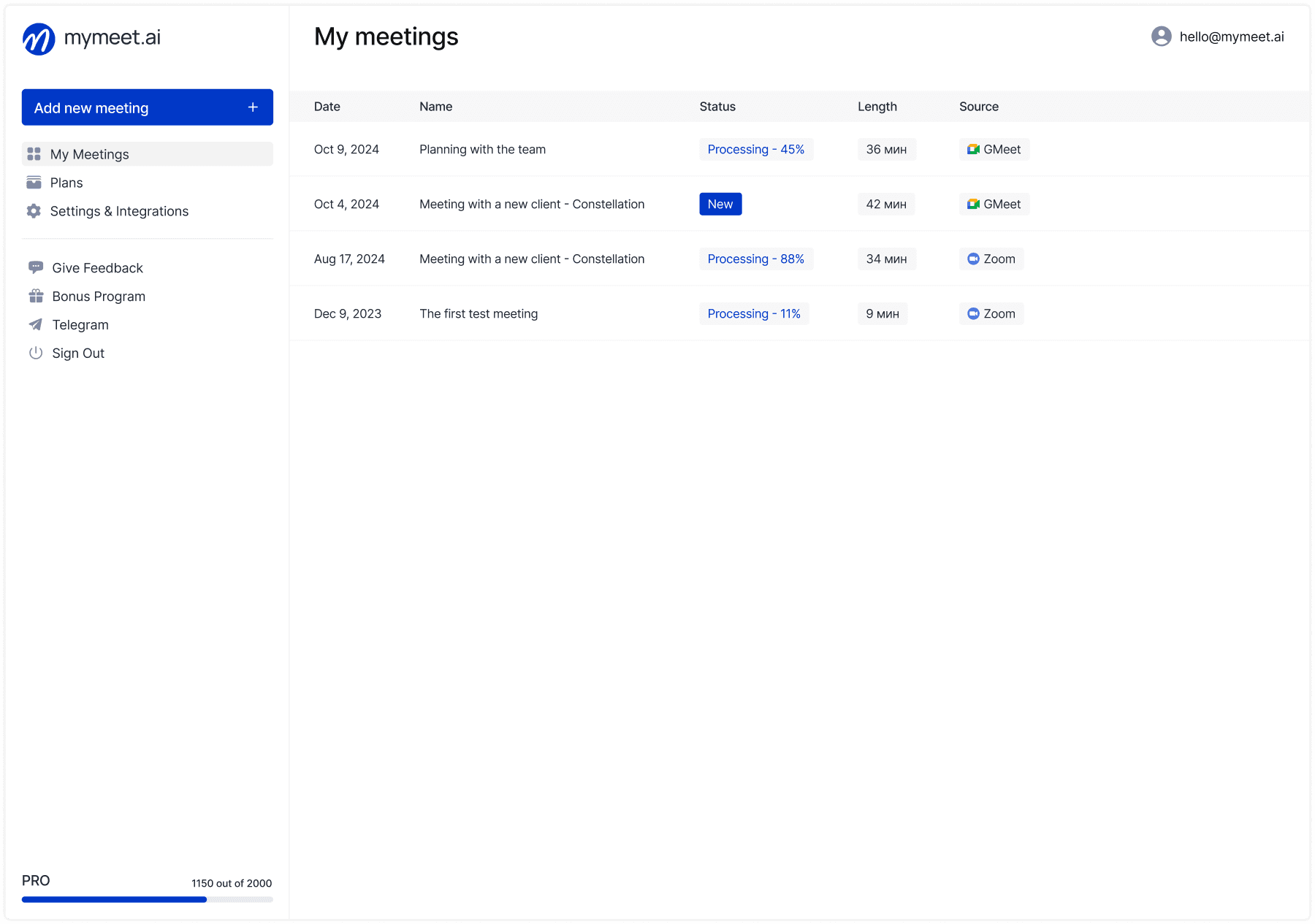
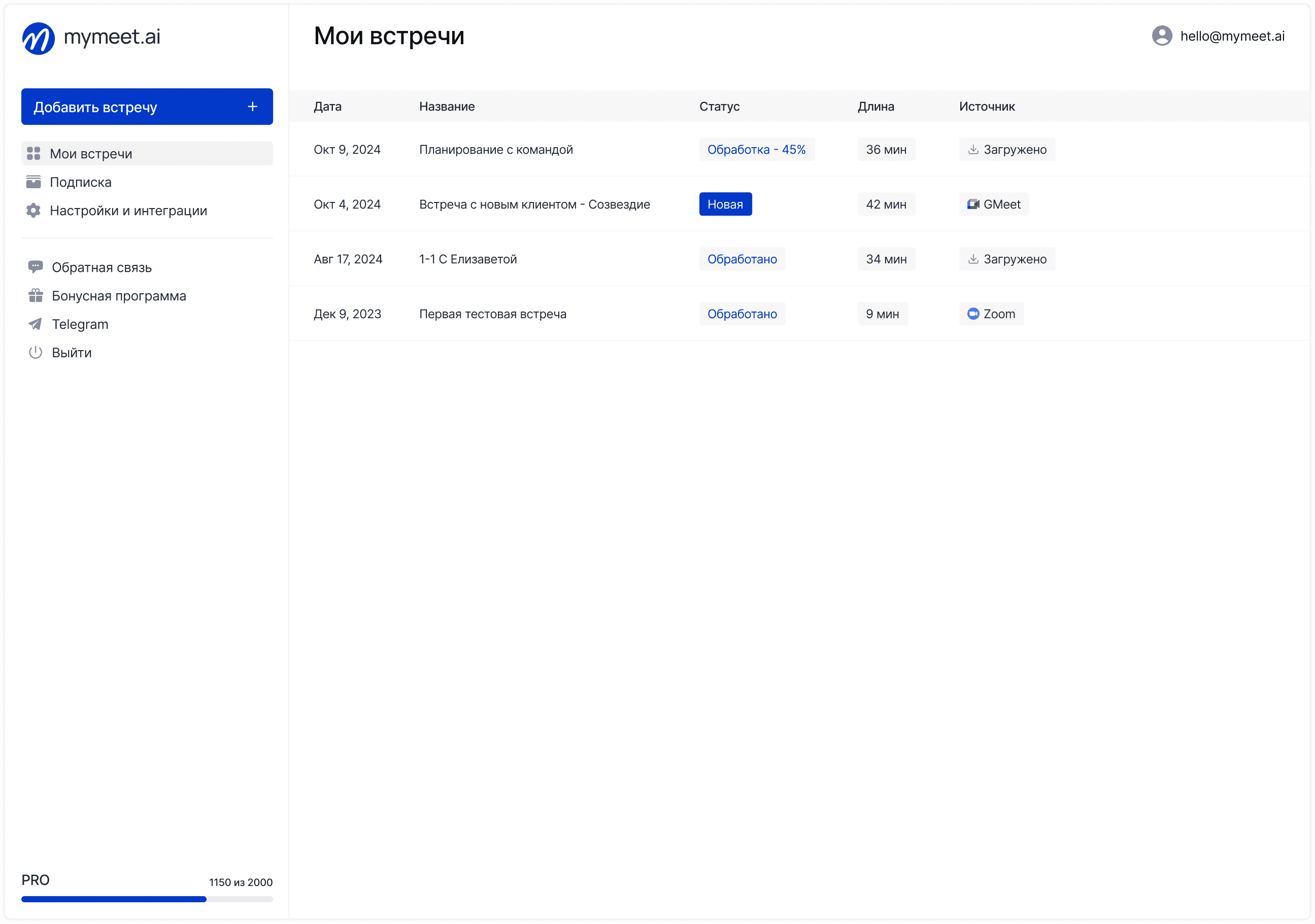
✅ Automatic retrospective recording and transcription - bot connects to meeting and captures all discussion with speaker separation
✅ Action item extraction with owners - AI automatically finds all action agreements and determines who's responsible for what
✅ Structured report by retro format - system groups discussion by Start-Stop-Continue categories or other chosen format
✅ Retrospective history with trends - can track which problems repeat, which improvements implemented, how team changes
✅ Interactive search through past retros - can ask AI "What did we discuss about code review last 3 months" and get specific quotes
✅ Automatic action reminders - system reminds owners about retrospective tasks
✅ Integration with Jira and other trackers - action items automatically created as tasks in sprint
✅ Anonymization for psychological safety - can configure report without indicating who specifically voiced criticism
Case Study: How Development Team Uses AI for Retro Analysis
A development team of 8 people conducted retrospectives regularly but faced two problems. First—a week after retro no one exactly remembered what they agreed to do. Confluence records were general and didn't reflect discussion nuances. Second—the same problems surfaced every 2-3 retrospectives because patterns weren't visible.
Implementing mymeet.ai automated retrospective documentation. After each meeting, the team gets a structured report with exact problem formulations, proposed solutions and concrete action items with owners.
Result: team sees improvement history for half year, can ask AI "what technical problems did we discuss in Q4" and get a list with context. The scrum master spends 20 minutes instead of an hour preparing for retro because can quickly check what was discussed last time.
Implement automatic retrospective documentation. Contact a consultant through a form to set up AI analysis for your processes.
Facilitator Role at Retrospective
The retrospective facilitator manages the process, not the content. Their task—create conditions for productive discussion, not impose their vision of problems.
Facilitator Tasks
Process and time keeper - ensures the team goes through all retrospective stages, doesn't get stuck on one topic, fits in timing. If discussion goes into details, gently return to structure.
Safe atmosphere creator - ensures everyone can speak without fear of judgment. Stops personal attacks, monitors discussion tone. Protects introverts from extrovert dominance.
Depth provoker - asks clarifying questions when discussion stays surface. "Why does this happen?", "What solution options do we have?", "What prevents doing this right now?". Digs to real problem causes.
How to Lead Discussion and Manage Time
Timeboxes for each stage help not drag out meetings. The facilitator warns 5 minutes before the stage ends and firmly moves to the next. Unfinished discussions taken to separate meetings.
Equal participation of all - facilitator explicitly asks opinion of those silent. "Ivan, do you agree with this? How do you see the situation?" Silence doesn't mean agreement, important to hear all viewpoints.
Working with Conflicts
Conflicts at retrospective inevitably when the team honestly discusses problems. Facilitator task—not hush conflict but help resolve constructively.
Focus on facts and behavior, not personalities. Instead of "Peter always does reviews late" say "PR #245 waited for review for three days, what can we do to speed the process". Discuss the situation, not people's character.
Common Retrospective Mistakes
Understanding frequent mistakes helps avoid them. Most retrospective problems repeat from team to team.
Formality Without Changes
Retrospective for checkbox—most common mistake. Team gathers, discusses, records, disperses. No actions taken, at next retro same problems. People stop believing in meeting value and participate formally.
This is because of the team's lack of authority to change anything. If all decisions require management approval and this approval doesn't come, retro turns into a complaint book without result.
Focus Only on Negative
Digging into problems without recognizing successes demotivates the team. If each retrospective—hour of criticism and failure analysis, people start perceiving meetings as punishment.
Balance is critically important—discussing what works well gives energy for working on problems. The team sees progress and understands moving forward, not spinning wheels.
Lack of Concrete Actions
General formulations don't work. "Improve code quality," "Establish communication," "Speed up development"—these aren't actions. Action is "Add linter to pre-commit hooks by end of week," "Conduct task grooming every Wednesday at 3 PM."
Each action must have an owner and a deadline. Without this action, good wishes remain. The owner is responsible not for doing action personally but for it being done.
Tracking Improvements After Retrospective
Retrospective doesn't end at meeting end but when agreements are implemented. Without tracking system actions forgotten.
Capturing Action Items
Actions recorded immediately in place accessible to all—Confluence, Jira, Notion. Capture format should be uniform—what we're doing, who's responsible, by when, how we'll check results.
Commitment publicity increases responsibility. When the entire sprint sees Peter take CI/CD setup action, he feels responsible to follow through.
Checking Completion at Next Retro
First item of the next retrospective—review of actions from the last meeting. What is done, what is not done, why. If action is not completed, I need to understand the cause—no time, it turns out harder, and loses relevance.
Honesty about uncompleted actions is more important than beautiful reporting. If the team systematically doesn't complete retro actions, this signals a problem—maybe taking too much, maybe no management support, maybe actions not concrete.
Team Progress Metrics
Team velocity - how many story points close per sprint. If retrospectives work, velocity should grow or stabilize at high level.
Production bug count shows whether quality improvements help. If discussed testing problems and implemented actions, bugs should decrease.
Team process satisfaction - regular survey on 1-10 scale. If people see improvements, their rating grows. Rating drop signals retrospectives not working.
Conclusion
Sprint retrospective is a powerful continuous improvement tool, but only if conducted systematically and brought to concrete actions. Formal retrospectives bring more harm than good because they create the illusion of working on problems.
Start with a simple Start-Stop-Continue format, focus on 1-2 actions per retro, and definitely check completion at the next meeting. Automate documentation to not lose context and see trends.
Ready to transform retrospectives into real improvement drivers? Try mymeet.ai free—180 minutes of meeting processing without card attachment. Get structured retrospective reports and track team progress from sprint to sprint.
FAQ
How often should sprint retrospective be conducted?
After every sprint without exceptions. For two-week sprints this is once every two weeks, for monthly—once a month. Skipping retrospective signals to teams that process improvement is not important. Even if the sprint went perfectly, there's something to discuss and reinforce successful practices.
How long should the retrospective last?
For a two-week sprint—1-1.5 hours, for monthly—up to 3 hours. Shouldn't be shorter, won't have time to deeply discuss problems. If regularly don't fit in timing, maybe trying to solve too much at once—focus on 1-2 main themes.
What to do if the team stays silent at retrospective?
Several causes—no psychological safety, tired of useless retros, introverts afraid to speak first. Solutions: start with written idea collection on stickers, try anonymous surveys before meeting, ensure actions from past retros being executed. If people see their words lead to changes, they start speaking.
How to conduct a retrospective for a remote team?
Use online boards like Miro, Mural or Google Jamboard for visualization. Turn on cameras for all participants. Give more time for written idea capture because taking turns speaking in video calls is harder. Record meetings and automatically process with AI to create minutes.
Is an external facilitator needed for retrospectives?
Scrum Master usually facilitates retrospectives. External facilitators are useful if conflict in a team, Scrum Master themselves are part of the problem, or the team is stuck in routine. Periodic facilitator change within the team also works—different people ask different questions and notice different problems.
What to discuss at retrospective if the sprint went well?
Successful sprint—excellent retrospective topic. Discuss what exactly worked well and how to reinforce these practices. A good sprint doesn't mean perfect—always something to improve. Maybe worth trying new techniques or experiments since the team is in good shape.
How to avoid repeating the same problems?
Maintain retrospective history and periodically analyze trends. Use AI tools to search repeating themes. If a problem surfaces a third time, I need to dig deeper—maybe solving symptoms, not causes. Sometimes a problem requires an organization-level solution, not a team.
Should the manager be present at the retrospective?
Depends on team culture. If the manager 's presence blocks honest discussion—no, better to get a summary after. If the manager is perceived as a team part and their absence strange—yes. Main criterion—does the team feel psychological safety to speak about problems with the manager present.
What tools to use for online retrospectives?
For visualization—Miro, Mural, FigJam, Google Jamboard. For video—Zoom, Google Meet, Telemost. For documentation—Confluence, Notion, Google Docs. For automatic recording processing and minutes creation -- mymeet.ai. More important is not specific tools but how the team uses it.
How to measure retrospective effectiveness?
Percentage of completed action items from retrospectives—basic metric. Team velocity growth, bug count reduction, predictability improvement show systemic improvements. Regular team survey "how useful was last retrospective" on 1-10 scale gives quick feedback. Main indicator—people want to participate, not trying to skip meetings.
Andrey Shcherbina